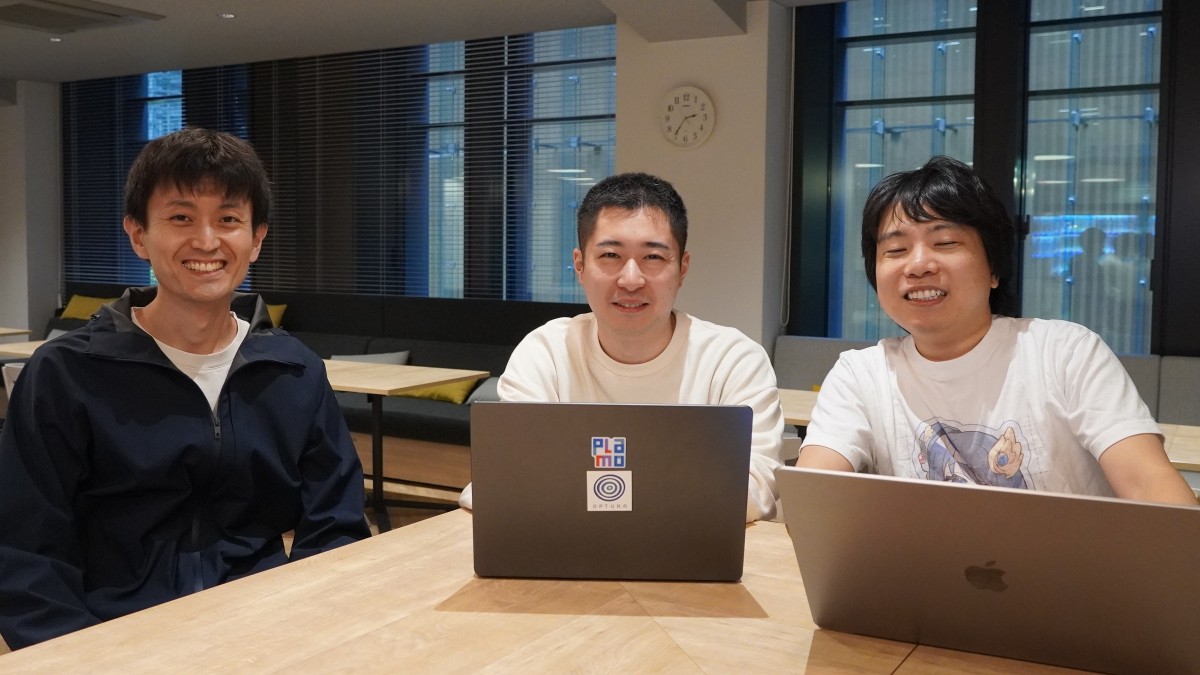
Japanese company Preferred Networks (PFN) provides “PLaMo,” a homegrown generative AI foundation model developed from scratch that is distinguished by its specialization in Japanese. “PLaMo Translation,” developed on the basis of PLaMo, delivers exceptionally high-quality translation and is offered not only as text translation but also as an extension for Firefox and Chrome. In October 2026, plamo-3-translate, based on PLaMo 3 NICT, was also released, bringing translation accuracy to a world-class level. To find out exactly how PLaMo Translation was developed, the GIGAZINE editor-in-chief, who has used the Firefox add-on continuously since it was first released, asked PFN's PLaMo development team about it in depth.
PLaMo
https://plamo.preferredai.jp/
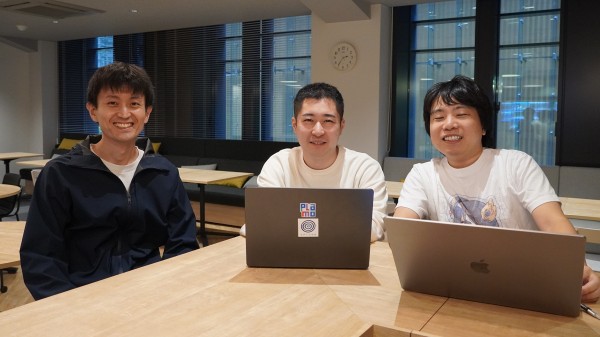
GIGAZINE Editor-in-Chief (hereinafter, G):
First, please introduce yourselves.
Hiroki Okui (hereinafter, Okui):
I'm Okui, a product manager.
Kaito Suzuki (hereinafter, Suzuki):
Pleased to meet you. My name is Suzuki, and I'm in charge of developing PLaMo Translation. Thank you.
Kentaro Imajo (hereinafter, Imajo):
I'm Imajo, and I also work on model development. On Twitter, I also use the account imosu. Thank you.
G:
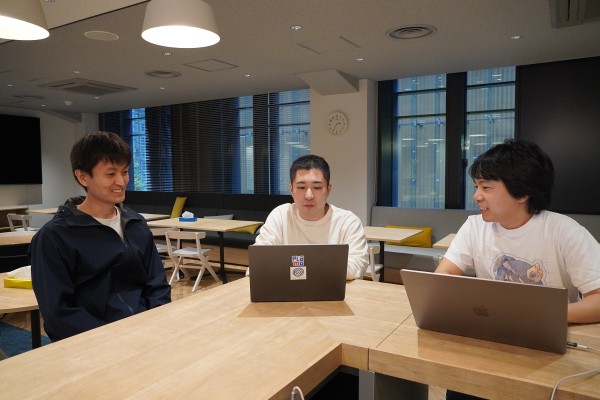
Pleased to meet you. I've been a user of PLaMo Translation since it first came out. Until now, I've used all sorts of translation services every day, including Google Translate, Bing, and DeepL, but I felt that PLaMo Translation stood far apart from the rest in terms of speed and accuracy. I thought it was amazing when PLaMo became version 2, but I believe version 3 has reached an astonishing level. Before that, I think many GIGAZINE readers may be wondering, “What is PFN?” Could you explain?
PFN Public Relations:
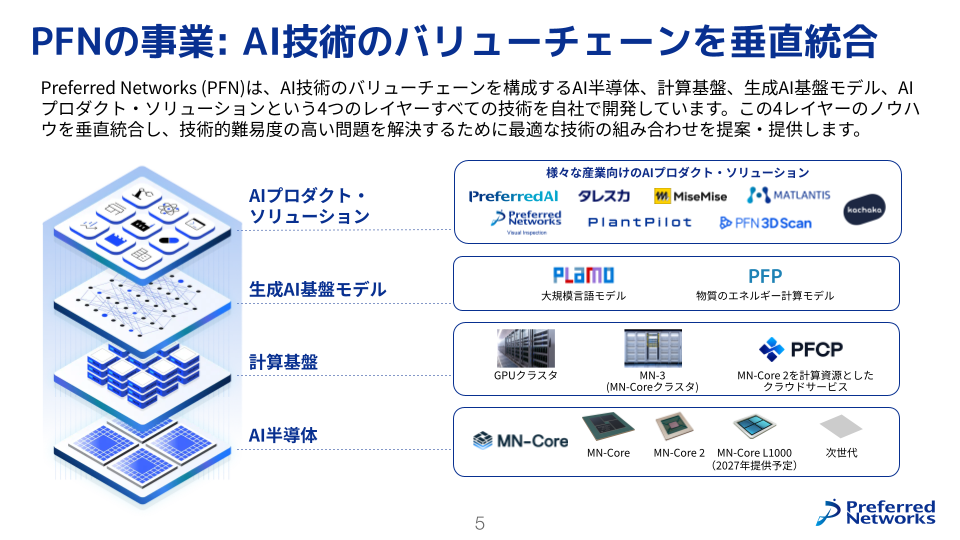
Yes. PFN was founded in 2014, so more than 10 years have already passed... at this point, it is no longer what you'd call a startup, but a seasoned AI company (lol). It has approximately 450 employees. It was originally founded by Toru Nishikawa and Daisuke Okano, and its business spans everything from AI semiconductors to computing infrastructure—in other words, generative AI foundation models such as PLaMo that run using supercomputers—as well as providing various AI solutions and products. The company develops a wide range of AI-related technologies in-house and has the same broad range of technology layers as major IT companies such as Google. There are virtually no companies in Japan with a similar business model, and even globally, there are few startups that cover so many different areas to this extent.
G:
I see. To begin with, I don't think AI models such as PLaMo existed when the company was founded more than 10 years ago. So how exactly did it come to start developing them?
PFN Public Relations:
PFN's predecessor was a search engine development company founded in 2006 by its founders, Okano and Nishikawa, who were graduate students at the time.In other words, PFN began as a software development company, bringing together many people with strong skills in computer science and competitive programming.
If you ask how AI and deep learning are actually made, fundamentally they are supported by semiconductors as a computational resource, and the greater the computational capacity, the more the technology improves. So, based on the idea that software and hardware should be developed as two halves of a vehicle, we started developing semiconductors in 2016. In other words, just two years after founding PFN, we took on the rather unreasonable task of developing semiconductors ourselves (lol). From the very beginning, we also thought that we should own a supercomputer—the computing infrastructure that is a source of competitive advantage—so we began developing a wide range of AI solutions with a large cluster. That's how things came about.
G:
I see, so that's how it was! And does that mean Imajo is building the foundation of PLaMo?
Imajo:
I was heavily involved in model development from the very beginning. I was also the one who came up with ideas when we were deciding on the PLaMo model names. It was me who proposed making a translation model, and I was also the one who created the first PLaMo translation model.

G:
So, what role does Suzuki play?
Suzuki:
After Imajo created PLaMo 2 Translate, the previous-generation model, I joined the team because we wanted to create something even better for the next generation. This time, I am responsible for scaling up the model's performance substantially.

G:
And what is your role in this project as product manager, Okui?
Okui:
Since the two of you, Imajo and Suzuki, developed a really good translation model, my primary role has been application development, so that the people using it can put it to work in their own actual workflows and experience its value firsthand.

G:
Thank you. As for why I started using PLaMo Translation, I normally use Firefox as my web browser, and the biggest reason is that there was a Firefox add-on for PLaMo Translation. In many cases, you just make a Chrome extension and call it done, so why did you decide to make a Firefox add-on?
Okui:
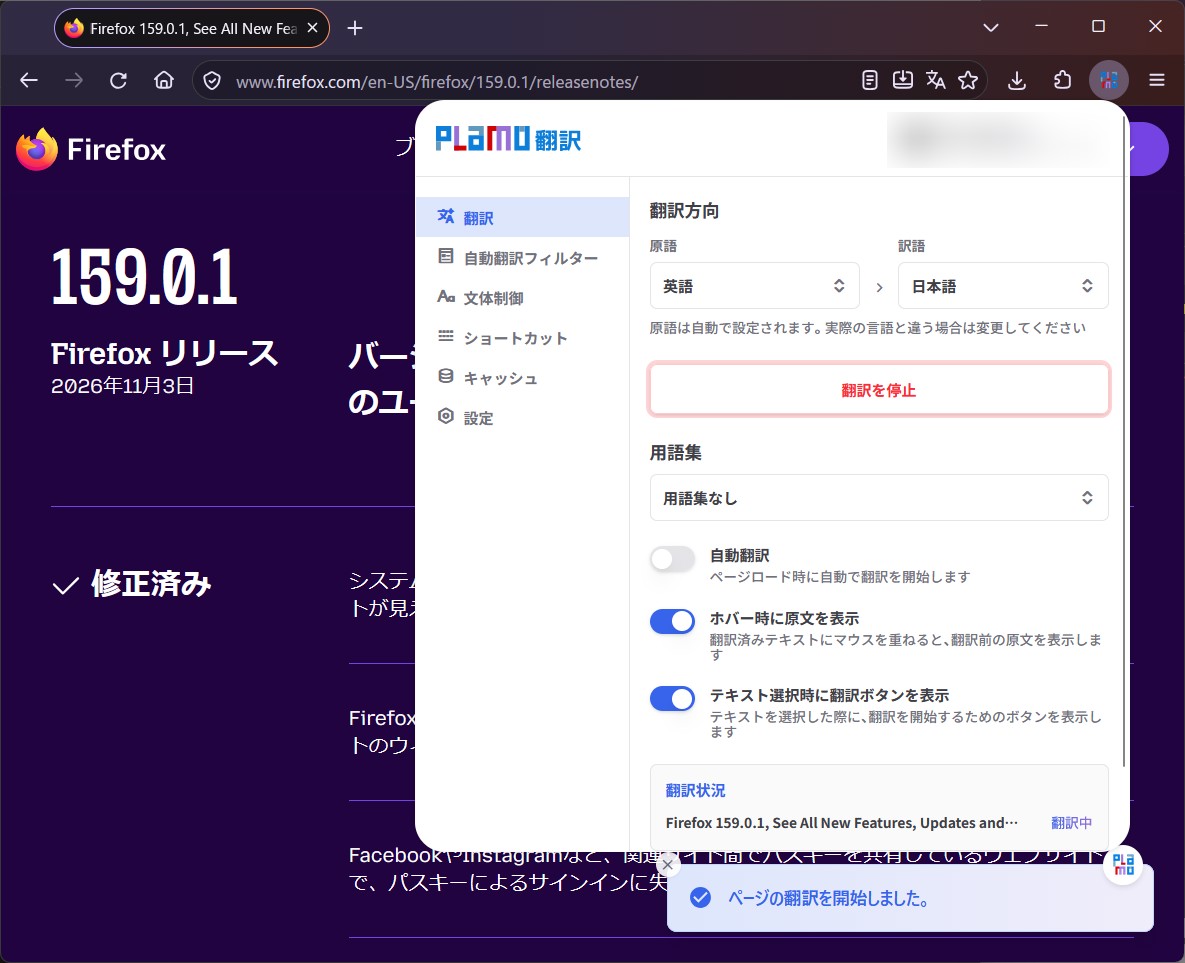
As you say, we initially made it for Chrome, but when we released the Chrome extension, a considerable number of people asked us to make a Firefox add-on as well, saying things like, "Firefox's translation is terrible, so please release a Firefox add-on." Many people use Firefox because of its security advantages, but when we actually tried it, we found that the quality of the translation feature included by default was indeed low. We thought, "If we can get Firefox users to use PLaMo Translation, the value we can deliver by improving translation quality will be overwhelmingly greater than with Chrome," so we wanted to make it available to them and developed the Firefox plug-in.
G:
I see. It makes sense, given that Firefox currently doesn't have a decent translation option for Japanese.Mr. Imajo, right at the very beginning, when you started building PLaMo Translation from scratch, were you confident that you could build something that would reach this point? Or did you proceed on the assumption that, “Well, it’ll probably work out”?
Imajo:
Well, I can’t say I had any real certainty. But beating OpenAI’s models with PLaMo itself is extremely difficult, so there was that element of hoping, “At least, I’d like there to be some kind of foothold.” This is looking back with hindsight, but nowadays, translation is becoming an area where, going forward, only LLM-based models will be able to win. At the same time, developing an LLM solely for the purpose of “building a translation model” is quite expensive. So I thought, “In that case, wouldn’t it be interesting to try making a translation model derived from an existing LLM?” When I actually looked at rankings of LLM use cases, translation came fairly high. On the other hand, it is a pain to have to ask ChatGPT, “Please translate this,” every single time, so my overall judgment was that a translation service itself would probably remain.

G:
I see, I see. So, did you get the company’s approval before trying to build the translation model?
Imajo:
Ah. I was given a certain amount of freedom to work on it independently...(laughs) So, I casually asked the company’s president, Okanohara, “I think we might be able to make something like this. What do you think?” and that’s how the project itself got started.
G:
I see, I see. So, rather than starting with a formal proposal, the process was more that you actually built it, showed it to them briefly, and then asked for their decision?
Imajo:
Yes. Once the model was completed, when we actually began developing it as a product, members including Okui helped me. That part was properly carried out according to the company’s internal processes.
G:
From the time you began working on it until you received the go-ahead in the form of, “This can become a company product,” roughly how long did it take?
Suzuki:
How long was it, I wonder?
Okui:
Wasn’t it fairly quick—both of you?
Imajo:
Yes. I myself had only been building the translation model, but Suzuki had also been doing some prototyping along the way, and it came up that turning it into browser translation might be convenient.
G:
I see. So, the image is that Suzuki was building the browser-translation version?
Suzuki:
Yes. To begin with, we quickly put out an internal prototype that translated web pages in the browser while properly preserving the layout. About one-third of the employees in the company ended up using it, and then Okui polished it into a form that people outside the company could use as well. That’s how it went from there to the public release.
G:
What impressed me when using PLaMo Translation was that it translated things properly while keeping the page layout as intact as possible. Although various companies are working on this, there weren’t many examples anywhere in the world that were doing it well, so I remember being surprised and thinking, “Did a Japanese company manage to build this?” So, was it you, Mr. Okui, who turned it into a form that could be released externally, in other words, a form that users could actually use?
Okui:
Yes, exactly as you said. Suzuki created the core technical elements, but because the quality was very high, I was responsible for turning them into something that would be easy for customers to use—developing the usability aspects, including the UX and security. I thought the overall speed was quite remarkable... The model was first developed and released, if I recall correctly, in late May 2025, but at that point there was absolutely no conception of this idea. Then, in late June of the same year, Suzuki created a prototype.
G:
That's fast!
Okui:
After everyone had tried out the completed prototype, the discussion caught fire: “This is really great. There must be a lot of people outside the company who want this, too.” From there, it took about a month to develop it and reach the trial release. So development proceeded at a pace where everything was accomplished in just one or two months.
G:
Amazing. As I listen, it's an astonishing pace (laughs). At that speed, this isn't a small or midsize company—it's a startup through and through. Just as a point of reference, was the development of PLaMo Translation fast even by PFN standards?
PFN Public Relations:
No. Looking at past examples, we've also built and released the deep-learning framework Chainer in just a few days. The company may appear to be a small or midsize business, but internally, it's a company where things move forward week by week.
G:
You're a company that really moves quickly. Impressive.
Suzuki:
First and foremost, our president, Okahara, reads cutting-edge papers every day. He's the sort of person who can answer even the most detailed technical questions, even when they're brought up abruptly, so I think a large part of the reason technical proposals get approved is that you can talk directly to the president about them. Because the company's leadership properly understands technical matters, when something good comes out within the company and someone says, “That's nice,” it goes ahead immediately. I think that ability to move quickly is the decisive difference from other large companies.
G:
I see, I see. You released it at such blistering speed. When you first actually put it out into the world, did you have a target of, say, “We want this many users”? Was it doing well from the moment it was released? Or did the number of users grow after some time, triggered by something?
Okui:
Yes, I think it did well with users right from the outset. When we released the model in May, we initially released something that could only translate text, but it was already creating a buzz at that point. Then, from around August, when we released the browser translation service, the number of users surged.
G:
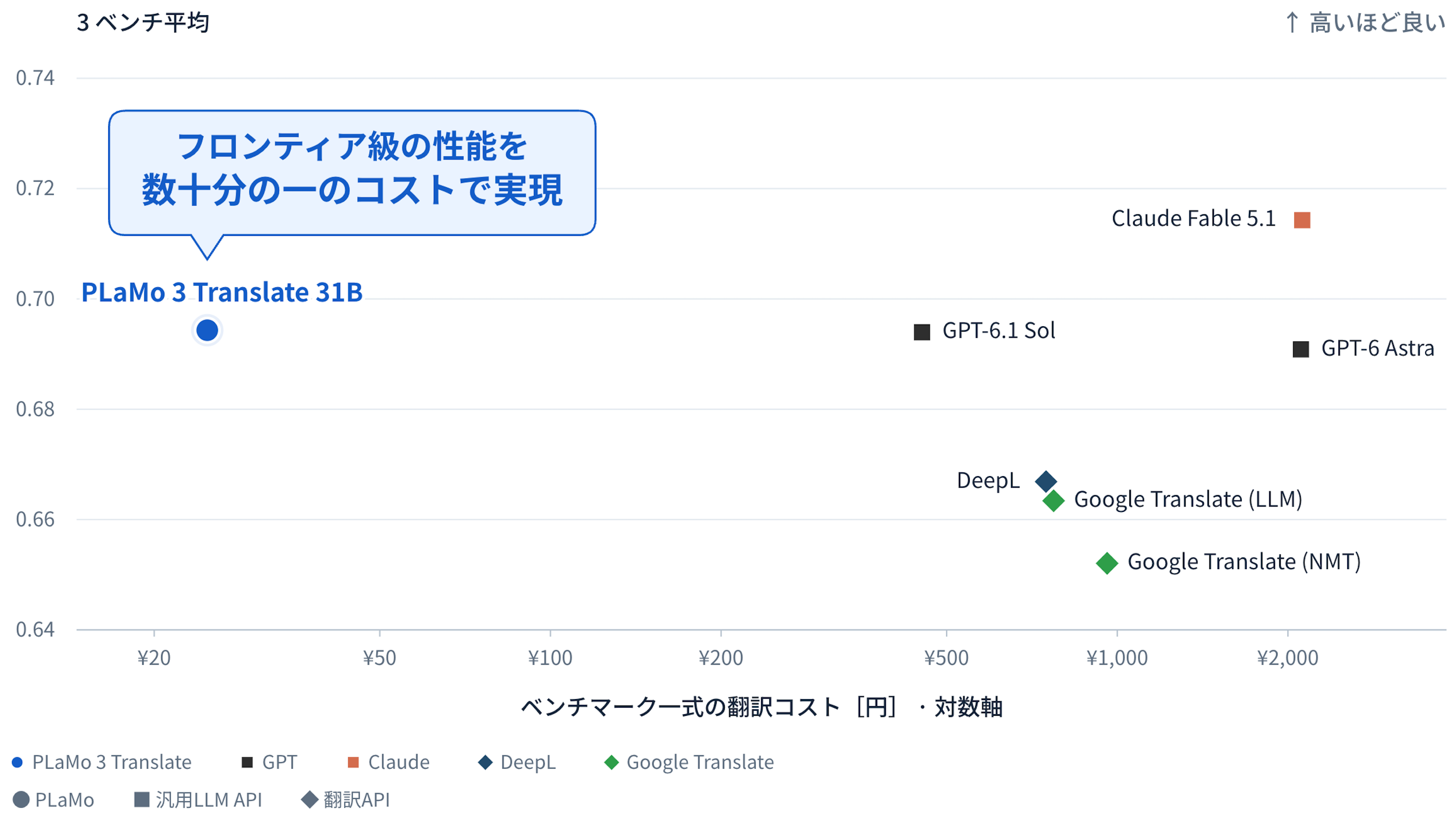
Also, that astonishingly low price was the most shocking of all, but you are making a profit at that price, right?
Okui:
We're doing all sorts of things to turn a profit, basically (laughs). To speak frankly about this, for example, Google Translate is provided free of charge as a built-in service, and DeepL also offers a similar browser translation service, but at a relatively similar price range. Of course, we're proud that we've created something good, but in terms of providing you all with value that lives up to that price... honestly, there are aspects where other companies are so cheap that it makes things rather difficult for us (laughs).
G:
I see.
Okui:
That said, we still have to make the pricing feel more valuable than that of competing products; otherwise, they won’t even consider it in the first place. The pricing is therefore quite challenging, but in a sense, we’re taking on a challenge.
G:
Honestly, what surprised me when PLaMo 3 came out was that, until then, it had only handled combinations of Japanese and English, but now it suddenly supported languages beyond those. The number of supported languages skyrocketed, so what happened there?
Suzuki:
There had been quite a few requests from the product side, so we had already decided to support multiple languages. Also, translation requires pairs of original text and translated text. For example, I doubt that almost anyone in the world has created translation data pairing Croatian and Russian. But by using an LLM, it has become possible to some extent to collect data in one language and synthesize the other. Using that synthetic data has made it easier than ever to create training data. This was already a trend a year ago, but I think it has recently accelerated significantly. By effectively incorporating those changes in the times, we were able to create translation data between various languages and rapidly expand language support.

G:
In other words, you didn’t actually buy mountains of multilingual books from used-book stores and cut them up. (laughs)
Suzuki:
That’s right. We didn’t do that. (laughs)
G:
PLaMo is known for producing translations with very fluent Japanese expressions, but I’m extremely curious how it can translate into such natural Japanese. How do you do that?
Suzuki:
The base model underlying PLaMo itself was trained on a substantial amount of Japanese. Even at the base-model stage, around 30% of the training data was Japanese. By contrast, ChatGPT probably contains only about 1–2% Japanese, if it contains any at all. In addition, the amount of additional training data was equivalent to roughly 720,000 paperback books, of which about 23%, or 170,000 books, were in Japanese. In other words, because of the proportion of Japanese in its training data, PLaMo is naturally better able to produce fluent Japanese. It’s also often said that the Japanese and English produced by AI such as ChatGPT can sound somewhat unnatural. I think this is partly because reinforcement learning for specific objectives, such as coding programs or solving mathematical problems, tends to neglect naturalness as prose.
In the case of PLaMo Translation, we created exceptionally good data and translated strictly according to that high-quality data. By thoroughly pushing this approach, known as SFT (supervised fine-tuning), we were able to maintain fluency. Once we had a good translation model based on PLaMo, we used it to recreate the data. Doing so slightly improved the data, and then we retrained on that data. The slightly improved model was then used once more for data synthesis, creating a small loop. As a result, both the data and the model can improve gradually as training progresses.
Imajo:
And the key to all of that is back translation.
G:
I see.
Imajo:
Even with today’s LLMs, it is extremely difficult to correctly evaluate the fluency of a passage.Even when benchmarking against Google Translate and other systems, the scores ignore fluency, so it is difficult to compete on those benchmarks. On the other hand, even if we want to improve fluency, we cannot evaluate it in the first place, so we have continued training the model to “prepare text translated as cleanly as possible and then restore the original text.”
For example, we train it by preparing English that corresponds one-to-one with a sentence written in Japanese and having it generate what the original Japanese sentence was from that English. As a result, the model naturally strives to generate text that is natural as Japanese, so we do this thoroughly. Then, as the next step, we tell it, “Let’s focus on back-translation rather than translation now,” which makes the English even more fluent as well. Repeating this is how we improve fluency without evaluating fluency; this is one of our techniques.
G:
I see.
Suzuki:
To elaborate a little, suppose we collect Japanese passages and use an LLM to synthesize English corresponding to the Japanese. The natural Japanese is necessarily the input, but the English on the output side becomes synthetic data. We flip this around once. In other words, when performing the operation of “synthesizing English from Japanese and then feeding that synthesized English in to generate Japanese,” we aim to create a system that internally has a mechanism for writing more natural sentences than the Japanese sentences written by the LLM used for the synthesis.
G:
I see. I imagine that loop would consume a great deal of time, and it would indeed seem to take considerable time to run in practice.
Imajo:
No, it was quite challenging (lol). In particular, maintaining fluency while improving accuracy was extremely difficult, so we put a great deal of effort into that. Incidentally, incorporating this back-translation lowers the benchmark scores. It is a trade-off.
G:
Imajo also posted on X that “the improvement in fluency makes one somewhat aware of an effort to distinguish how male and female characters are translated,” so I had gotten the impression that he was particularly committed to fluency in Japanese translation.
PLaMo Translation, with the improvement in fluency, one can somewhat sense an effort to distinguish male and female characters in translation. If you manage to produce an interesting translation, please make sure to post it on X (?).
— Imos (@imos) October 7, 2026
(This is a side effect, not an official feature. Since the model has a demonstration feature, it is better to use that for practical purposes.)https://t.co/ZFPUu6PHRW https://t.co/p7YB73ylpA pic.twitter.com/jhkbYpFPSL
Imajo:
When translating a novel, if male and female characters are not distinguished in the translation, it still feels unnatural. We are consciously working on being able to handle that properly.
G:
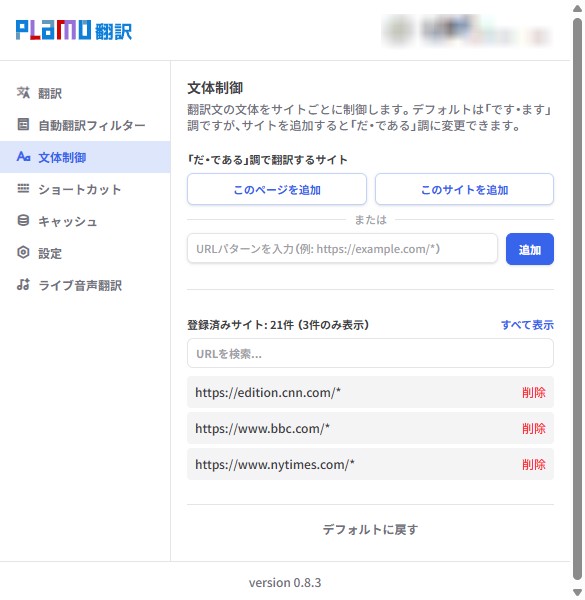
Indeed. That is the aspect of it that I admire.PLaMo has a setting for switching between the “da/de aru” style and the “desu/masu” style. In terms of tone and sentence endings, even a straightforward translation reads without anything awkward. Articles translated with PLaMo 3 are rendered in natural, fluid Japanese, so you can read them through without anything catching your eye.
G:
One more, less obvious point is that the speed of translating an entire page seems to have increased dramatically. Is there some reason the rendering speed suddenly improved? Was it simply because response times got faster, or was there a different reason?
Suzuki:
That’s model inference optimization. Fine-grained quantization, a bit of look-ahead, and similar small refinements can add up to enable fine-grained optimizations that can make even the same model run roughly twice as fast. We’re incorporating these optimizations while developing PLaMo 3.
G:
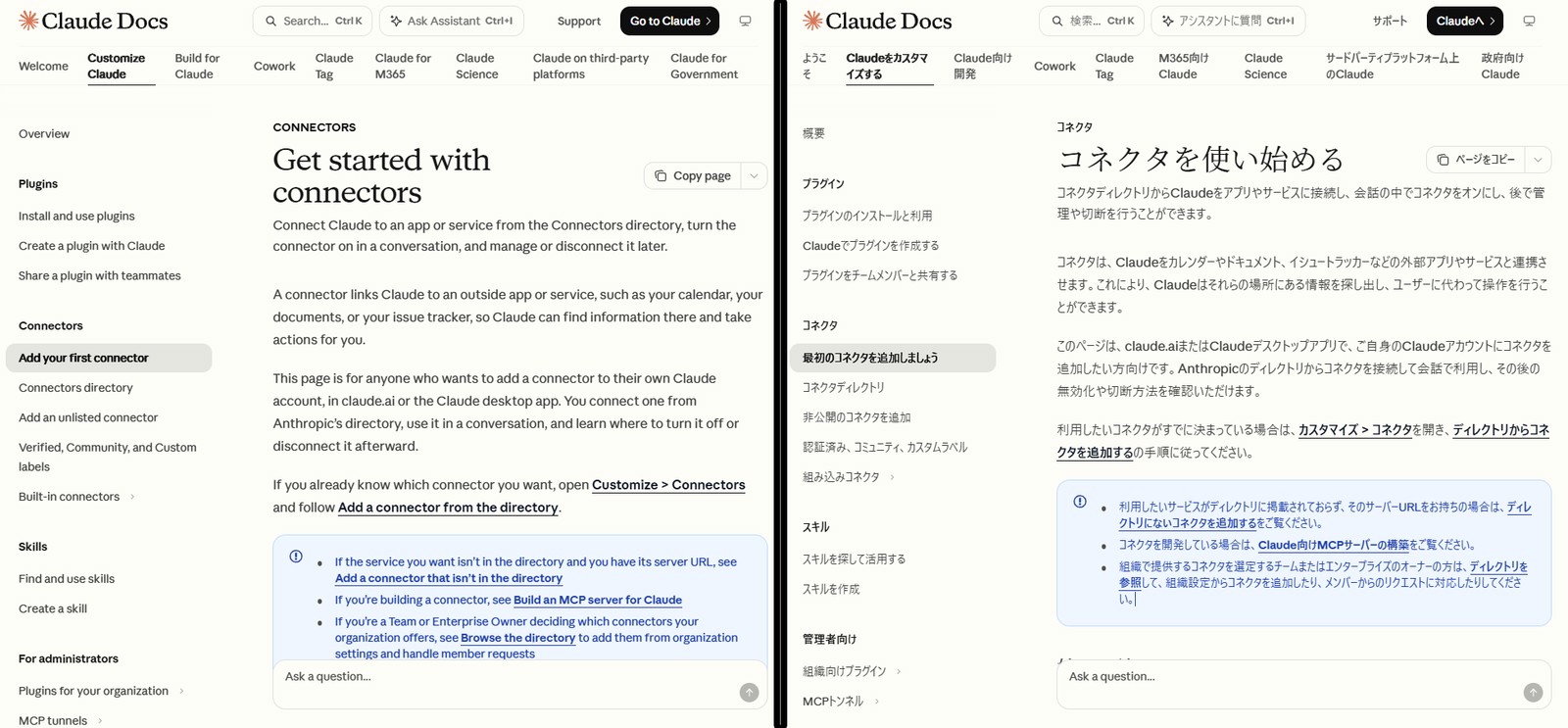
Google Translate rewrites content at this astonishing speed—I keep wondering how on earth it manages to do that. That said, it can sometimes break the layout.
Suzuki:
I think some other companies use older models, which makes them display content much faster at the expense of accuracy.
G:
Exactly. So when you improve the accuracy, there are times when it seems to say, “Wh-what’s wrong? Is it frozen or something?” I’d also be very happy if there were a feature that avoided, to some extent, sentence endings repeating in exactly the same form. For example, when “desu” appears repeatedly at the end of sentences, it starts to look unsophisticated, so I avoid it when writing articles for GIGAZINE, too. Such sentences can still work in academic papers, but sometimes they give you the uncomfortable feeling that, “No, native Japanese speakers would absolutely never put it that way.” It would be nice to have one more refinement in Japanese expression, such as adding variety to sentence endings in translations as well. Sorry... I suddenly started making feature requests (lol).
Imajo:
This is a user interview! (lol)
Suzuki:
That’s funny.
Okui:
Thank you for your valuable feedback.
G:
OpenAI, Anthropic, and Google are also developing AI models, but what are the factors that distinguish PLaMo from models like theirs? Speaking of what we’ve discussed so far, would it be roughly correct to say that PLaMo “has so much Japanese in its training data to begin with that it can clearly stand out in that area”?
Suzuki:
If I had to describe PLaMo accurately at the moment, that would probably be right. To put it bluntly, I think the reason somewhat odd expressions sometimes appear in ChatGPT and Claude is probably that training focused only on writing programs and solving math can proceed in a direction where “programming and math can take priority at the expense of everything else.” After doing that to the extreme, odd expressions may end up appearing frequently. In that sense, if we pushed PLaMo’s development to the limit, it could end up heading in that direction as well. Of course, my goal for the future is to make sure that doesn’t happen.
G:
I see, I see. Imajo-san, who laid the foundation, what do you think?
Imajo:
No, this is a very difficult problem... It would be nice if there were some way to evaluate it. Since evaluating it is difficult, I’ve been working hard in various ways. For example, if it were translation, using a translation model could be one approach, or perhaps using a correction model—something along those lines. I want to do my best to make it work somehow. And, well, I personally find it deeply unsettling that people around the world seem to pay so little attention to Japanese expressions... For example, there are TikTok videos with captions rendered in Chinese fonts, right? I watch them and simply can’t stand it.

G:
(laughs)
Imajo:
I hope it gets resolved somehow. But at the same time, when text written in a Chinese font appears in an official document, it ultimately affects the company’s credibility, so I think it will eventually be resolved. With Chinese-language models, characters and idiomatic expressions unique to Chinese do tend to appear a lot. I’m hoping that those aspects might be used to differentiate the models.
G:
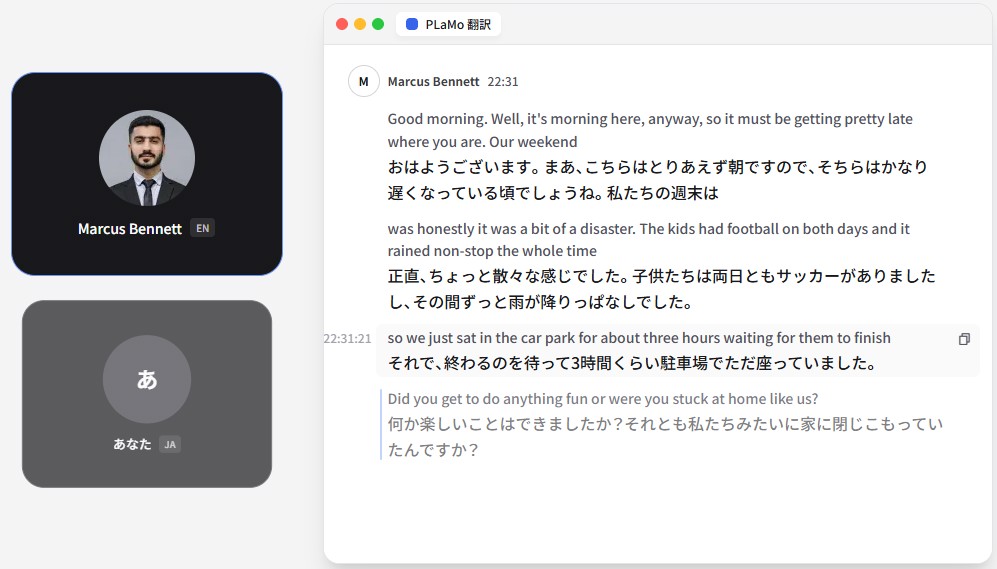
Regarding the “Meeting Translation” feature, which uses PLaMo to translate meeting audio in real time, an amazing feature was somehow implemented that allows PLaMo to participate in an online meeting and translate simultaneously into three languages. Was something like that also built as an extension of the PLaMo 3 model?
Okui:
Yes. Meeting translation naturally uses PLaMo 3, and it clearly benefits from the improvements in translation quality and speed brought about by PLaMo 3. In addition, implementing meeting translation requires not only translation but also real-time transcription with a high degree of accuracy. If translation takes time, the pace of the meeting inevitably suffers, and if transcription fails, translating an incorrect passage will naturally result in an incorrect translation. We built the feature with a focus on improving that quality, which is how the meeting translation feature came to be. So, you could say, it was made possible by combining the refinement of the model with the refinement of the application itself to improve its quality.
G:
When I looked at the pricing table, I noticed that there’s a limit on how many tens of thousands of words can be used. Does the fact that a cap like that has deliberately been set mean that a certain number of people exceed it even on the highest-priced plan?
Okui:
It depends on the feature, but among the features where the cap is based on character count, almost no one reaches it. The limit is set quite high, so there are only a very few people who do—truly extremely rare.
G:
Even so, there are some, huh. (laughs)
Okui:
Yes. However, with the top-tier plan, no one should have reached it yet, so we’ve made it available in a way that allows you to use it very extensively.
G:
So the limit is set considerably higher, then.
Okui:
That’s right.
G:
I don’t know if it’s okay to ask this, but when will translation become capable of producing Japanese at a natural level like that spoken by ordinary Japanese people—in other words, at a level completely indistinguishable from writing by a human, with absolutely no sense of awkwardness? I understand that it’s difficult, but is it simply a matter of time, or is that not the case?
Okui:
Having absolutely no sense of translation may be difficult, but with current translation models, the quality has already reached a pretty high level, at least when it comes to translations produced at this speed. In that sense, I think we may be entering an era in which it’s becoming difficult to stand out. On the other hand, when translating books, there are still sometimes points that give you pause. That is, to some extent, closer to engineering than to the translation model itself. When translating books, you first create a rough translation and then edit it, I think. Pushing things further will probably be in that direction. Having said that, I don’t think it will be long before that becomes possible. Even with current technology, depending on how you approach it, I feel it could be done a little better.
G:
Ah, I see. Hearing you say that makes me realize just how impressive the current translation models are. Finally, after reading this interview, I’m certain there will be GIGAZINE readers who say, “I see, so maybe I’ll try PLaMo once.” If you have advice for those people on things like, “If you’re going to use PLaMo Translation, this is how you can use it to really feel its performance,” I’d love to hear it.
Imajo:
I find browser translation interesting for reading foreign novels, so it could be quite interesting to see differences emerge in that kind of use case. Also, I wonder if I’m allowed to say this... but we’re releasing a smaller model soon. It performs so well locally that it’ll surprise you. I really hope you give it a try. Please do give it a try.
G:
That’s amazing.
Imajo:
That’s right. It runs quite well even on smartphones, so please look forward to that.
G:
That’s very exciting. It really is amazing that it runs on a smartphone.
Imajo:
Of course, on PCs, and naturally on smartphones too. On a PC, it runs extremely smoothly, and on top of that, your text doesn’t flow out onto the network either, so people can use it with peace of mind in a wide variety of ways. This hasn’t existed in Japan before, and I think it’s quite rare overseas as well.
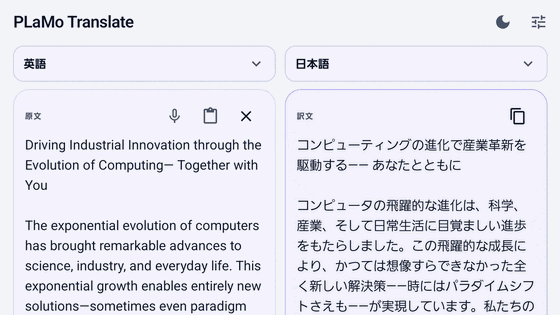
Editorial note: After this interview was conducted, PFN went on to release four model weights for PLaMo 3 Translate. You can see the results of actually running the 0.8B and 2B models at blistering speed in local environments on smartphones and laptops in the following article.
PFN Freely Releases the Four Models of Japan-Developed Japanese Translation AI “PLaMo 3 Translate”—We Tried It After Ultra-Fast, High-Precision Japanese Translation Became Possible Even When Running Locally on a Smartphone - GIGAZINE
G:
I see. From engineer Suzuki’s perspective, are there any recommended use cases or ways of using it?
Suzuki:
Well, as Imajo said, we’re releasing a variety of models, so people are welcome to incorporate them into their own apps and use them, and it could also be fun to try them out. In particular, since we’re releasing one that runs even on smartphones soon, I think the most important thing is to keep an eye on that.An LLM of a scale small enough to run on a smartphone is typically 1 billion parameters or fewer, and at around that size it becomes practically unusable for chat. For translation, however, I believe it has reached a level that is completely satisfactory for ordinary use cases. I think we have created the world’s most advanced practical use case for an LLM that runs on a smartphone, so please do keep an eye on this, and look forward to it.
G:
Finally, we’d like to ask Okui, the product manager, if there are any recommended ways to use it that you’d like to share with the GIGAZINE readers.
Okui:
Well, the first point will largely be the same as what Imajo and Suzuki said, but... I truly think we are getting close to a world in which automatic translation is almost indistinguishable from translation by a human. LLMs ultimately come down to factors such as their size and the computational resources invested in them, and the field has come to resemble a sheer contest of resources, premised on the idea that “a bigger model is now inherently right, and the bigger it is, the more accurate it becomes.” Google and other companies have released larger models and promoted the idea that translation accuracy soars when you use them. At the same time, what our work claims is that “we achieve equivalent accuracy with an extremely small model.” From the user’s perspective, in the end, whether the underlying model is large or small makes no difference if the final interface is the same. The only differences users can actually experience are lower costs and faster processing.
G:
Right.
Okui:
However, the fact that the model is small means that it can actually run on a smartphone or your own PC. Information leakage is a major problem these days, but because you can run it locally, use cases such as translating even highly confidential material are set to expand greatly. We believe that creating “an extremely high-quality model that runs locally” is the major achievement of this project, so we want to make it possible for as many people as possible to try it. We would really like everyone to give it a try.
G:
I see.
Okui:
Another point is that translation using LLMs has also grown to achieve very high quality, so even when comparing models from different companies, it is quite difficult to differentiate them significantly. On the other hand, in actual use cases, translating in a browser, for example, can change the structure of sentences and make them strange, and even when reading a paper in a PDF file, mathematical formulas can get mangled. The same applies to meeting translation. Google Meet, Teams, and Zoom all have built-in translation, and while they can be used to understand the content of a meeting yourself, it is still difficult for participants to converse with one another in their respective native languages, isn’t it? Since many Japanese people have difficulty speaking English, wouldn’t they be delighted if they could speak in Japanese as well?
G:
That’s true.
Okui:
Improving the user experience in these areas is extremely important, and we want to continue focusing on that. In addition to producing an excellent product with a small model, there is still a great deal we can do to further improve the actual translation experience, and we will continue working diligently on that. We will keep providing browser translation, file translation, meeting translation, and perhaps something a little surprising, so please do try them, and look forward to future updates as well.
@@
G:
Wonderful, a perfect way to wrap up! (lol) Thank you for today.




