
Regardless, both topics are among the most important issues humanity needs to address currently.
That's what Paulo Artaxo, professor at the Physics Institute of USP, said in an interview with Olhar Digital. Artaxo is also the coordinator of Amazônia Sustentável, a research center at the university.
When it comes to climate change, AI can both help and worsen
AI can be a useful tool in combating climate change.
Through the technology, people could, for example, develop more sophisticated disaster warning systems. Or, who knows, find ways to alleviate water scarcity worldwide.
However, when considering the short-term future, the outlook is that AI will make it harder to reduce greenhouse gas emissions.
Why? It's a technology that requires data centers to function. And data centers consume a lot of energy.
 Data centers require electricity – and it's not always possible to generate it through renewable sources – Image: Frame Stock Footage/Shutterstock
For you to have an idea, AI data centers must consume almost three times more electricity than Nigeria, Pakistan, and Bangladesh combined, according to the UN. Together, these countries house 650 million people.
Data centers need electricity. And it's not always possible to generate electricity through renewable sources, such as solar, hydro, and wind. Brazil, for example, has thermal power plants.
The thermal power plant issue
Thermal power plants convert heat into electrical energy. First, fuel (coal, natural gas, oil, or biomass) is burned. This generates heat.
This heat warms a lot of water in a boiler. This generates steam, which is directed to the blades of a turbine.
The force of the steam makes the turbine spin at high speed. The turbine is connected to a generator, which converts this mechanical energy into electrical.
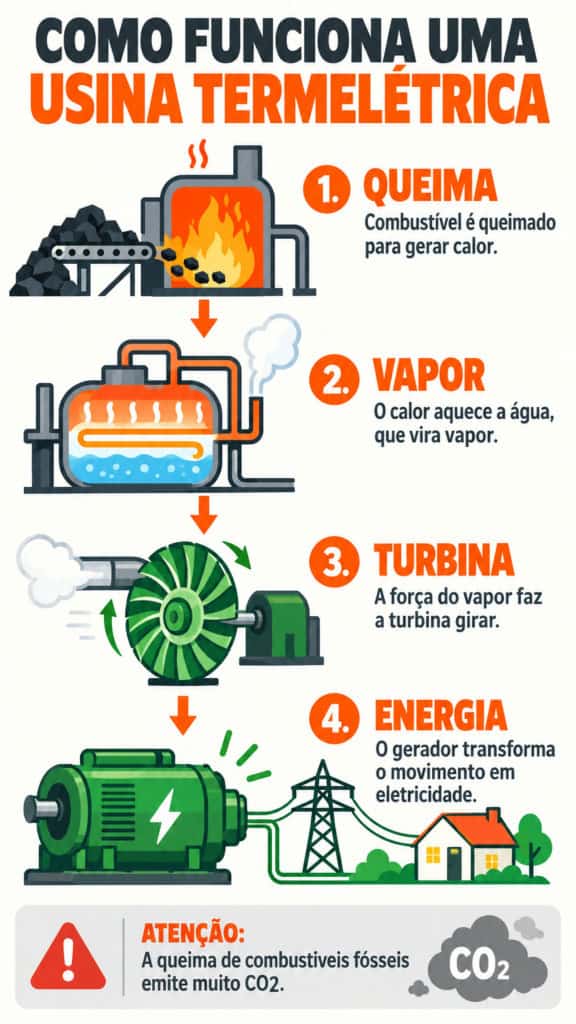 Environmental impact of thermal power plants varies depending on the fuel used – Image: Olhar Digital via ChatGPT
The problem with this type of plant is the environmental impact, which varies depending on the fuel used.
To begin with, the burning of fossil fuels (mainly oil and coal) releases tons of carbon dioxide.
In addition, the process of generating energy emits toxic gases (such as sulfur and nitrogen oxides) and soot, which worsens air quality, causing respiratory diseases and even acid rain.
AI needs data centers to function – and this can be a problem.
Artaxo points out that “gigantic data centers consume a brutal amount of natural resources – electricity and water, in particular.”
“Installing data centers to emit greenhouse gases during electricity generation makes no sense, neither in Brazil nor in other countries,” says the expert.
Therefore, the professor emphasizes that “it is very important that there be regulation in Brazil and globally so that these data centers can only be installed if their energy is generated by solar and wind power.”
 ‘Gigantic data centers consume a brutal amount of natural resources,’ says a USP professor – Image: shihabsarkar/Shutterstock
There are proposals in this regard in the government plans of the candidates for the 2026 presidential election. And counterparts in Redata.
Meanwhile, technology companies, which have become major energy buyers, support projects from both renewable sources and fossil fuels.
In a recent speech, Simon Stiell, head of the “climate department” at the UN, classified the AI industry as “energy-hungry.”
For Stiell, the sector needs to “respect science and start aligning with global climate efforts – urgently.” For Artaxo, too. But it doesn't seem that this will happen soon.

Pedro Spadoni is a journalist trained at the Universidade Metodista de Piracicaba. He has written for websites, magazines, and newspapers.

