Companies are steadily expanding their use of image-generation AI and exploring its possibilities. Examples of incorporating it into advertising or using it to edit photographs are no longer unusual. In recent years, led by apparel companies, there have been many attempts to combine AI-generated images of clothing customers do not possess with their own photos, enabling virtual “try-ons.”
KAINZ is one such company. However, what can be tried on is not clothing but interior furnishings. The company has developed in-store signage called “CAINZ Fitting Room,” which uses image-generation AI to virtually replace the furnishings in a room. It is testing the system's effectiveness and convenience.
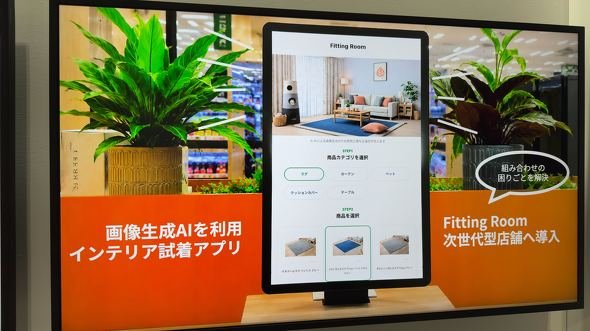 An image of CAINZ Fitting Room
The initiative was also introduced at the AWS Summit Japan 2026 booth, held at Makuhari Messe from June 25 to 26. Already being trialed at some stores, the system was discussed with a company representative, who explained how it works and its current status.
“Dressing Up” Furniture: KAINZ’s Use of Image AI
In CAINZ Fitting Room, the furniture, rugs, and curtains shown in the room photograph on the signage can be replaced with other KAINZ products. While viewing the room photograph on the signage, users select the furniture, curtains, rugs, and other items they want to incorporate. The furniture, curtains, rugs, and other items already shown are then replaced with the selected products, making it easier to imagine how the room would look with the items actually placed in it.
All the replacement images are created using image-generation AI. To prevent problems where the generated image differs in appearance from the actual product, the system does not generate images in real time. Instead, it uses images created in advance and swaps them in according to the user's selections.
Furthermore, the replacement furniture images are generated one by one while being visually checked on the administration screen. Users specify the area of the room image they want to replace and use prompts to define the appearance of the furniture and other items before generating the image. Work to correct and adjust discrepancies between the generated images and the actual products, such as differences in size, is still performed manually.
For the service, KAINZ adopted Amazon Bedrock, AWS's generative AI platform. Through this service, it uses Amazon's image-generation AI model, “Nova Canvas.”
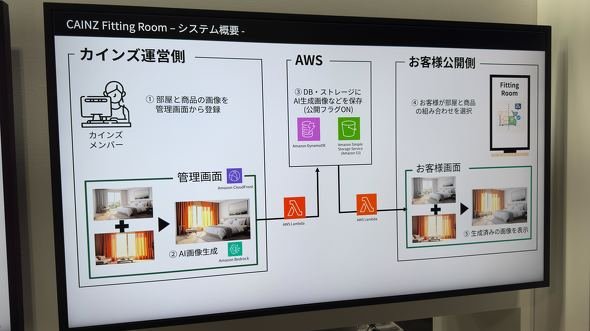 System overview
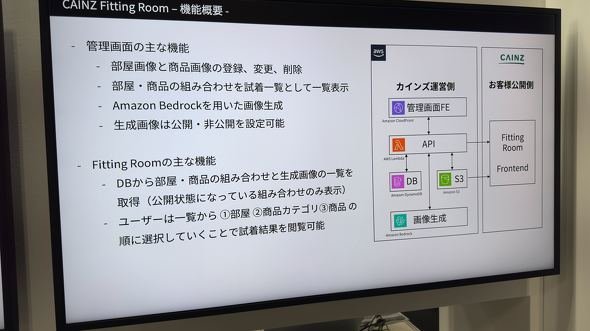 Feature overview
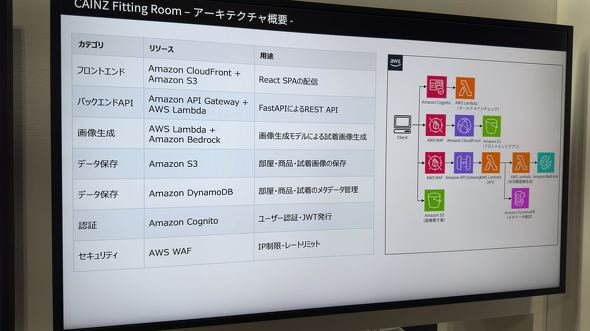 Architecture overview
Accuracy and efficiency must be balanced; effectiveness testing is still ahead
The system began operating around April and has been introduced at three stores, including the Yoshikawa Minami Store in Saitama Prefecture. The initiative aims to improve its appeal in stores and reduce the effort required to take photographs. However, its effects on sales and average customer spending are still being verified, and no concrete results are yet visible.
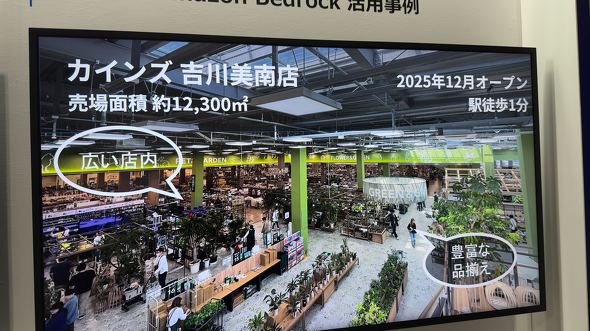 Yoshikawa Minami Store
Having said that, compared with model rooms and the like, the photography workload is lower—or so I thought. However, at this stage, the workload for visually checking and correcting the generated output is still substantial, and they say, “We want to be able to mass-produce it as soon as possible.” Meanwhile, they have also begun testing a new image model called “Pruna.” Since its accuracy is better than Nova Canvas, they expect it to bring improvements.
For signage, they are currently using demo room images prepared by CAINZ, but going forward, a CAINZ representative says, “What customers really want is to see how it would look in their own rooms.” Although there are challenges such as accuracy and workload, they ultimately aim to generate images tailored to each customer’s own room.


