DeepSeek Sparks a Boom in Sparse Computing as Domestic Chip Companies Accelerate Their Breakout: This Company Raises Nearly RMB 1 Billion Again
Q3 Revenue Grows Severalfold
Yunzhong, from Aofeisi
QbitAI | Official WeChat Account: QbitAI
Recently, Moxin Artificial Intelligence (Moxin for short) completed a nearly RMB 1 billion Series C+ funding round.
Only five months after its previous nearly RMB 1 billion funding round, Moxin completed two consecutive funding rounds in a short span, reflecting the capital market's strong recognition of its technological barriers and commercialization progress in the dedicated sparse inference chip sector.

With its first-mover advantage built on accumulated technical expertise and successful product deployment, and with commercialization accelerating across the board, Moxin was the first to seize the opportunity as demand for inference computing surged, further highlighting the generational advantage of dedicated sparse inference chips.
Betting on Sparse Computing, Pursuing a Differentiated Chip Roadmap
At present, the continued evolution of large-model technical architectures is pushing sparse computation from an auxiliary optimization technique to an important role in AI compute design.
As the Mixture of Experts (MoE) architecture is adopted at an accelerating pace, large-model inference exhibits pronounced conditional-computation characteristics; meanwhile, sparse structures in weights and activations create room to reduce redundant computation.
Taking DeepSeek-V4-Pro as an example, it has approximately 1.6 trillion total parameters, but activates only around 49 billion parameters when processing each token, roughly 3% of the total.
How to translate model-level computational savings into actual improvements in inference efficiency and reductions in cost is becoming a key issue that the development of AI compute must address.
To process such workloads efficiently, the choice of chip architecture is a critical variable.
General-purpose GPUs must accommodate multiple types of workloads, including training, inference, and scientific computing, making it difficult to deeply co-optimize algorithms and hardware for specific sparsity patterns.
Dedicated chips for sparse inference, by contrast, can reduce wasted computation and data-movement overhead through the co-design of algorithms, compilers, and hardware. The value of this architectural difference is being reassessed by the industry.
This is precisely the technical direction Moxin has been cultivating for years. Since its founding in 2018, Moxin has focused on sparse computing, invented the “weight sparsification + activation sparsification” dual-sparsity algorithm, and gradually established an “algorithm–software–hardware” co-design technology system on this basis.
Turning this technology system into mature chip products requires full-stack engineering capabilities spanning algorithms, compilers, chip architecture, and the software toolchain.
Members of Moxin's founding team come from Carnegie Mellon University and leading semiconductor companies such as Intel, Qualcomm, and Marvell. They bring both algorithmic research and chip engineering backgrounds, with experience mass-producing dozens of products and more than 5 billion chips.
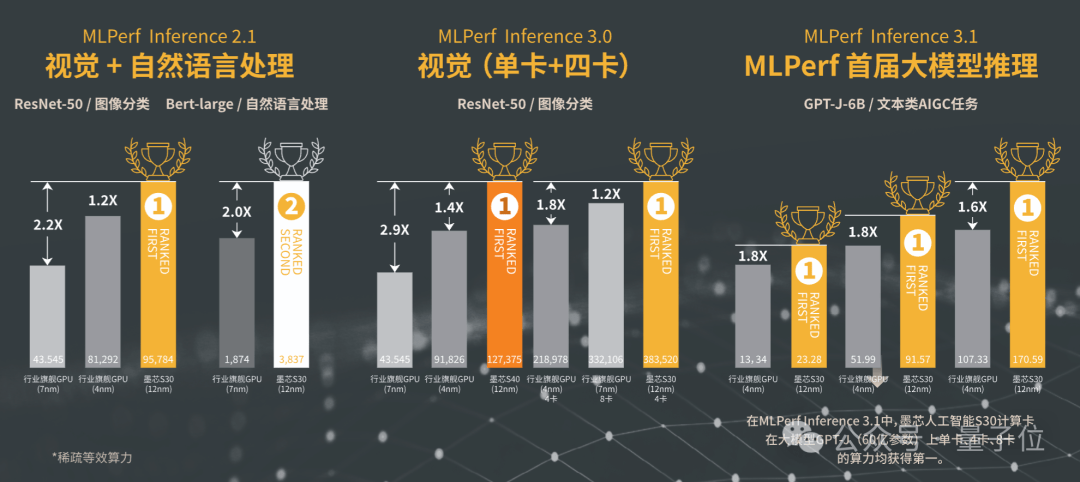
Thanks to this engineering capability, the performance and efficiency of Moxin's products have been validated in internationally recognized benchmark tests.
In MLPerf™ Inference testing, the S30 compute accelerator, in some of the test categories in which it participated,topped the rankings for three consecutive editions. In mainstream tasks such as computer vision and natural language processing, its energy efficiency and inference throughput per unit of compute power remain industry-leading, validating the engineering feasibility of dedicated sparse inference solutions under real-world data center workloads.
Multi-scenario deployment and ecosystem co-building: sparse computing enters a new stage
Large-scale deployment is further consolidating MetaX's leading position in the field of sparse inference chips.
MetaX's inference clusters, built on its proprietary chips, have been strategically rolled out across theNorthwest, Southwest, East China, and North China, four major regions. On this foundation, MetaX's commercialization is accelerating across the board:
Revenue in the third quarter of 2026 achievedseveral-fold growth, while sparse computing power is being deeply integrated into China's computing power infrastructure to support the development of the intelligent industry.

Specifically, in supporting the construction of new computing infrastructure, MetaX participated in China's first offshore computing Token factory project, developed by a Shanghai state-owned platform company.
The project relies on green electricity from offshore wind farms and seawater cooling to reduce PUE and electricity costs, but the inference costs of general-purpose GPUs may still offset the cost savings generated by green electricity. To address this pain point, MetaX leveraged the advantages of its sparse architecture and combined them with a hybrid heterogeneous computing model to reduce per-Token inference costs at the chip level, bringing together the benefits of “cost savings from green electricity” and “cost savings from the computing architecture.”
Focusing on the frontier fields of spatiotemporal AI and spatiotemporal big data, MetaX has used sparse computing power to provide a cost-effective computing foundation for applications such as intelligent spatiotemporal big-data computing.
MetaX is collaborating with the Institute of Earth and Space Technology, Shanghai Lingang International Science and Innovation Center, Peking University. Based on MetaX's proprietary sparsification technology, the two sides have adapted and benchmarked two internationally mainstream foundation models for intelligent remote-sensing image analysis on MetaX compute cards:
With virtually no loss of workload accuracy and without retraining downstream tasks, inference throughput increased by up to2.88×, while the model compression ratio reached up to7.64×.
This means that computation saved at the model level can, through hardware-software collaboration, be translated into tangible improvements in processing efficiency, enabling large-scale remote-sensing image interpretation to be completed with less computing power and in less time, while also providing engineering validation for sparse computing power to support geospatial foundation model inference.
As real-world business requirements are incorporated into chip design and software R&D, MetaX will also convert its accumulated technical expertise and large-scale deployment experience into sustained iteration capabilities, driving purpose-built sparse inference chips to evolve from“usable” to “effective and easy to use”.
In terms of product iteration, the next-generation card productSP200will be officially unveiled before the end of the year.
In terms of ecosystem compatibility, MetaX's upgraded software stack, SECA (Sparse-native Efficient Computing Architecture), a sparse-native efficient computing architecture, is about to be released. It will strengthen support for large-model inference deployment and cluster O&M, further lowering the barriers to model migration and deployment.
In addition, MetaX will extend its technological advantages to the broader ecosystem, further increasing its industry influence in the field of sparse computing.
In August this year, MetaX initiated the establishment of the “Sparse Computing Industry-Academia-Research Alliance,” focusing on frontier research, breakthroughs in key technologies, and the commercialization of research findings, and distilling its accumulated technical expertise and industrial practice into a foundation for collaborative innovation across the industry, driving the continued development of sparse computing technologies.
Competition among large models isshifting from “computing more” to “computing smarter”.
As the continued scaling of model size becomes increasingly constrained by computing costs and energy consumption, the industry's core proposition has changed:
How to deliver more intelligence with less computation.
Sparse computing is one direct answer to this question.
The value of MoXin lies in providing adifferentiated technological path for Chinese AI chips to participate in the next stage of competition.
*This article was published by QbitAI with authorization. The views expressed are solely those of the original author.