
Zhidx (WeChat official account: zhidxcom)
Author | Sun Xiaowen
Editor | Cheng Qian
Zhidx reported on Nov. 5 that Beijing-based large-model startup TokenRhythm today released a large model for agent tasksNeoHorse-1.5-Flash Preview and opened it to internal beta testing. According to TokenRhythm, the model underwent recursive self-improvement (RSI) iterations based on Qwen3.8-Flash. The main model has 125 billion parameters, with 6 billion activated.
According to TokenRhythm, the team this time brought the previous-generation model NeoHorse-1 back into its multi-model task execution system, accumulating new execution records and capability feedback that were then used to train NeoHorse-1.5.
According to the evaluation results published by TokenRhythm, compared with the Qwen3.8-Flash base model, NeoHorse-1.5-Flash Preview’s overall score on Agents’ Last Exam rose from 41.20 to 50.43, an improvement of about 22.4%, with the physical science task score increasing by about 106.1%. In the evaluation of code repositories generated from natural-language prompts, the new model’s overall score rose from 44.24 to 50.16, an improvement of about 13.4%.
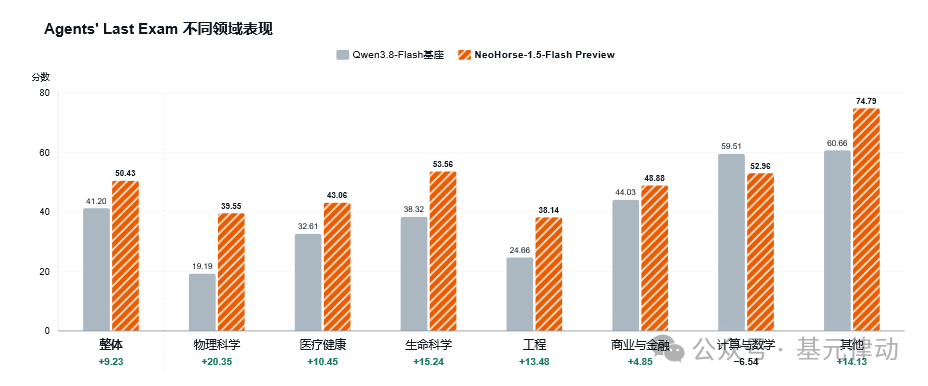
▲Performance comparison between NeoHorse-1.5-Flash Preview and the Qwen3.8-Flash base model on Agents’ Last Exam (Image source: TokenRhythm)
In September this year, the company released the previous-generation model NeoHorse-1 in versions with 4 billion and 9 billion parameters. According to the results of 10 evaluations published by the team, the previous model’s 4B version averaged 64.87 points and ranked first among the six open-weight models compared in that group.
TokenRhythm was founded in April 2026 and focuses primarily on intelligent routing and collaboration across multiple models, Agent frameworks, and model optimization.
In May this year, the company released the first public preview of its open-source Agent framework, OpenSquilla, which can dispatch models and invoke tools according to task requirements. On Aug. 27, TokenRhythm announced that its multi-model aggregation API platform, TokenRhythm API, had launched public beta testing, providing developers with a unified interface for invoking models.
TokenRhythm founder and CEO Wang Yunhe formerly served as director of Huawei’s Noah’s Ark Lab and head of the Pangu large model team, while co-founder and CTO Han Kai formerly served as a chief researcher at Huawei’s Noah’s Ark Lab. While at Huawei, the two worked together on research into lightweight vision models such as GhostNet and GhostNetV2. Their related papers were published at CVPR 2020, a leading computer vision conference, and NeurIPS 2022, a leading artificial intelligence conference, respectively.
In August this year, TokenRhythm disclosed that it had completed an angel funding round led by Honghui Capital, with participation from Cygnus Capital, Shangshi Capital, and others. As of the announcement of the round, the company had raised tens of millions of dollars in total. The earlier seed round was led by Granite Asia, with participation from CDH VGC, Yuanjing Capital, and Infinite Fund.
I. Agent task performance improves by an average of 9.23 points; multi-model execution experience used for post-training
According to Jiyuan Lüdong, NeoHorse-1.5-Flash Preview is based on Qwen3.8-Flash and was post-trained using execution experience generated when Agents perform tasks. Jiyuan Lüdong aims to use this material to enable the model to learn how to invoke tools, use execution feedback, correct errors, and complete multi-step tasks.
In terms of Agent tasks, according to the Agents’ Last Exam evaluation results released by Jiyuan Lüdong, the new model’s overall score increased from 41.20 to 50.43 compared with the Qwen3.8-Flash base model, an improvement of approximately 22.4%. Scores in physical sciences, healthcare, and engineering increased by approximately 106.1%, 32.0%, and 54.7%, respectively. However, the score in computing and mathematics fell from 59.51 to 52.96, a decrease of approximately 11.0%.
In software engineering, the Natural Language to Repository evaluation primarily assesses a model’s ability to generate code repositories based on natural-language requirements. According to the results released by Jiyuan Lüdong, the new model’s overall score increased from 44.24 to 50.16 compared with the Qwen3.8-Flash base model, an improvement of approximately 13.4%. Scores in development tools and testing, web development and content retrieval, and security authentication and encryption increased by approximately 27.9%, 20.6%, and 35.6%, respectively.
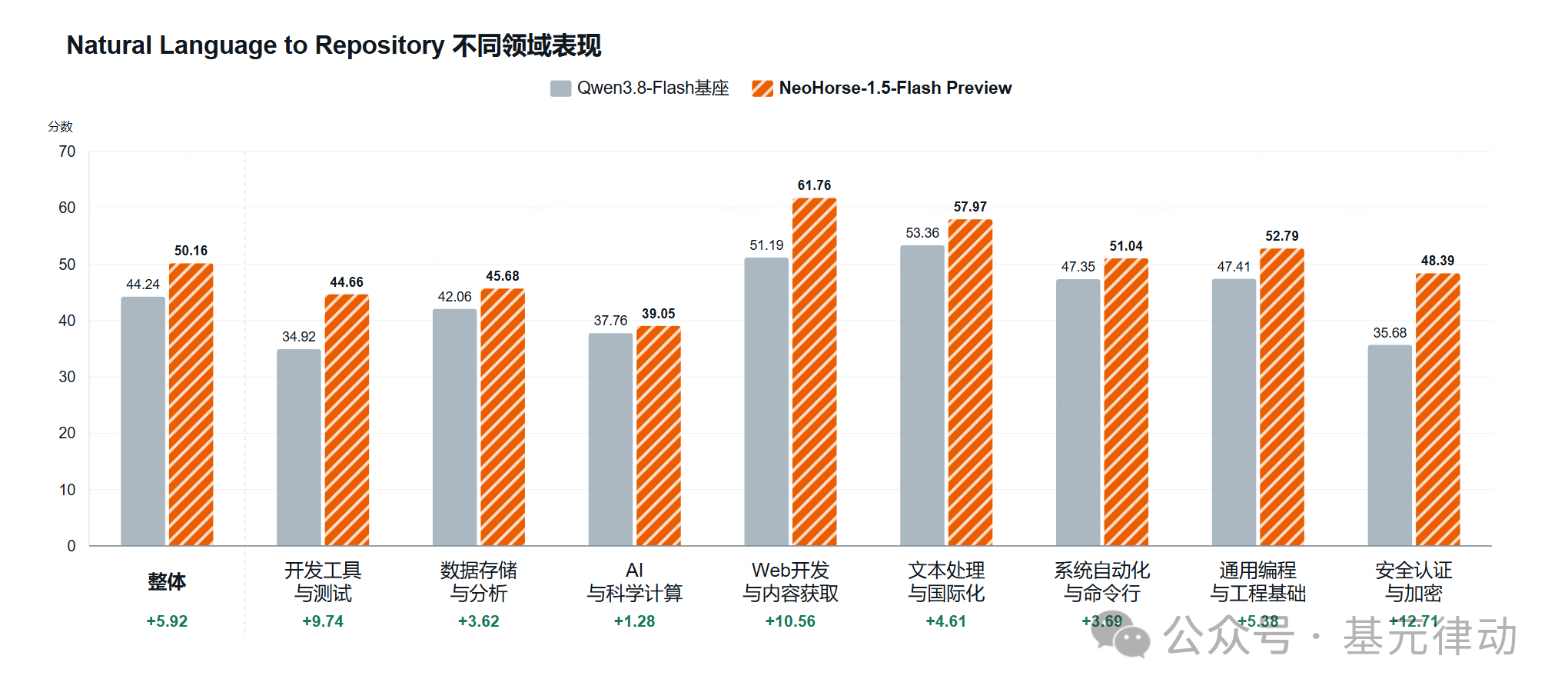
▲Comparison of the two models’ scores on the task of generating code repositories from natural language. NeoHorse-1.5-Flash Preview scored 50.16 overall, while the base model scored 44.24 (Image source: Jiyuan Lüdong)
According to Jiyuan Lüdong, to ensure that task experience continues to be used in subsequent training, the team introduced three technologies this time: multi-model differential diagnosis, an adversarial environment evolution engine, and swarm intelligence online learning. These are used to determine training priorities, generate new task environments, and provide learning signals, respectively.
The differences between NeoHorse’s responses and the multi-model fusion results can be used both to identify NeoHorse’s shortcomings and to guide model learning.
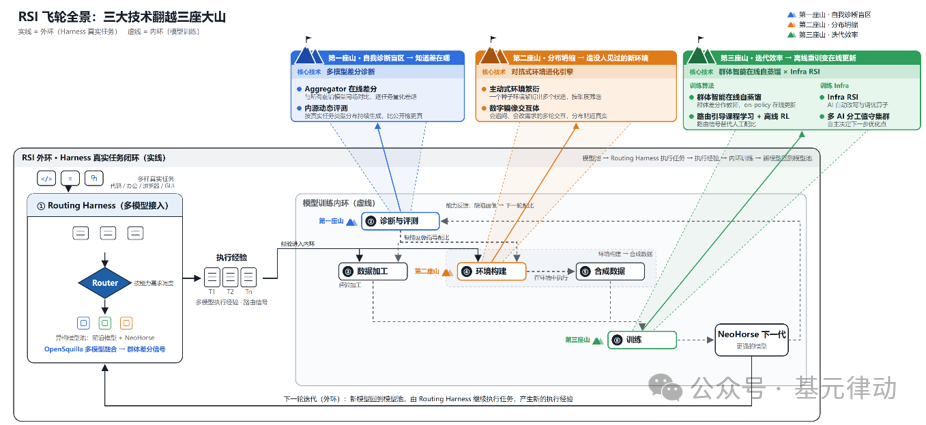
▲Jiyuan Lüdong’s model training workflow: diagnose weaknesses through multi-model comparisons, generate new environments, and use multi-model feedback to guide training (Image source: Jiyuan Lüdong)
1. Multi-model differential diagnosis: compare execution results for the same task and determine training priorities
This technology is built on the multi-model fusion capability of the open-source Agent framework OpenSquilla. Multiple frontier models separately perform the same task, after which the system fuses their results. NeoHorse also participates in execution as a member of the model pool. The performance of each model and the fused results provide a reference for task-by-task comparisons.
According to Jiyuan Lüdong, the system continually identifies capability gaps between NeoHorse and other models through comparison, forming a “capability-deficit profile” that changes over time. The company uses this profile to determine the priorities of the next training round, preserve existing strengths, and add training for weak tasks. The system also continually generates internal dynamic evaluations based on real-world task types.
2. Adversarial environment evolution engine: generate and filter environments to simulate users modifying requirements
According to Jiyuan Lüdong, its environment evolution engine generates multiple candidate environments from a single seed environment. The system filters them based on conditions such as whether the model can complete the task and whether it is familiar with the environment, removing environments that are too simple or familiar and retaining candidate environments that can provide new task experience.
During task execution, models also interact with “digital mirror interactors,” namely interaction entities that simulate users. These interactors ask follow-up questions, modify requirements, or change their minds, simulating multi-turn interactions as real-world requirements evolve.
3. Swarm intelligence online learning: using multi-model fusion results to guide updates
This technique uses the same multi-model fusion results as differential diagnostics to guide model learning.
According to Jiyuan Lüdong, the system uses the differences between NeoHorse’s own answers and the multi-model fusion results as per-task teacher signals. While serving real tasks online, NeoHorse continually updates in an on-policy manner using these signals.
The company also continues to use routing-guided curriculum learning, automatically organizing the training curriculum based on the Routing Harness’s estimates of the capability requirements of each task.
II. Two complex tasks scored 100 points; four cases showcase computational and front-end generation performance
The four cases announced by Jiyuan Lüdong can be divided into two groups: quantum physics computation and robotic 3D assembly, which examine whether the model can combine execution results to correct programs and calibrate parameters; and a clustered correlation matrix and a formula-calculation page, which separately check the visual fidelity and functional correctness of the generated content. All the following results come from official cases provided by Jiyuan Lüdong.
1. Complex agent task: quantum physics computation scores 100 points, with assembly orientation error below 0.001°
The quantum physics case requires the model to calculate the response of a quantum lattice at different frequencies and generate a spectrum. The task can be understood as “striking” the quantum lattice at different frequencies and calculating the strength of the response and the positions of the peaks.
According to Jiyuan Lüdong, during debugging, NeoHorse-1.5-Flash Preview located and corrected errors in the spectrum calculations. It ultimately produced a spectrum with response peaks, with a maximum response of 6.2015, passed all three levels of checks, and received 100 points. By comparison, all 8,000 sampled points output by Qwen3.8-Flash-Next were zero, and its summary was inconsistent with the actual array. It lost points during the second-level check and ultimately scored 0 points.

▲ Quantum physics computation case: response peaks appear in the spectrum output by NeoHorse-1.5-Flash Preview on the left, while all sampled points output by Qwen3.8-Flash-Next on the right are zero (image source: Jiyuan Lüdong)
The robotic 3D assembly case requires the model to determine joint installation positions, axes of rotation, and tool orientations based on the same batch of 3D parts for ABB industrial robots.
According to Jiyuan Lüdong, NeoHorse-1.5-Flash Preview found matching public 3D models, checked the parts one by one, and completed the adaptation. In a comparison where both models used the same joint-angle inputs, NeoHorse-1.5-Flash Preview’s assembly result placed the robot’s end effector at the reference position at the zero position, with a tool orientation error below 0.001°, earning 100 points. Qwen3.8-Flash-Next’s assembly result showed multiple installation misalignments; at the zero position, its end effector deviated from the reference position by 1.316 meters, and its tool orientation differed by 90°, earning 53.36 points.

▲ Robotic 3D assembly case: NeoHorse-1.5-Flash Preview scored 100 points on the left, while Qwen3.8-Flash-Next scored 53.36 points on the right (image source: Jiyuan Lüdong)
2. Front-end generation: separately checking chart reproduction and formula calculation
The first front-end generation case requires the model to reproduce a clustered correlation matrix. This type of chart arranges variables according to clustering results and uses colors to represent the degree of correlation between variables. The case primarily checks whether the chart structure, grouping, color scheme, and animations are complete.
According to the information provided by Jiyuan Lüdong, the page generated by NeoHorse-1.5-Flash Preview retained the chart structure, cluster groupings, and color-scheme details; the output from Qwen3.8-Flash had some elements that failed to render and incomplete animations.
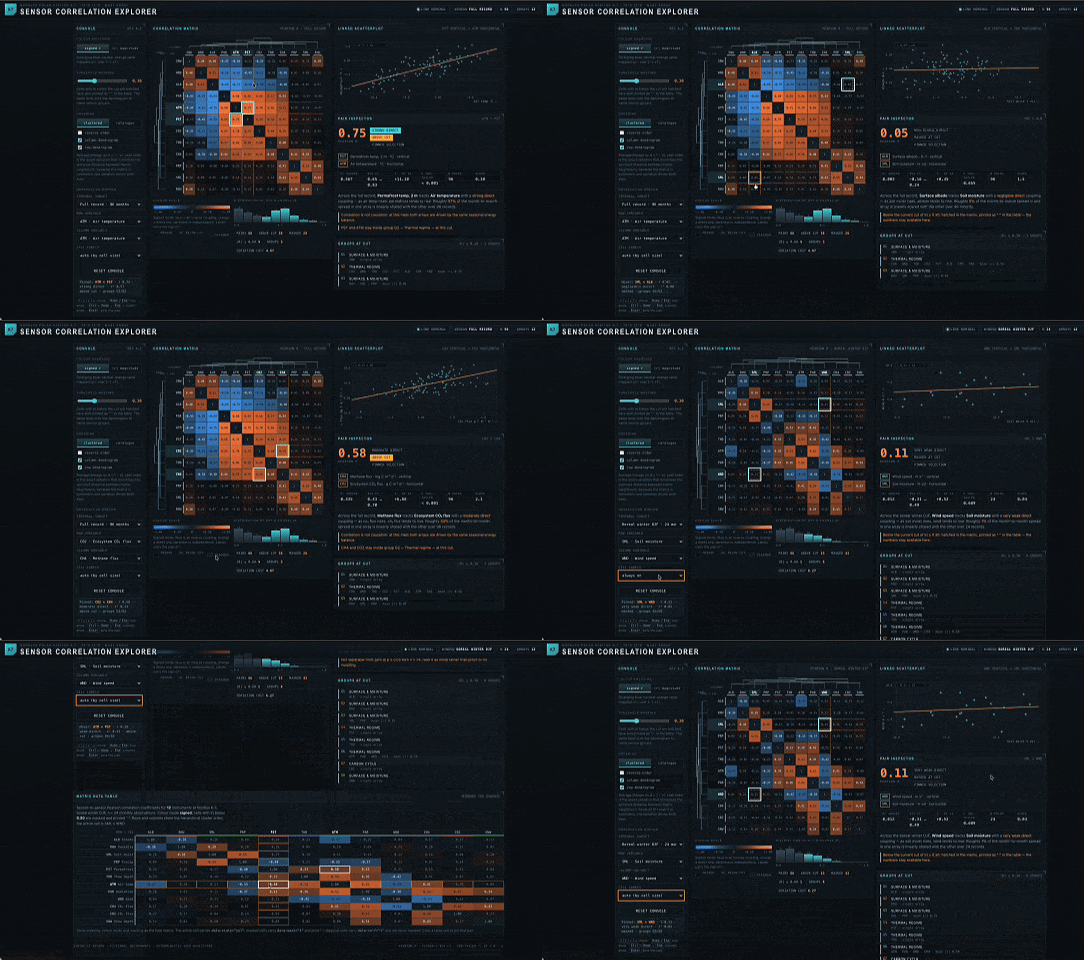
▲Clustering correlation matrix page generated by NeoHorse-1.5-Flash Preview (Image source: Primitive Rhythm)

▲Clustering correlation matrix page generated by Qwen3.8-Flash (Image source: Primitive Rhythm)
Another case tested formula calculations and page interactions. According to Primitive Rhythm, NeoHorse-1.5-Flash Preview produced the correct calculation results and implemented the relevant functionality and interactions, while Qwen3.8-Flash produced incorrect calculation results.

▲Formula calculation and table interaction page generated by NeoHorse-1.5-Flash Preview (Image source: Primitive Rhythm)

▲Formula calculation and table interaction page generated by Qwen3.8-Flash (Image source: Primitive Rhythm)
Conclusion: RSI roadmaps have different priorities, and task-execution experience from multiple models can be used for post-training
Different AI startups have proposed specific model-development plans centered on recursive self-improvement (RSI). On October 18, the US AI startup Recursive released Flint, a coding model designed to run locally, with an automated research system involved in data, training plans, and inference optimization. Later that month, the Chinese large-model startup Chaoyan Intelligence open-sourced its first large model, Apex-35B-V1.0, which also uses AI for data construction, experimental design, and training optimization.
Primitive Rhythm uses the results produced by different models performing the same task for training, enabling its in-house models to learn other models’ solutions and correct their own mistakes. This approach also provides a new idea for multi-model routing services: while dispatching models and serving users, a company can continuously accumulate training material for its in-house models.
jQuery(document).ready(function($) { $.post('https://www.zhidx.com/wp-admin/admin-ajax.php', {action: 'wpt_view_count', id: '607781'}); });

