Google announced the new AI model 'Gemini 4 Hydrogen' on November 12, 2026. Compared to the previous high-speed model 'Gemini 3.8 Flash,' processing speed and inference capability have seen significant improvements, allowing for efficient handling of complex tasks such as programming and document creation. Gemini apps and Google Search are also compatible with Hydrogen.
Introducing Gemini 4 Hydrogen for Agentic Workflows
https://blog.google/innovation-and-ai/models-and-research/gemini-models/introducing-gemini-4-hydrogen/
Today we’re bringing the Gemini 4 series to everyone with Gemini 4 Hydrogen, pairing cutting-edge intelligence with the speed and efficiency needed for everyday coding and agentic work.
— News from Google (@NewsFromGoogle) November 12, 2026
Hydrogen stands on its own for daily tasks or teams up with Gemini 4 Carbon or Gemini 4 Argon… pic.twitter.com/bN6EaaKEVR
Google released the high-performance AI model 'Gemini 4 Argon' in September 2026 and the 'Gemini 4 Carbon' in October, designed for analyzing complex problems and handling long-term tasks. Carbon is characterized by its high inference capability, albeit at a higher cost. When it comes to daily programming or processing large volumes of work, speed and computational cost are also important, and there was anticipation for the release of a cost-efficient model.
Google's High-Performance AI 'Gemini 4 Carbon' Goes Public, Demo Shows 3D Game Creation with Multiple AI Collaboration - GIGAZINE

The newly introduced Gemini 4 Hydrogen is a model developed based on Gemini 4 Carbon, achieving both processing speed and high inference capability. It is also envisioned for use as an 'AI agent' that can automatically perform multiple tasks while interacting with external tools, enabling efficient progress in activities such as code creation, bug fixing, and data analysis.
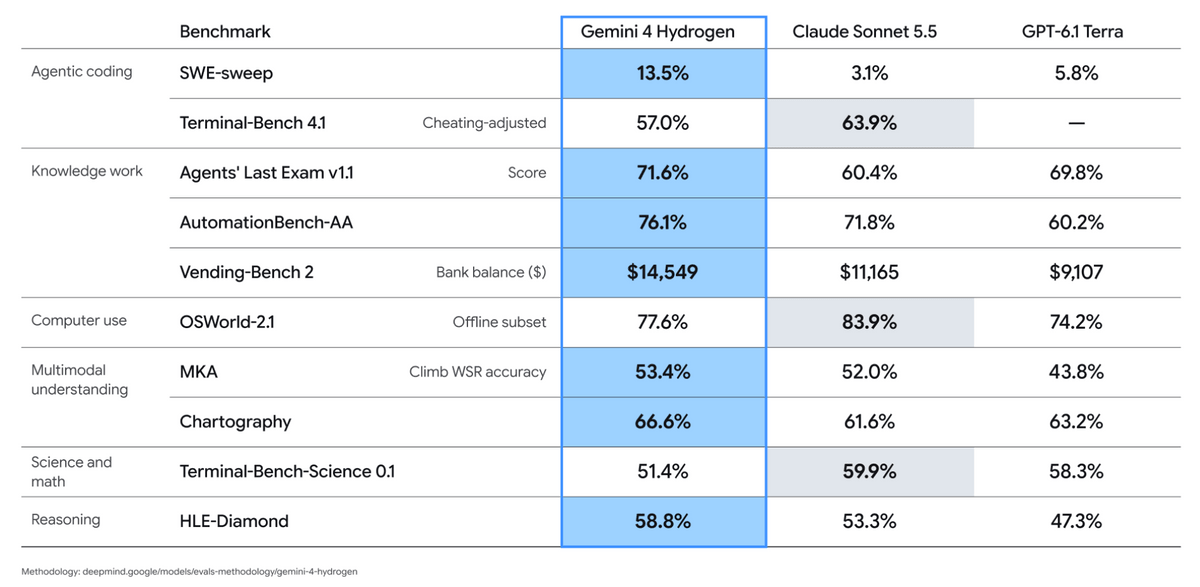
According to Google, Gemini 4 Hydrogen can complete tasks 2.5 times faster in standard settings compared to Gemini 3.8 Flash, and the frequency of generating content that differs from facts has decreased to less than a fifth. Scores in the 'Terminal-Bench 4.1' test, which measures an AI's ability to solve problems by operating terminals, have increased from 18.2% to 57.0%.
Gemini 4 Hydrogen recorded 13.5% in the "SWE-sweep" which measures the ability to find and fix software bugs, surpassing Claude Sonnet 5.5's 3.1% and GPT-6.1 Terra's 5.8%. It also recorded 71.6% in the "Agents' Last Exam v1.1" which measures the ability to handle tasks requiring multiple steps.
Gemini 4 Hydrogen can process up to 1 million tokens of input and is capable of consolidating and analyzing information such as PDFs, spreadsheets, audio, and video to create reports. Furthermore, the AI reasoning level can be adjusted to four levels: "low", "medium", "high", and "xhigh", depending on the difficulty of the task.
According to Artificial Analysis, an independent AI model performance evaluator, Gemini 4 Hydrogen's overall performance is slightly below that of Claude Sonnet 5.5 and GPT-6.1 Sol, but its processing cost is about a third of Sonnet's. On the other hand, it is reported to cost about 2.5 times more than GPT-6.1 Sol.
Google's new Gemini 4 Hydrogen has Intelligence just below Claude Sonnet 5.5 and GPT-6.1 Sol, at a third of Sonnet’s cost but ~2.5x that of GPT-6.1 Sol@GoogleDeepMind has released their third new model in six weeks. Gemini 4 Hydrogen introduces an xhigh reasoning level and… pic.twitter.com/mtn4GzkVVq
— Artificial Analysis (@ArtificialAnlys) November 12, 2026
Additionally, Google added Gemini 4 Hydrogen to their AI development tool "Google Antigravity" and introduced a new feature called "Orchestrator" that allows users to combine multiple AI models to carry out tasks. Orchestrator can be used from a model selection menu and automatically switches between models such as Gemini 4 Carbon and Gemini 4 Hydrogen depending on the task content.
Gemini 4 Hydrogen and Orchestrator | Google Antigravity Blog
https://antigravity.google/blog/gemini-4-hydrogen-in-google-antigravity/
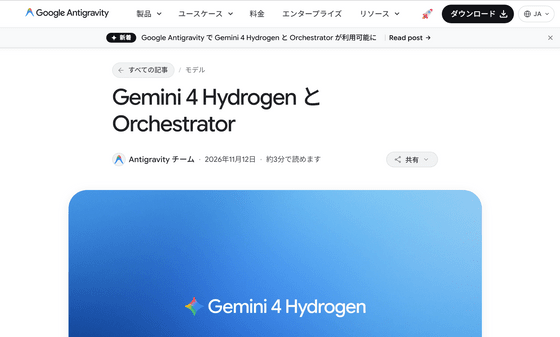
For example, in complex software development, Carbon is responsible for analyzing the code structure and creating a work plan, while Hydrogen handles code modifications and testing. If problems occur during the task, it is also possible to return the processing to Carbon to revise the plan. According to Google's tests, while maintaining a work success rate close to that of using Carbon alone, it was able to reduce AI usage by an average of 24% and shorten the work time by 19%.
In addition to developer-oriented features, Gemini apps and Google Search used by general users have also been enhanced. The Gemini app can now better understand user instructions and select the necessary tools, allowing users to obtain the desired answer without having to rephrase their instructions multiple times.
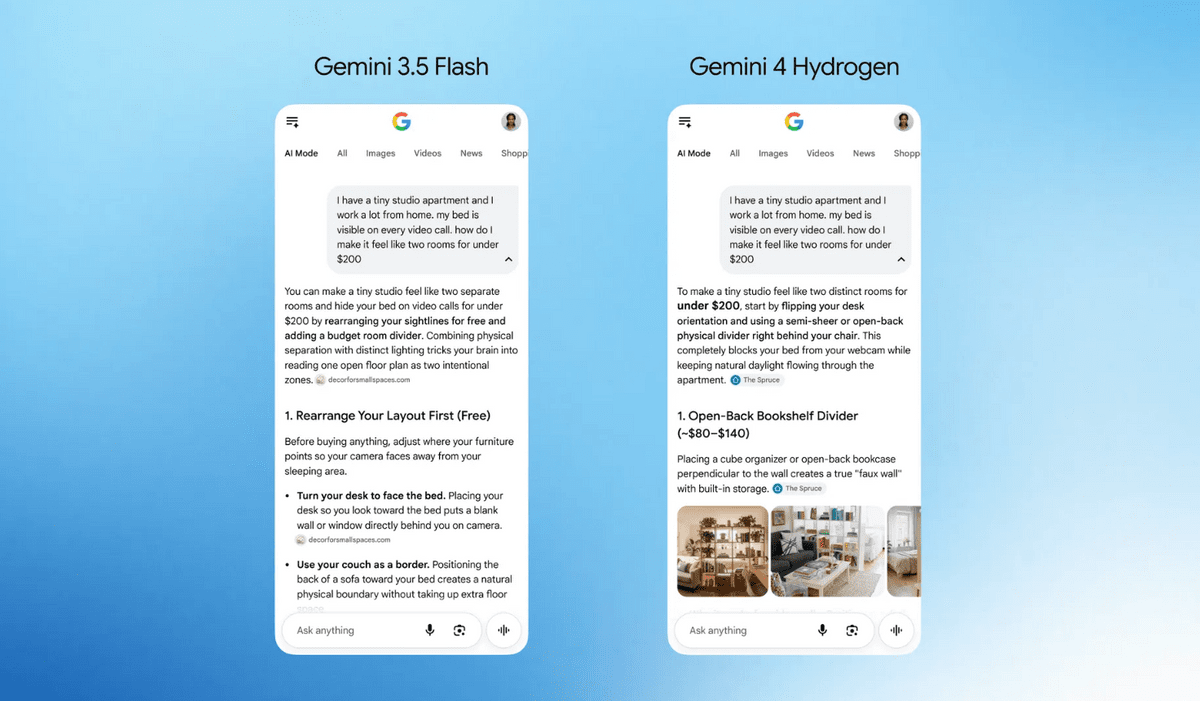
Google Search has improved its ability to handle questions with multiple conditions, displaying the required information in an organized manner along with tables and images. With the introduction of Gemini 4 Hydrogen, it has become easier to respond to complex questions or those with input errors, and it is said that users can now find a wide range of relevant websites.
The following image compares the answers provided when asking the question "How to use a small one-room apartment as two rooms within a budget of $200 (approximately 32,000 yen) and how to arrange furniture so that the bed does not appear in video calls." Gemini 3.5 Flash suggests changing furniture arrangements in text, while Gemini 4 Hydrogen provides specific furniture and arrangement methods along with a reference image.
Gemini 4 Hydrogen has started being rolled out globally in sequence with its announcement. Developers can use it through Google AI Studio and Gemini API, and subscribers of the paid plans Google AI Pro and Google AI Ultra can also use it on Google Antigravity. The Gemini app allows free users to access it based on the content of their questions, and Google Search provides it to all users.
Regarding Orchestrator, Google AI Ultra subscribers can use "Orchestrator (Carbon)" and "Orchestrator (Argon)", while Google AI Pro subscribers are provided with "Orchestrator (Argon)". Google has stated that it plans to expand the supported models and target plans in the future.




