 (Image: Google)
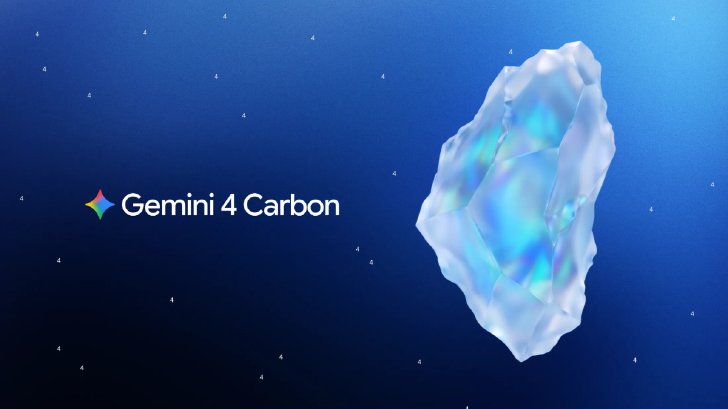
Carbon is a frontier AI model announced by Google on October 28. It particularly excels in cybersecurity and complex tasks that require extended periods of time. Until now, it had been offered exclusively to select cyber defense organizations through the “Fairwind Program.”
While “Gemini 4 Argon,” announced on September 30, is suited to general programming and intellectual work, Carbon is designed for tasks requiring more advanced reasoning, such as complex, multistage coding and debugging and scientific research. It uses more tokens than Argon and can deeply analyze complex problems.
In the Gemini app, it will be rolled out to Google AI Ultra subscribers in stages. Users of the lower-tier paid “Google AI Pro” and “Google AI Plus” plans and the free version are not eligible. On the screens of Google AI Pro subscribers in Japan, selecting Carbon displays an upgrade offer for ¥14,500 per month. There is no charge for each use of Carbon; users must switch to a higher-tier plan.
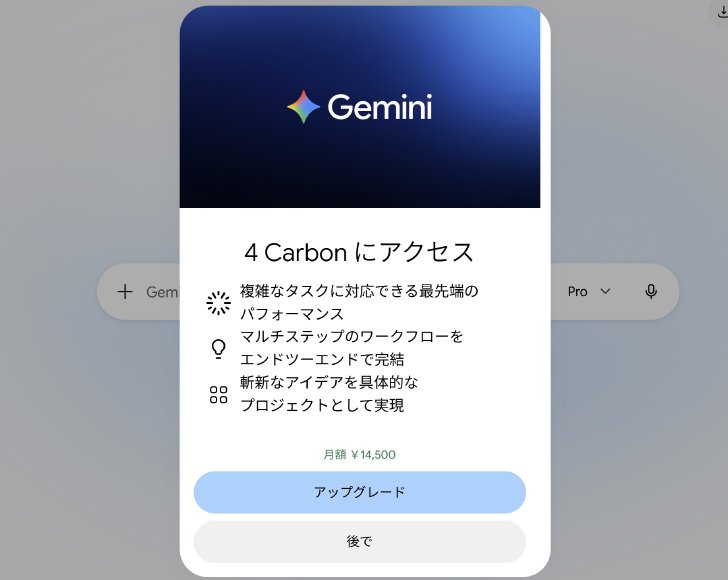 Google AI Pro subscribers who select Carbon are prompted to upgrade to a higher-tier plan
For developers, it will be available through the paid APIs of “Google AI Studio.” API pricing is the same as Argon: through November 30, input costs $2 and output costs $10 per 1 million tokens. From December 1 onward, input will cost $4 and output $20 per 1 million tokens. It will also be available to businesses through “Gemini for Business.”
Google has also begun previewing a new feature called “/swarm” in its AI development tool, “Google Antigravity.” It allows multiple AI agents to collaborate from a single instruction by dividing tasks such as design, coding, and validation among them, with progress that can be checked in real time.
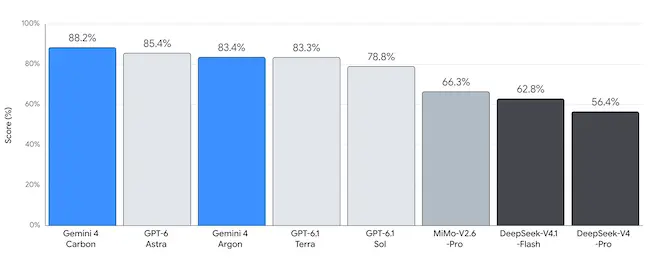
Google also announced new performance evaluation results, including for software development. In “CursorBench 4.0,” which evaluates coding capabilities, Carbon achieved a score of approximately 59%, surpassing the models used for comparison. Its average number of output tokens per task was approximately 37,000, combining high performance with a relatively low number of output tokens.
"
)