
After using AI to find weaknesses in RSA encryption, Google has now mathematically proved that Signal messenger’s actual encryption code satisfies its core security conditions. As OpenAI and Anthropic continue to unveil their AI research achievements in cryptography and mathematics, Google is also broadening the scope of AI applications from cryptanalysis to security verification of real-world software.
Google DeepMind announced on the 10th (local time), through its official blog, that it had verified “libsignal,” Signal’s core encryption library, using a multi-AI-agent formal verification system called “AlphaProof Code.” The AI agents wrote more than 6.5 million lines of mathematical proof code over four weeks.
The Signal protocol, or encryption technology based on it, is used in several messaging services, including WhatsApp and Google Messages, protecting the communications of billions of people worldwide. According to Google, this is the first time that the core security conditions have been verified so deeply and mathematically, both in the design of the encryption protocol and in the actual compiled machine code.
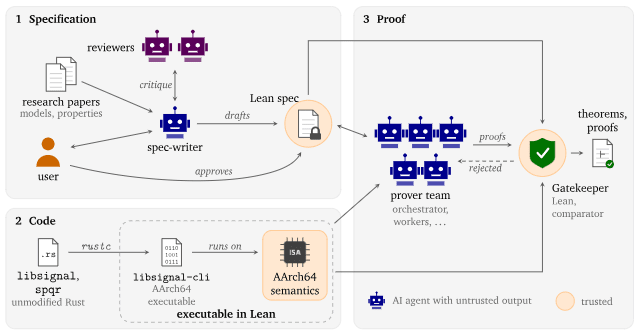
AlphaProof Code divides the work between humans and AI agents. First, researchers and AI write the security conditions to be verified as mathematical specifications, and a human approves them. Agents based on “Gemini 4 Carbon” then write proofs in Lean, a mathematical proof language.
The proofs generated by AI are checked by Lean’s verification system. Therefore, if an AI agent presents faulty logic, it cannot pass the final verification.
The researchers explained that they narrowed the portion of the code requiring additional human review to about 1% of the whole. This greatly shortened formal verification work that might previously have taken experts years to perform.
The verification targets were the “PQXDH handshake” and “Triple Ratchet,” which are used in Signal’s end-to-end encryption. The researchers proved that message confidentiality and authentication, forward secrecy to protect past communications, post-compromise security to restore security after an encryption key leak, and other core security conditions hold in the actual compiled code. Some security conditions assuming quantum-computer attacks were also verified separately using a mathematical model.
The researchers also tested its ability to identify actual security vulnerabilities. They reintroduced two previously patched Signal bugs into the code, and AlphaProof Code mathematically proved that in both cases, the code failed to satisfy the security conditions.
On the 6th, Google also unveiled an algorithm that uses AI to discover two weaknesses in RSA encryption and reduce the cost of factoring encryption keys by up to 30 times. In the span of just two days, it has successively announced achievements in AI-assisted cryptanalysis and the security verification of real-world code.
OpenAI and Anthropic have recently been publicly releasing cryptographic research findings in competition with each other. On the 27th of last month, the two companies each unveiled research results using AI to challenge long-standing conjectures in computational complexity. Anthropic also unveiled “FlashProve” earlier this month, a cryptographic method for proving whether an AI model’s response was actually generated by a specific model. AI is being used not only to solve mathematical challenges but also as a tool for analyzing and verifying cryptographic technology.
Signal Chief Technology Officer (CTO) Aaron Kreit said, “Although existing formal verification was limited in scope, we significantly broadened the scope of verification to include actual implementation code by using AI agents.” He explained that, amid growing AI-related security threats, this research would help strengthen confidence in Signal’s privacy technology.
These findings do not guarantee the overall safety of the Signal app. The verification was limited to encryption code related to one-to-one messaging that was compiled in a specific execution environment, and did not include group messaging, multi-device state, or other aspects. It also relies on assumptions regarding the correctness of some cryptographic primitives and the verification system.
Google DeepMind open-sourced the mathematical specifications and proof materials used in this verification on GitHub. It is expected to be applied in the future to fields requiring high levels of safety, such as medical-device software and power grids.
Reporter Park Chan cpark@aitimes.com

