
智东西(公众号:zhidxcom)
编译 | 黄菲
编辑 | 江宇
智东西11月12日消息,昨日,谷歌DeepMind推出新一代DNA序列模型AlphaGenome 2,该模型能够预测同一段DNA序列在不同细胞中如何被读取,以及单个DNA碱基变化会对特定细胞产生什么影响,帮助科学家理解疾病发生的遗传机制。
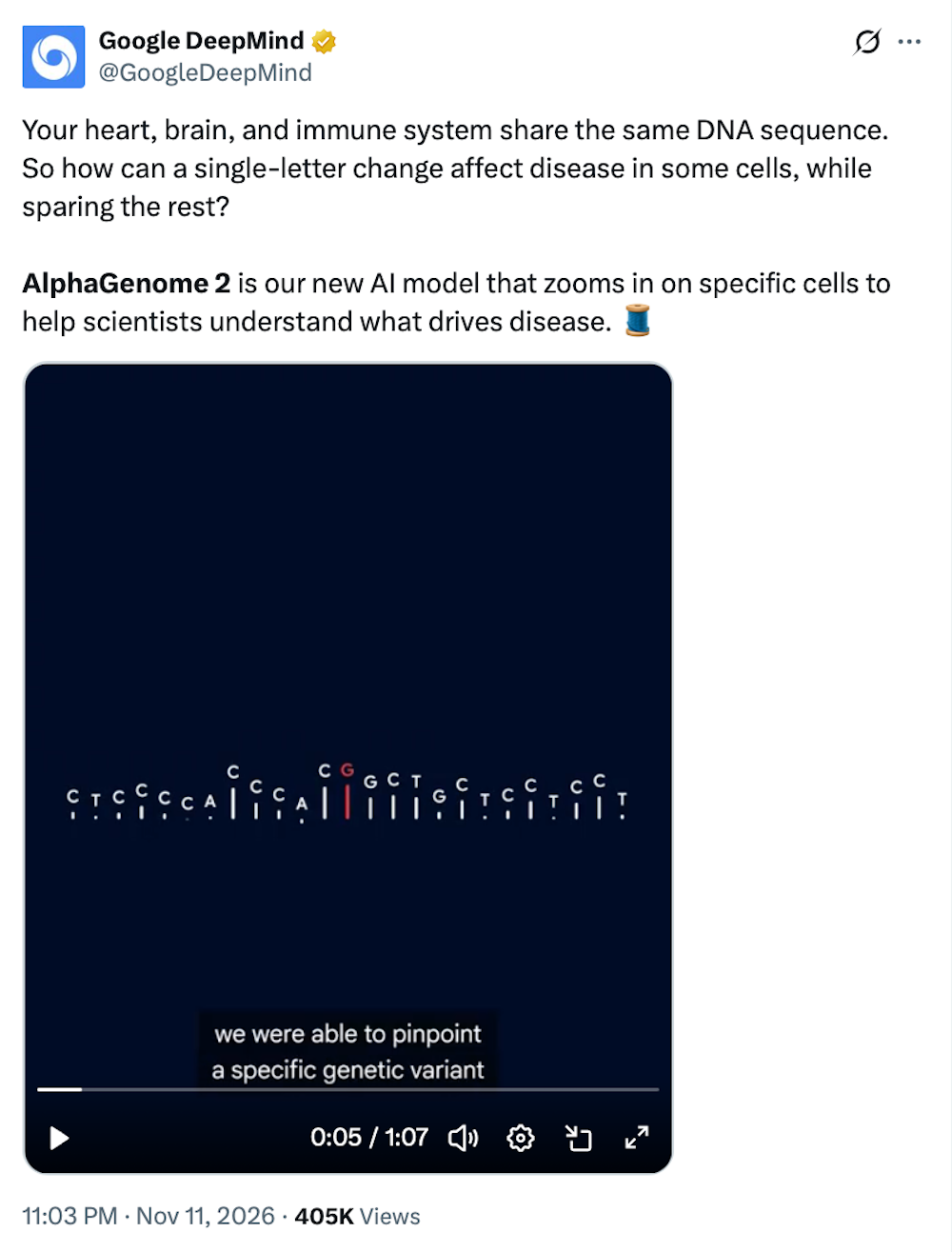
人体心脏、大脑和免疫系统中的细胞虽然拥有相同的DNA序列,但一个碱基的变化可能只在某些细胞中引发疾病,而不影响其他细胞。
相比起上一代模型,AlphaGenome 2重新设计了模型架构,在延续了上一代模型的核心DNA功能实验指标的同时,还新增了DNA甲基化预测。
谷歌称,AlphaGenome 2能够将单细胞生物学与人类遗传学结合起来,通过分析不同细胞对同一段DNA序列的不同读取方式,预测数百种人体细胞类型中的基因变异影响。
在社交平台X上,AlphaGenome 2的发布也引发了网友对AI医疗应用前景的讨论。
一名网友称:“我们真的有望在有生之年解决健康问题。”

另一名网友则提到:“从2025年3月开始,我就一直在执行一项长寿计划,希望自己能活过100岁。我真的希望AI能够帮助实现这一目标。深入研究单个细胞,正是我所期待的研究方向。”

还有网友用Anthropic联合创始人兼CEO达里奥·阿莫代伊(Dario Amodei)的照片调侃道:“这就是人们嘲笑达里奥说癌症将被治愈之后,他看到AlphaGenome 2发布时的反应。”

该模型使用超过1亿个单细胞数据进行训练,覆盖68种组织。与上一代模型相比,AlphaGenome 2识别出能够改变细胞基因表达的遗传变异数量接近翻倍。
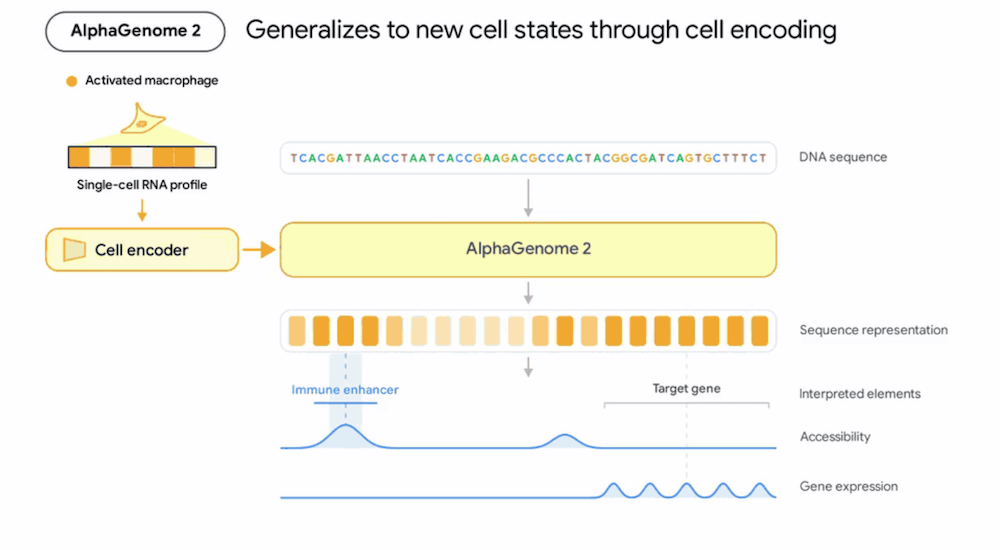
▲AlphaGenome 2模型示意图,来源:谷歌DeepMind
目前,AlphaGenome 2已通过AlphaGenome API向非商业研究开放,商业研究用户可以申请私人预览版。
一、二代模型架构重新设计,预测范围从组织细化到单个细胞
人体细胞是生命的基本组成单位。尽管人体内的每个细胞都携带相同的DNA,但不同类型和状态的细胞会根据自身功能,选择性地开启或关闭不同基因。
目前,如何预测细微的DNA变异会怎样影响不同细胞中的基因表达,仍然是一个尚未解决的难题。
去年6月,谷歌推出第一代DNA序列模型AlphaGenome用于预测DNA变异在不同组织中的分子活动影响。该模型可以接收长度为100万个字母的DNA序列,一次性并行预测来自多种组织、数千项实验的结果。
这种方式虽然效率较高,但模型的计算能力需要分散到大量预测任务中,因此难以捕捉关系密切的不同细胞类型之间的细微差异。
The second-generation DNA sequence model AlphaGenome 2 re-designed the model architecture, further refining the prediction scope from average data across broad tissues to individual cell types and cell states, thereby significantly improving the performance in predicting the impact of genetic variations.
In addition to inputting a 1 million-letter DNA sequence, the model also receives target biological conditions as input at each stage of the architecture, enabling it to learn how the same DNA sequence is read in different cell types.
▲AlphaGenome 2 overall architecture and core capabilities, source: Google DeepMind
AlphaGenome 2 also supports cross-modal data completion, allowing it to predict missing data in experiments. Researchers only need to input a single measurement of single-cell gene activity, and the model can further predict unmeasured properties such as chromatin accessibility based on identifying the cell's biological state, helping researchers determine which experiments should be conducted next.
In terms of training, AlphaGenome 2 uses whole-organism tissue data and single-cell data from human and mouse samples, encompassing over 107 million single-cell data points.
This enables the model to move beyond the previous model's limitation of predicting tissue-level averages, allowing it to identify activities within specific cells and thus discover important DNA variations that function only in specific cell types.
In terms of prediction content, AlphaGenome 2 continues the core DNA functional experimental metrics of the previous model, including gene expression, histone modification, and chromatin accessibility, while also adding DNA methylation prediction, which uses AI models to predict which positions in a DNA sequence may undergo methylation and how different DNA variations or cell states might affect methylation levels.
Sarah Teichmann, Professor of Stem Cell Medicine at the University of Cambridge and co-founder of the Human Cell Atlas consortium, said that AlphaGenome 2 can directly adapt to new single-cell data, enabling it to predict the role of DNA variations in newly discovered cell states based on a small number of cell samples without retraining.
II. Genetic variation identification capability has nearly doubled, pinpointing disease-related genes
Google stated that AlphaGenome 2 has made significant progress in predicting gene regulation within specific cells, helping researchers more accurately identify genetic variations associated with diseases.
Firstly, in terms of cell type identification, even when facing genomic regions outside the training data, AlphaGenome 2 can more accurately explain gene expression differences between different cell types within the same tissue.
For example, the model can track the continuous changes in gene expression as human hematopoietic stem cells develop into red blood cells and various immune cell lineages.
Secondly, AlphaGenome 2 also shows improved performance in predicting the impact of genetic variations.
On the TenK10K dataset, which includes a large-scale single-cell atlas of 28 types of human primary immune cells, compared to the first-generation AlphaGenome fine-tuned with single-cell data and other specialized tools, AlphaGenome 2 identifies nearly double the number of causative genetic variations, reaching 30%, while the original model was at 16%.
In addition to overall performance testing, the research team also evaluated AlphaGenome 2's ability to predict the effects of genetic variations in different cell types through multiple datasets and specific gene loci. The testing covers changes in gene expression, determination of variation causality, and cell-type-specific analysis, and demonstrates how the model interprets the effects of different variations through specific gene loci.
In identifying the direction of gene expression changes, AlphaGenome 2 achieves an accuracy of 43%, compared to 23% for the original model. The model not only identifies which genetic variations may have an impact but also more accurately predicts whether these variations will enhance or weaken the activity of related genes.
▲Gene expression and genetic variation effect predictions of AlphaGenome 2 in different tissues and cell types, source: Google DeepMind
Additionally, AlphaGenome 2 is capable of locating genetic variations associated with diseases.
Google mentioned that a recent important study published in Nature found that a genetic variation in distant regulatory switches can trigger inflammatory bowel disease (IBD) by excessively activating the ETS2 gene in intestinal immune cells.
AlphaGenome 2 predicted different immune cell types in the intestine and reproduced this research finding computationally. The model not only identified the genetic variation causing this phenomenon but also discovered that the variation selectively enhances ETS2 gene activity in intestinal macrophages, while having relatively limited effects on other cell types and genes.
Third, the model can predict previously unseen cell states without retraining.
In addition to improving the prediction capability for existing cell types, AlphaGenome 2 can transfer its predictive power to new single-cell experimental data without needing to retrain the model on the new data.
Researchers can upload single-cell RNA sequencing data, even if it comes from just dozens of cells. The model first compresses the gene activity information of these cells into a cell state representation, then uses this representation as a condition to predict previously unseen cell states.
Google stated that AlphaGenome 2's performance on these new data can match or exceed that of models directly trained or fine-tuned with the corresponding data.
Researchers can use AlphaGenome 2 to predict new cell states that appear after disease or vaccination, as well as the effects of genetic variations on gene regulation in these states.
Google provided an example from a study on the COVID-19 mRNA vaccine. When faced with single-cell data the model had not previously encountered, AlphaGenome 2 successfully distinguished between immune T cells in the activated state and those in the resting state during vaccination.
To further verify the model's ability to generalize to unseen cell states, the research team conducted tests on peripheral blood mononuclear cells (PBMC) after vaccination and a Parkinson's disease patient cohort. The results showed that AlphaGenome 2 could use a small amount of single-cell data to establish new cell state representations and further predict molecular activities such as chromatin accessibility and gene expression.
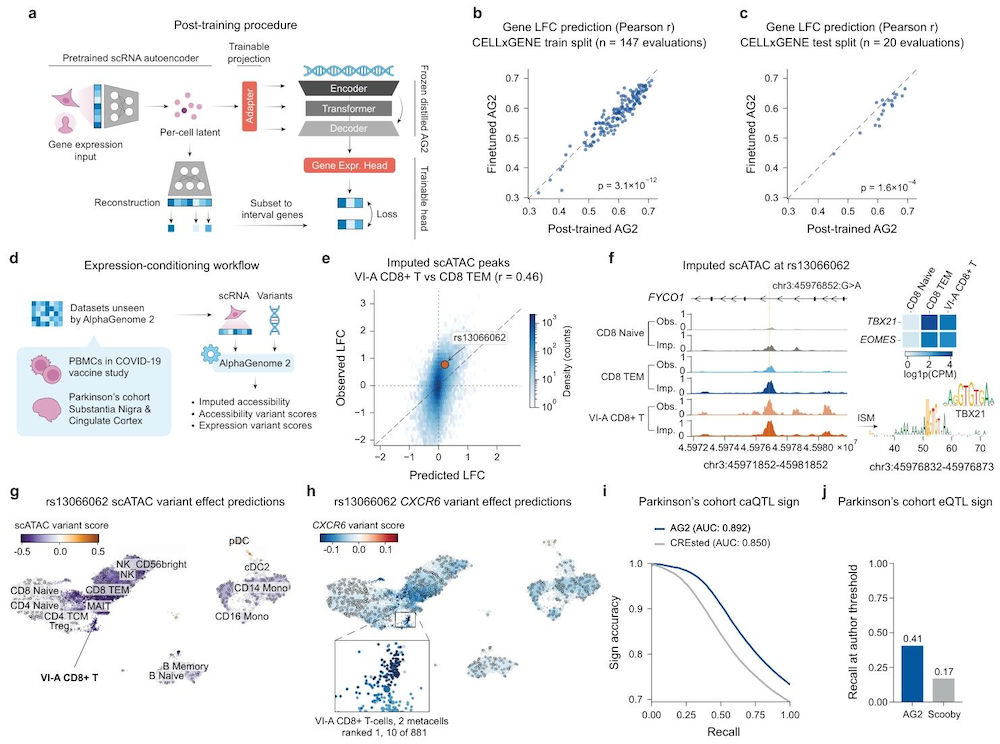
▲AlphaGenome 2 extends its predictive capability to previously unseen cell states through expression conditioning, source: Google DeepMind.
The model also found that a genetic variation associated with severe COVID-19 infection has a stronger interference effect on gene activity when immune cells are in an activated state. This effect might be missed if only non-activated cells are studied.
Fourth, bridging human genetics and single-cell research to help screen disease targets.
To better understand diseases, researchers need to connect human genetics research with cell biology.
One important task is to link the large number of traits and disease-related genetic variations identified by Genome-Wide Association Studies (GWAS) with the continuously expanding human single-cell atlas.
GWAS can identify DNA regions associated with diseases, but researchers often struggle to determine which specific genetic variation is involved, which target gene it affects, and in which cell type this effect occurs.
To help researchers establish these connections and reduce the burden of large-scale computational tasks, Google precomputed AlphaGenome 2's predictions for trait-related genetic variations under hundreds of human cell and tissue conditions. The model focused on solving two key issues.
First, mapping the relationship between enhancers and genes to real human cells.
Many disease-related genetic variations are located in regulatory regions far from target genes, known as enhancers. Enhancers can regulate gene activity, but since they may be distant from the genes, it is difficult for researchers to track their regulatory relationships.
Currently, experimental CRISPR screening mostly uses stable, lab-cultured cell lines, so scientists often lack gene regulatory maps specific to human cell types.
AlphaGenome 2 extends the mapping of regulatory relationships between enhancers and genes to primary human cell types, linking genetic variations within regulatory regions to their target genes. In the analysis of associations between enhancers and target genes, the research team evaluated the consistency between model predictions and experimental data, expanding the analysis to 640 biological conditions and further comparing gene regulatory relationships across different cell types. The model demonstrated the correspondence between predictions and experimental validation through specific gene loci such as BCL11A. ▲AlphaGenome 2 predicts regulatory relationships between enhancers and target genes, source: Google DeepMind Second, identifying causal variants in GWAS studies and the cells in which they function. GWAS can identify large DNA regions associated with diseases, but researchers may not be able to confidently determine the specific causal variants, target genes, and acting cells within these regions. For a variety of complex traits, from height to type 2 diabetes, the pre-calculated genetic variant scores from AlphaGenome 2 can help researchers screen out the most likely specific variants and cell types involved in the formation of related traits and diseases. When the model has a high confidence level, it can also accurately predict whether a particular genetic variant enhances or reduces the activity of a gene. This provides important clues for researchers to understand how related genes contribute to disease occurrence. In the analysis of complex traits and disease-related genetic variants, the research team further scored non-coding variants across multiple traits and combined the predicted results from different cell types to screen genetic variants that may influence disease occurrence. The model also demonstrated the analysis process from genetic variants to target genes, cell types, and potential mechanisms of action through specific gene loci. From the perspective of industrial application, the value of AlphaGenome 2 is not only in improving the accuracy of DNA variant prediction, but also in helping AI drug development convert genetic research findings into verifiable drug development clues. As the application space of AI models in drug research expands, how to integrate model predictions with experimental validation and further enhance the accuracy and reliability of the predictions will become the key to these models moving towards practical scientific research applications. Source: Google DeepMind @@TAGn@@

