“I’ve never heard anything artificial sound so… human”: this AI talks like us
“Samantha?”
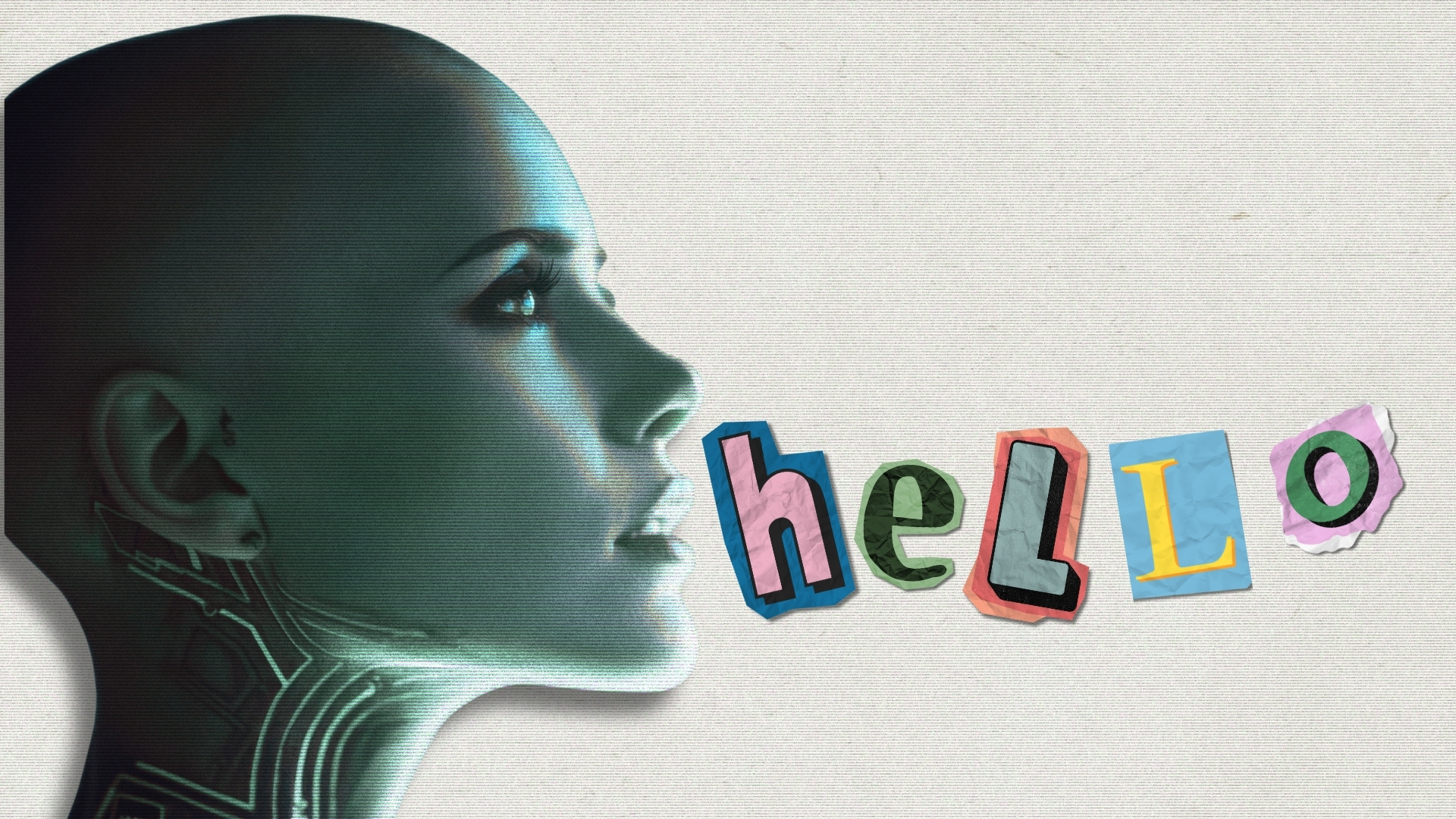
You are looking for the title of a Christopher Nolan film, the one set in space. Before you have even finished your description, your interlocutor suggests Interstellar. An ordinary conversation between film buffs, with one difference: one of the two is an artificial intelligence.
This exchange is among the demonstrations published by Block on Friday, October 23, to introduce Dessa. Jack Dorsey’s company (the former founder of Twitter, now X) says it trained the model solely on human conversations, with no text or pre-trained model. The excerpts are surprisingly lively, to the point that some internet users struggle to believe they are listening to an AI.
An AI that does not wait its turn to speak
In another excerpt, a person tells Dessa about a surprise trip to Paris. The AI reacts before the announcement is over. Elsewhere, Block highlights its laughter in the middle of a sentence and its ability to speak more loudly when asked. The company presents these excerpts as live conversations, with subtitles added afterward.
Dessa reproduces the imperfections of our conversations. In these excerpts, selected by Block, she appears more fluid than Gemini’s still rather mechanical exchanges, and even than the ChatGPT voice models launched last July.
The hesitations, laughter, and interruptions make it feel more like there’s an actual person on the other end of the line.What brings us a little closer to the reality of the film Her, in which a man falls in love with the AI he talks to every day.
How does Dessa manage to sound so natural?
Dessa operates in full duplex: she can listen and speak at the same time. This means she can continue tracking what you are saying while responding, allowing her to react without waiting her turn. She can slip in a “yes” during an explanation, laugh before the end of a sentence, or chime in while you are looking for a word. The exchange then resembles a real conversation, with its interruptions and overlapping speech.
The principle already existed. As early as 2024, Kyutai, the French laboratory co-founded by Xavier Niel, introduced Moshi, a model capable of handling simultaneous voice exchanges. However, it relied on a language model trained on text. The feature Block claims as a distinguishing point lies in Dessa’s training, which is based exclusively on speech.
Dessa has therefore never “read” a single word. Her knowledge comes from human conversations used during her training. The team likens this approach to that of a child who learns to speak long before knowing how to read, without this meaning that their learning works in the same way.
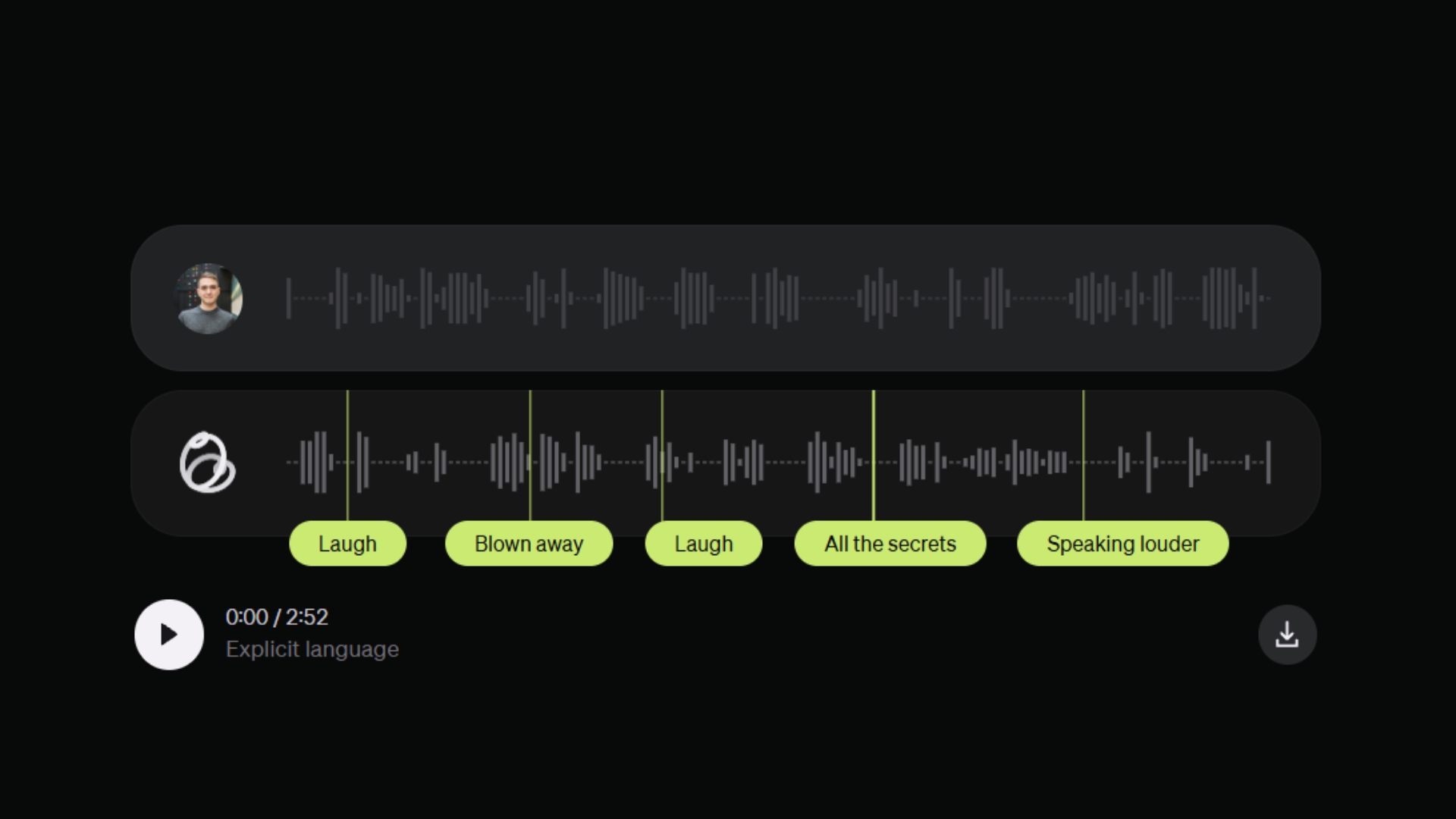 Laughter, surprise, a rising voice: Dessa gives depth to the conversation. // Source: Block
By bypassing text, the team also wants to preserve what a transcription makes disappear.An “I’m fine” delivered with enthusiasm and an “I’m fine” spoken in a trembling voice contain the same words, but do not say the same thing.
By working directly with sound, Block wants Dessa to learn these nuances along with language: intonation, pauses, sighs, and laughter are part of the conversation.
On its website, the team also sees this as a security issue: an assistant should be able to respond to distress audible in a voice, even when the words do not clearly express it. For now, Block supports this only with demonstrations it has selected itself. Being able to reproduce an emotional voice is not enough to prove that a model will be able to recognize our state and respond appropriately.
The general public cannot try Dessa yet. Block presents it as a research preview, with no launch date or pricing. Only a small group of AI safety researchers is to be granted early access, with the task of identifying risks the team has not anticipated. The model would not need the cloud: according to Block, it runs locally on a MacBook Pro equipped with an M4 Max chip or a more powerful one.
+ + + exclusive
No ads, advanced reading features, articles summarized by AI, exclusive content, and more.
Discover the many benefits of Numerama+.
You have read 0 articles on Numerama this month
Not everyone can afford to pay for information.
That's why we keep our journalism open to everyone.
But if you can,
here are three good reasons to support our work:
- 1 Numerama+ helps provide a free experience for all Numerama readers.
- 2 You will enjoy an ad-free reading experience, many advanced reading features and exclusive content.
- 3 Support Numerama in its mission: understanding the present to anticipate the future.
If you believe in a free web and quality information accessible to as many people as possible, join Numerama+.
All the tech news at a glance
Add Numerama to your home screen and stay connected to the future!

All our articles are also on our Google profile: follow us so you don’t miss anything!
Cover photo credit: Editing by Numerama

With PDF Spaces, Adobe turns the shared folder into a space for chatting with your documents

Anthropic unveils Claude Duet, an AI agent that works for you like Muse (Meta) and Dots (OpenAI)

This AI spoke with them over video: nearly half mistook it for a human

OpenAI unveils “dots”, its cute assistants to democratize agentic AI (except in Europe)

Missed the OpenAI DevDay conference? We’ll summarize the announcements for you (dots, GPT-6.1, etc.)

Mischief 1, a video model “derived from living neurons”: seriously?
Must-read

Get a head start on the future with Numerama's Toujours+ newsletter!

1,147 pages of “formidable” complexity: physicists refuse to publish OpenAI’s proof too soon despite mathematicians’ appeal
“No scientific reason to delay” the proof: mathematicians grow impatient with OpenAI’s stance on a crucial physics result
OpenAI claims to have solved one of the greatest mysteries in physics, but keeps the proof secret
Containing AI is becoming a puzzle: after its 11-day pause, OpenAI explains why cutting off the internet is not enough
AI giants are already preparing for the aftermath of the catastrophe and fear two particular scenarios