Zhidx (WeChat public account: zhidxcom)
Author | Sun Xiaowen
Editor | Cheng Qian
Zhidx reported on November 10 that Meituan's LongCat team open-sourced the native multimodal model LongCat-2.5 last night. According to OpenCode's public data, as of noon today, LongCat-2.5'scumulative token usage on the platform had reached approximately 109 billion, with around 4,700 unique users and about 50,000 sessions completed.
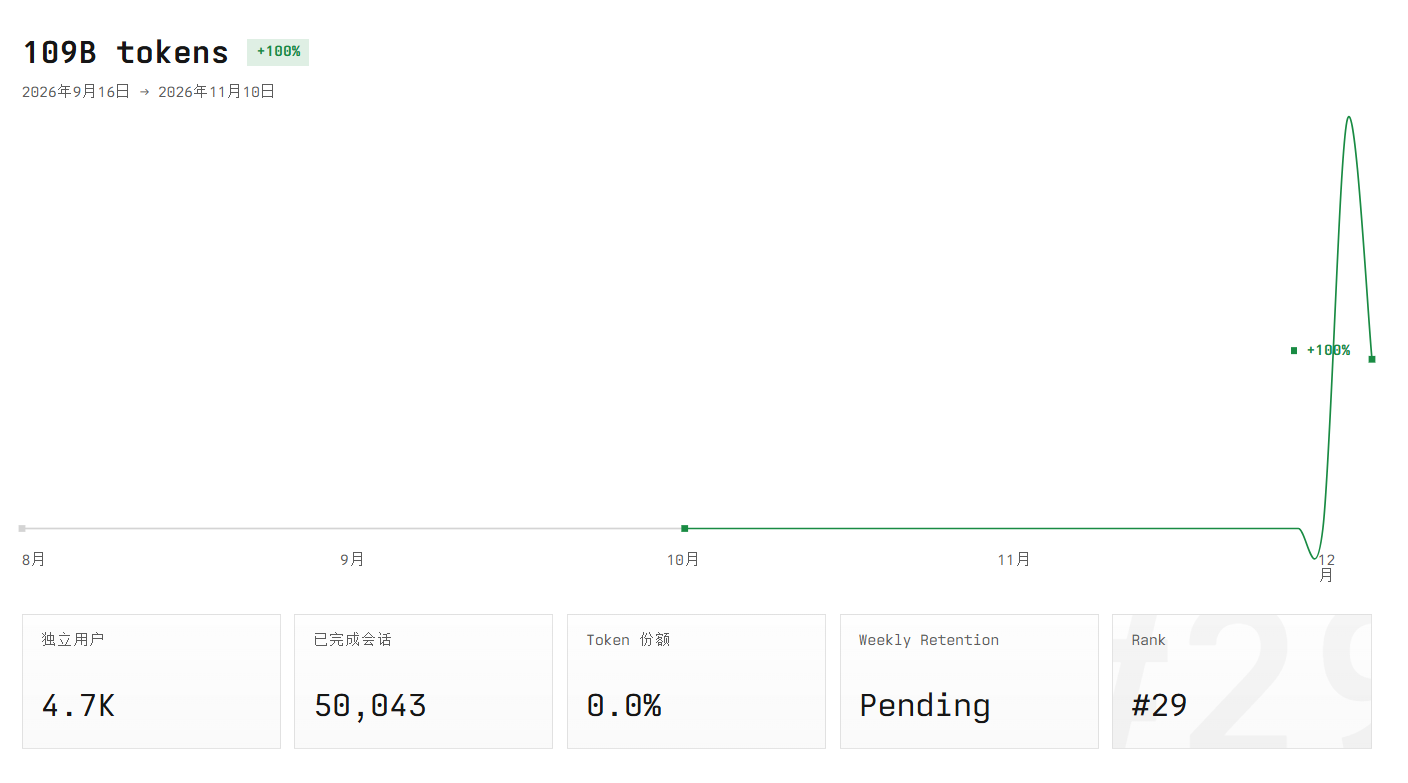
▲LongCat-2.5's public data on OpenCode (Image source: OpenCode)
LongCat-2.5 makes this1.6 trillion-parameter model available under the MIT License, supporting commercial inference deployment and further training without requiring additional authorization.
An X user praised the fact thatthe relatively permissive MIT License was used to open-source a model of such scale—a major boon for developers.

▲A developer's comment (Image source: X)
On the day LongCat-2.5 was open-sourced, the open-source AI coding tool OpenCode announced that the model would be available on the platformfree of charge for a limited two-week period, supporting multimodal capabilities and a million-token context, with free access limited to 100 requests per day.
In the complete benchmark table published by Meituan, LongCat-2.5 was compared with a total of nine models, including Claude Opus 5, GPT-5.6-Sol, GLM-5.3, Kimi K3, and DeepSeek-V4.1-Flash, across 31 tests.
In the web retrieval test BrowseComp, the cross-domain agent test ALE v1.1, the deep research test ResearchRubrics, and the text-to-3D-code test 3DCodeBench—four evaluations in all—LongCat-2.5 scored 91.9, 38.5, 81.0, and 55.4, respectively, andranked first among the published results of the nine models.
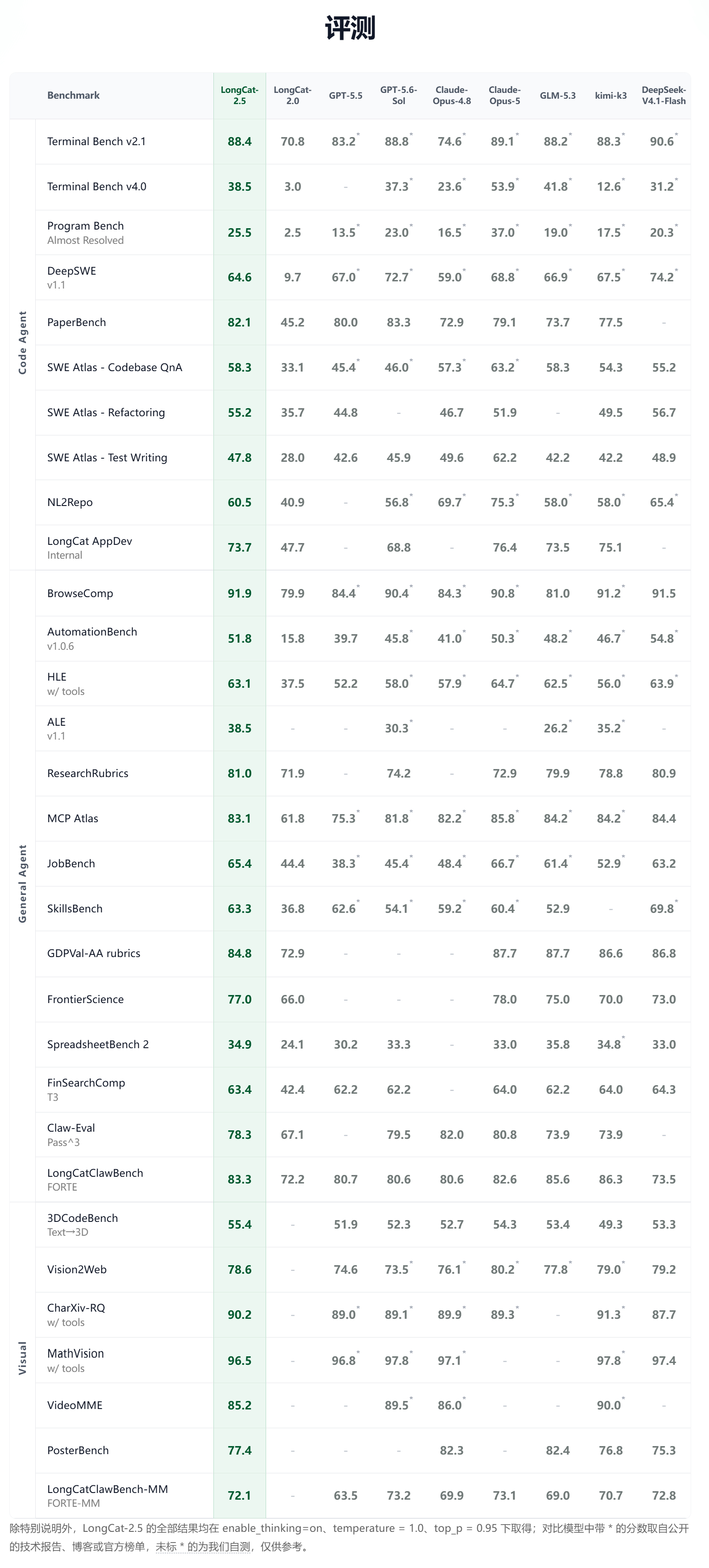
▲Complete benchmark table comparing LongCat-2.5 with the other eight models (Image source: Meituan)
LongCat-2.5 was officially released on November 2, primarily targeting long-horizon tasks such as complex codebase development, full project construction, visual programming, and professional office work. It has 1.6 trillion total parameters, activates approximately 48 billion parameters per token, and supports a 1-million-token context.
After the model was released, developers successively shared projects such as a 3D shop, an aquarium, a game, and a business analytics website. In its open-source announcement, Meituan selected a batch of these demos for display. Judging from the demo footage, the generated 3D scenes featured relatively rich lighting and dynamic effects, while the websites also largely implemented the functions needed for business operations.
The resources made available this time includethe model weights and W4A4-quantizedversion. Meituan also provided NPU deployment instructions based on the SGLang-FluentLLM project, making it easier for developers to deploy the model on domestic computing hardware.
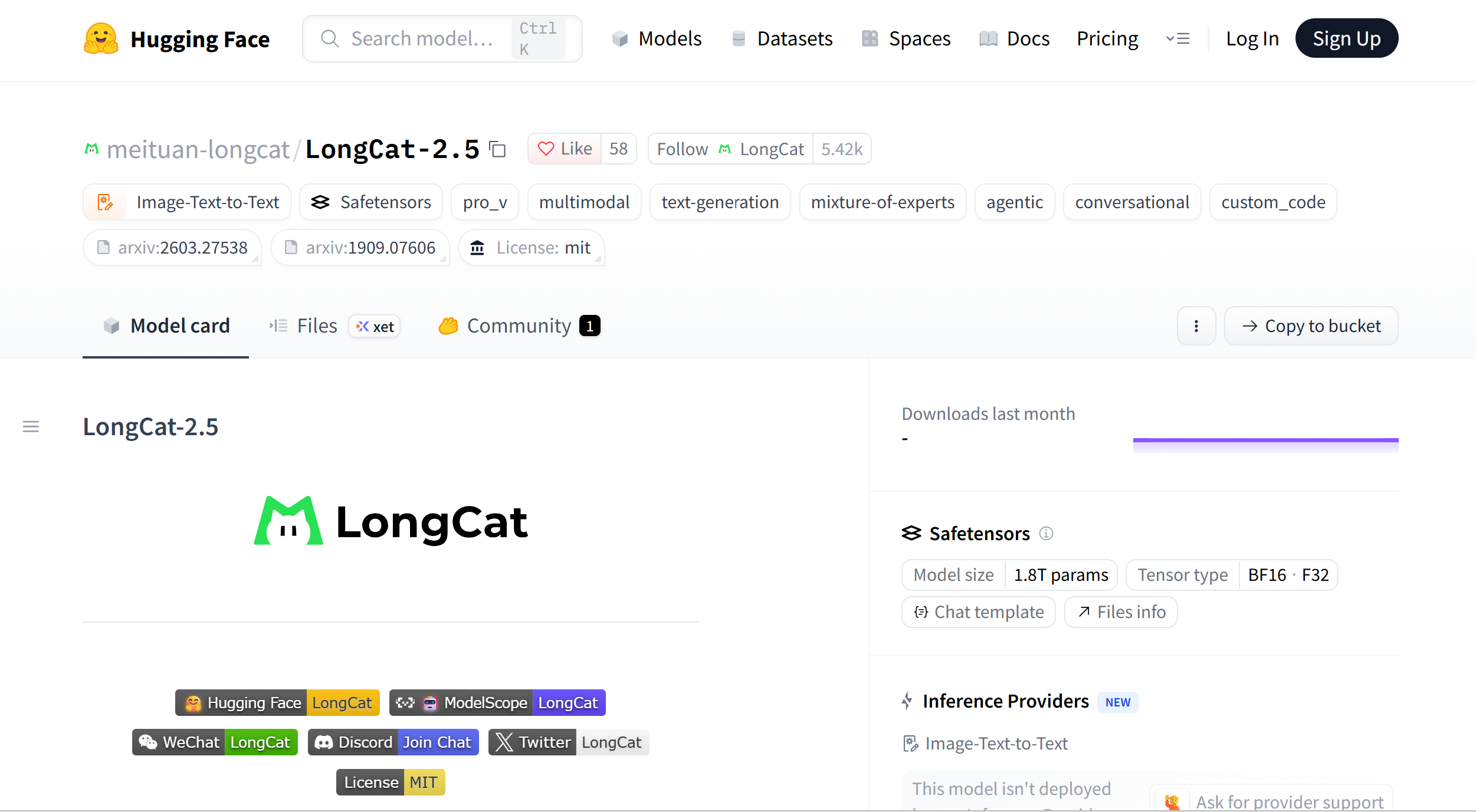
▲LongCat-2.5 open-source homepage (Image source: Hugging Face)
Previously, U.S. AI research institution Nous Research had also offered a one-week free trial through its model service platform Nous Portalone-week free trial. The official LongCat platform has also provided instructions for integrating tools such as Claude Code, Codex, OpenCode, and Hermes.
In terms of API pricing, LongCat-2.5 currently has a limited-time promotional price of 2 yuan per million tokensfor input, 8 yuan for output, and 0.04 yuan for cache-hit input, significantly lower thanthe four overseas models mentioned above that participated in the evaluation.
However, compared with domestic Chinese models,its price advantage is less pronounced. DeepSeek-V4.1-Flash scored higher than LongCat-2.5 in 14 of 26 comparable tests.14 tests. Its updated Flash-1017 version has the same peak pricing as LongCat-2.5, while costing half as much during off-peak periods.
Compared with DeepSeek V4-Pro-0813, which also hasa total of 1.6 trillion parameters, LongCat-2.5 has a lower unit price in all three categories.
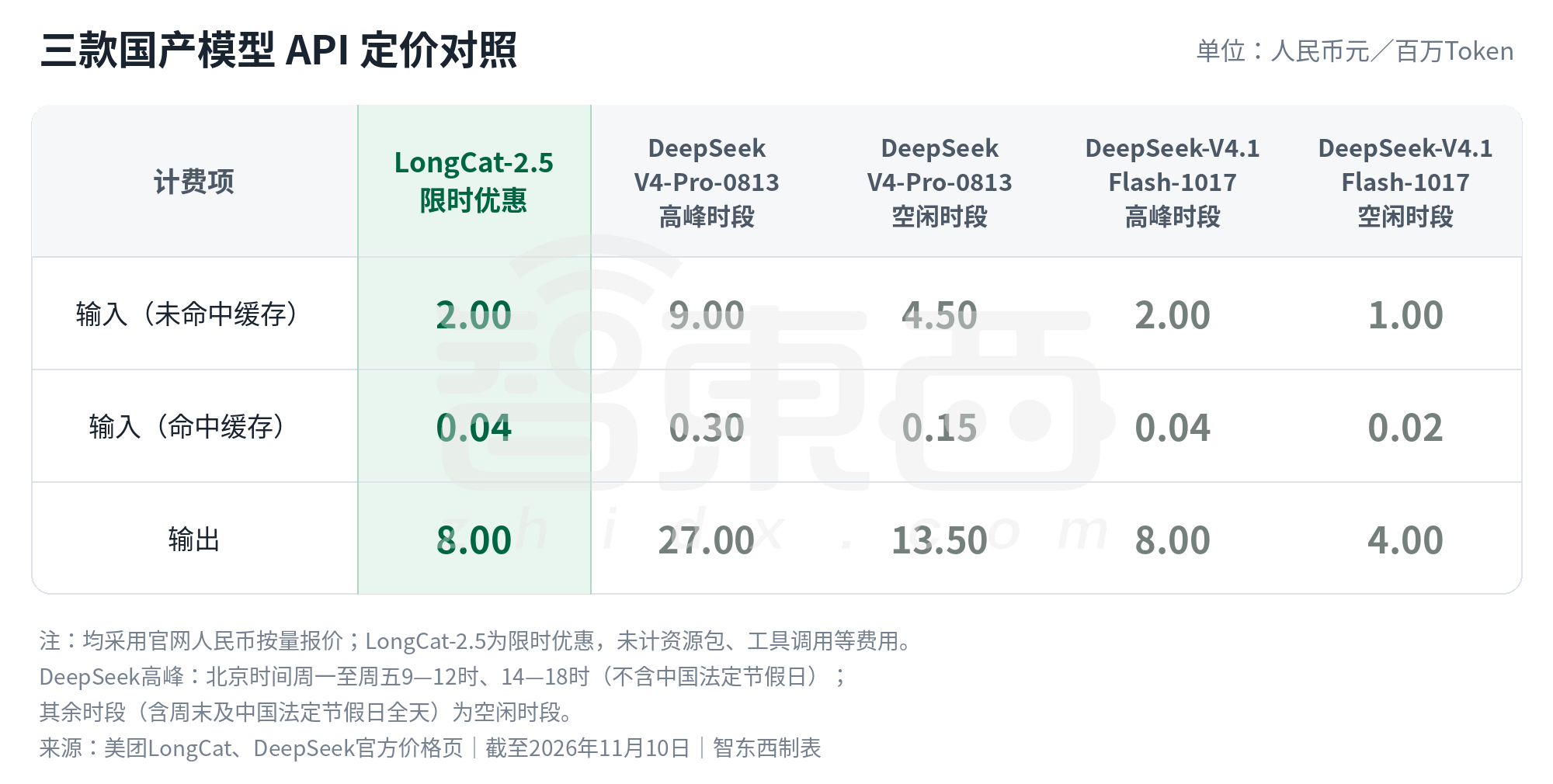
▲API price comparison between LongCat-2.5 and the two DeepSeek models (data source: each vendor’s official pricing page; table compiled by Zhidongxi)
Open-source repository:
https://huggingface.co/meituan-longcat/LongCat-2.5
Quantized version:
https://huggingface.co/meituan-longcat/LongCat-2.5-W4A4
I. Developers showcase hands-on projects, building interactive 3D scenes and business analysis websites
In the cases showcased by developers, LongCat-2.5 has already been able to generate relatively complete 3D scenes and implement interactive features such as viewpoint switching and character control. Some developers have also used it to build business analysis websites that integrate transaction details, refunds, operational losses, and other information into a single set of tools.
In visual programming, tech blogger cxuanAI created an aquarium with switchable viewpoints using LongCat-2.5. The scene initially presents the perspective of a visitor viewing the aquarium tanks inside the exhibition hall, with the visitor’s silhouette retained in front of the glass and whale sharks, manta rays, and schools of small fish swimming in the water.
As the viewpoint moves underwater, schools of fish gather and disperse among rocks and aquatic plants, while a whale shark swims past close to the camera. A control panel is also placed on the right side of the page, allowing the demonstrator to adjust the viewing angle and lighting effects.
▲Aquarium page created by cxuanAI (video source: WeChat public account)
Visually, the blue-green tones, light streaming in from above, and fish schools at varying distances combine to create a sense of depth underwater. After switching viewpoints, the rocks, aquatic plants, and marine life retain a consistent visual style, giving the overall scene good cohesion.
In game development, developer AI Oddball Frank showcased a multi-scene fighting game generated with LongCat-2.5. The game uses an angled overhead perspective, depicting a village on a rainy night, with gray-tiled houses, warm yellow window light, and red lanterns lining both sides of a stone-paved road. The character moves through the streets and alleyways, fighting groups of enemies and producing ring-shaped effects when attacking. As combat progresses, a “Martial Arts Insight” interface also pops up, allowing players to choose new martial arts skills.
▲Fighting game created by AI Oddball Frank (video source: WeChat public account)
AI Oddball Frank said that he was fairly satisfied with the game’s front-end design and dynamic interactive effects generated by the model.Among them, the ink-wash wuxia game's interactions are smooth and natural ; after adding multi-scene combat and wuxia skills, its gameplay has also become richer.
In professional office scenarios, developer LurenjiaTM presented an e-commerce business analysis website generated with LongCat-2.5. The website presents operating surplus and changes in revenue and expenses on an overview page, and includes pages for transaction details, refund analysis, loss analysis, and more.
▲E-commerce business analysis website created by LurenjiaTM (video source: Meituan)
In the footage, the demonstrator opens a pop-up window for modifying transaction-record categories and switches between pages to view the refund distribution and composition of operating losses. The website presents overview metrics, transaction details, and specialized analyses in a layered format, with charts and corresponding data on the same page, making it convenient for users to review operating results and specific revenue and expense items.
However, some users on X have also reported that the official version of LongCat-2.5 still exhibits circular reasoning. One developer argued that although the model can draw on existing knowledge and perform relatively comprehensive reasoning, it sometimes goes in circles repeatedly, generating redundant content and affecting execution efficiency.

▲A developer's feedback on LongCat-2.5's circular reasoning issue (image source: X)
2. Multiple technical capabilities upgraded, with fine-tuning throughput on domestic computing resources increasing by 86% and inference throughput increasing by approximately 43%
The technical design behind LongCat-2.5 involves visual representation, large-scale agent reinforcement learning, and multi-expert online teaching, among other things, which respectively support multimodal information processing, long-horizon task execution, and the integration of capabilities across different domains.
First is visual programming and 3D tasks. The model applies residual vector quantization to the native-resolution features of images, generating multilevel discrete tokens, which are then passed to the backbone model for processing together with text tokens. The embedding representations corresponding to the visual tokens are trained jointly with the backbone model, supporting the combination of visual understanding and code generation.
During training, a fixed visual tokenizer can generate and cache visual tokens in advance, allowing the backbone model to directly read the processed sequence, reducing online visual computation during training and simplifying the packing, splitting, and load balancing of long sequences.
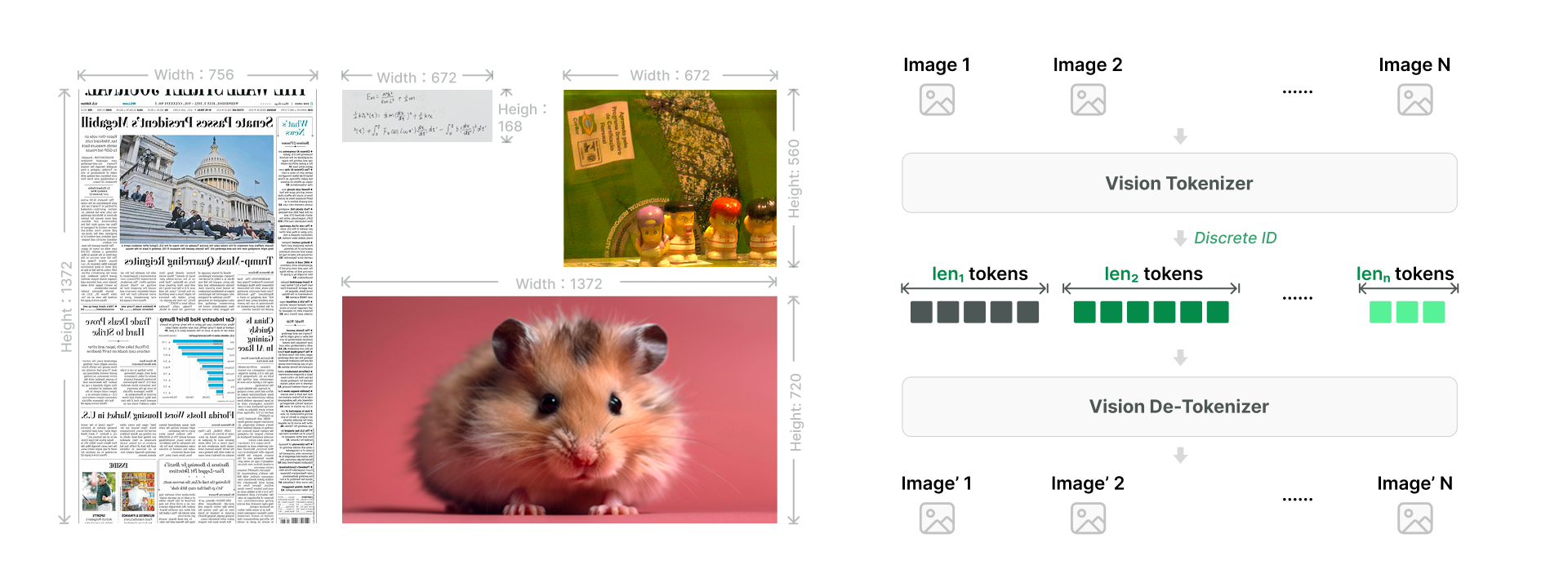
▲Images of different resolutions are encoded into discrete token sequences (image source: Meituan)
Next is code development and long-horizon agentic tasks. The team expanded the training pipeline in areas such as training data, reinforcement-learning scheduling, and behavioral constraints, turning the failure processes of real agents into reproducible, verifiable training tasks.
During the reinforcement-learning sampling stage, the system saves trajectories from unfinished long-horizon tasks and resumes their execution in subsequent sampling stages; for old trajectories generated across model checkpoints, it adjusts gradient contributions to reduce the bias caused by sample staleness. The task environment also disconnects from the network and clears the Git history and file cache, while training imposes constraints on behaviors such as repeated thinking and repeated tool calls.
In the Terminal Bench v4.0 terminal-operation test, LongCat-2.5 scored 38.5 points, compared with 3.0 points for the previous generation.

▲LongCat-2.5 expands long-horizon task training across multiple stages (image source: Meituan)
Third is professional office work and business analysis. The model retains the multi-expert online teaching mechanism: the student model generates answers for tasks in different domains, and training is then carried out based on differences in the output probability distributions of domain experts and the student model, incorporating agentic, reasoning, and interaction capabilities into the main model.
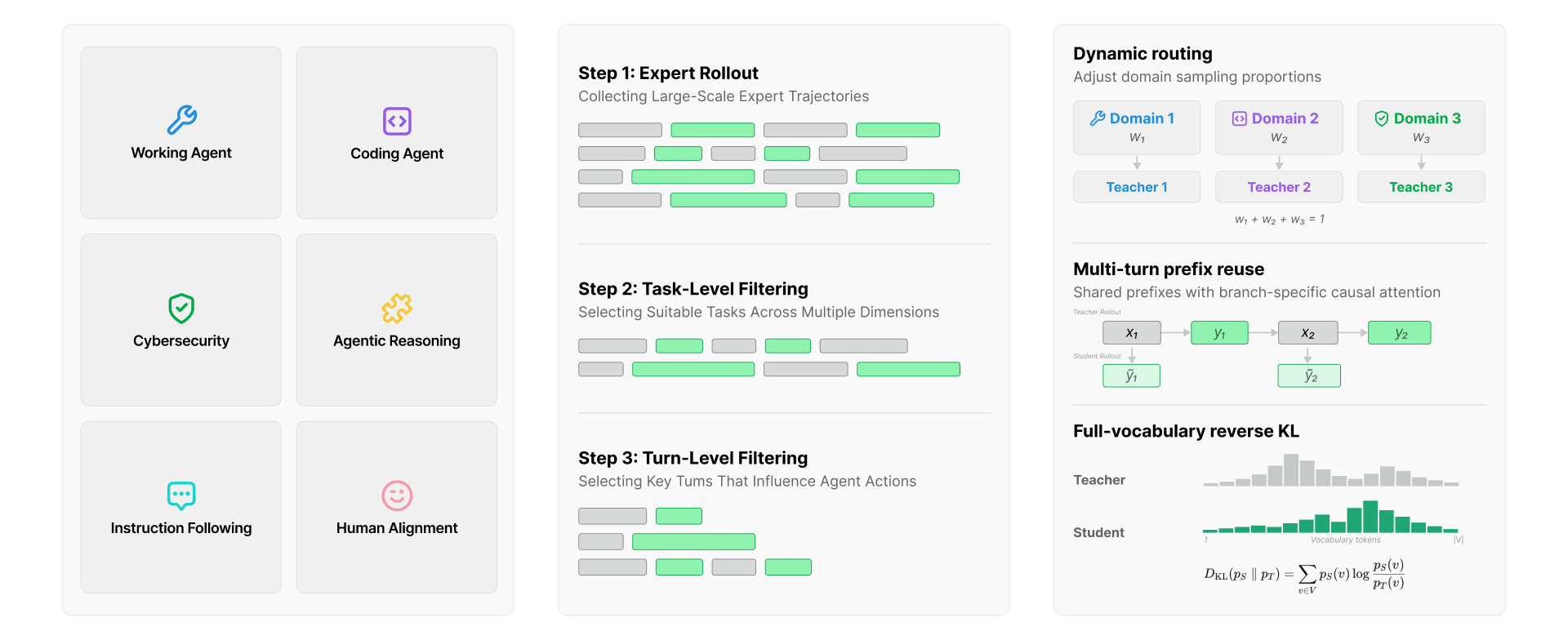
▲Multi-expert online teaching process (image source: Meituan)
To control distribution shifts in long-response training, the team split teacher responses into fixed-length segments and limited the student sampling length. By sharing input-processing computation and caches and introducing Tree Attention, it reduced redundant computation and storage overhead for samples within the same group.
Designs such as multi-expert online teaching and long-horizon reinforcement learning collectively support material-processing, analysis, and delivery tasks. In the professional-task benchmark JobBench, LongCat-2.5scored 65.4, an increase of 21 points over the previous generation’s score of 44.4.
In addition, LongCat-2.5 also optimized training and inference efficiency on domestic computing hardware. To address the limitation of less than 80 GB of memory per card on the domestically developed AI accelerators used, the team distributed memory pressure through multi-card sharding, arranged communications such as parameter aggregation and inter-expert token exchange over the high-bandwidth interconnect within a supernode, and overlapped communication with computation. On long-sequence supervised fine-tuning tasks, the optimized FSDP configuration delivered an 86% increase in single-card throughput compared with the DDP baseline.
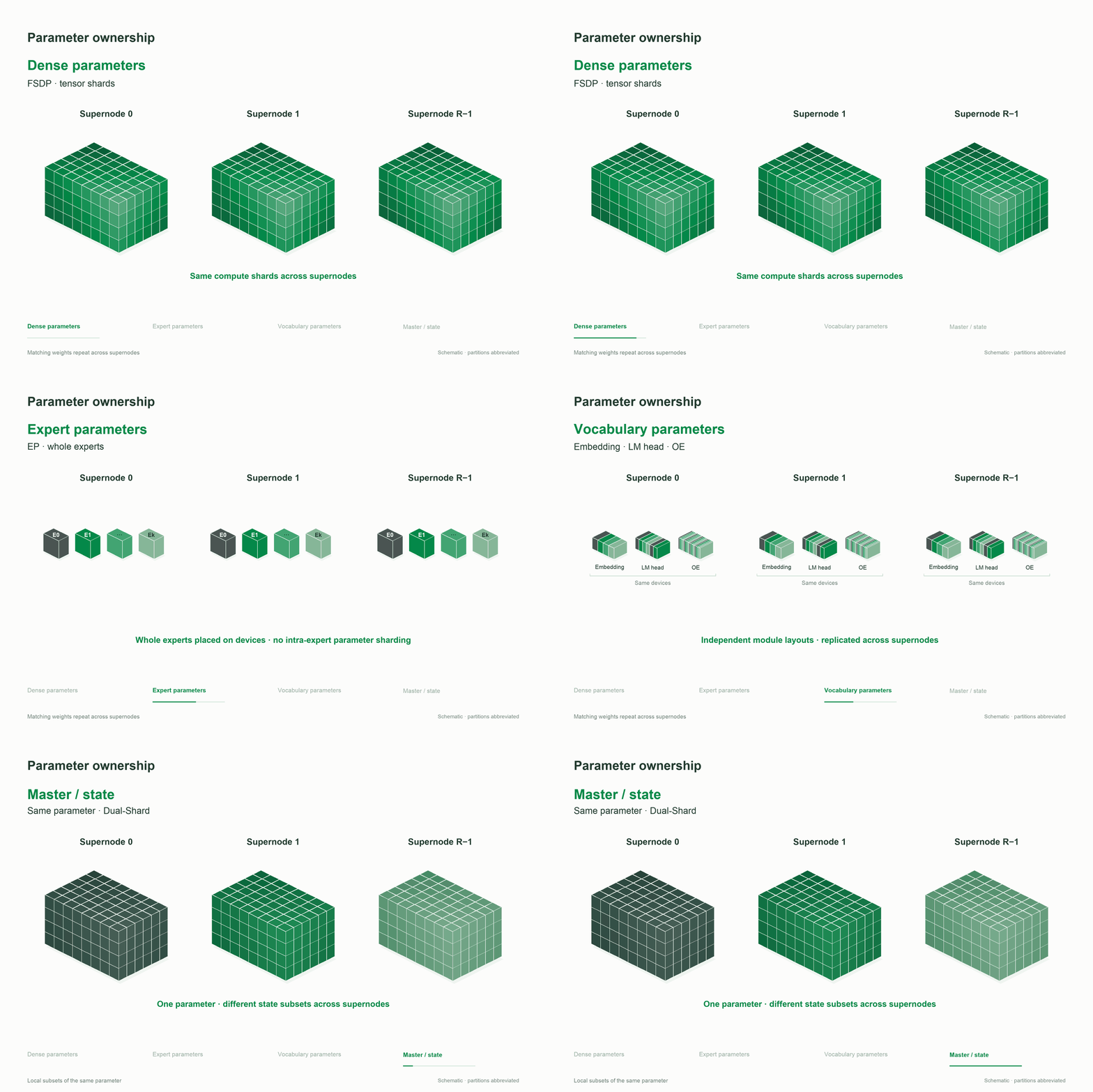
▲Parameter and state sharding layout during LongCat-2.5 long-context training (Image source: Meituan)
In terms of inference, the newly released W4A4 version quantizes both expert weights and activations to 4 bits. Compared with the W8A8 INT8 baseline, prefill and decode throughput in online stress tests increased by 43.3% and 42.77%, respectively, providing efficient support for deploying trillion-parameter models.
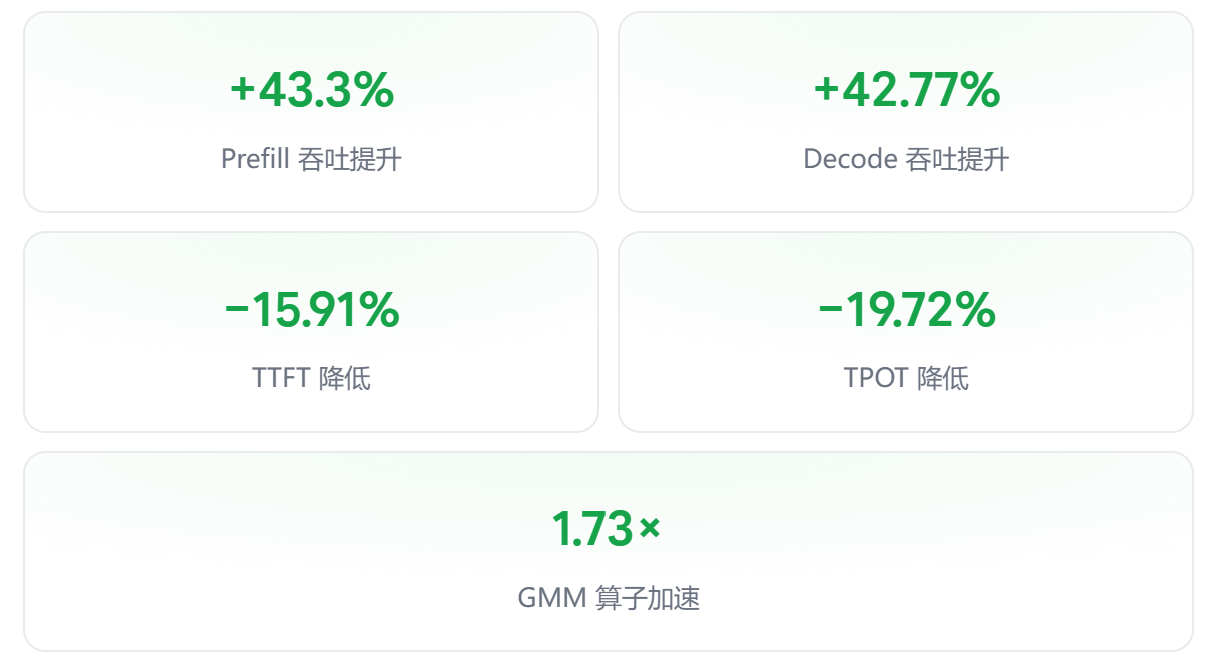 ▲Change in inference throughput of the W4A4 solution relative to the W8A8 INT8 baseline (Image source: Meituan)
Conclusion: Major technology companies increase investment in coding and office productivity, while pricing and deployment influence developers’ choices
LongCat-2.5 builds further on LongCat-2.0, with a focus on visual programming, long-horizon task execution, and professional office work. This release of model weights and a quantized version provides development teams that wish to deploy the model themselves or continue training it with a new option.
Coding and office productivity are also areas in which other major technology companies have continued to invest this year. On August 12, Alibaba released the weights for its flagship Qwen3.8 model, with a focus on improving code development, professional work, and long-horizon agentic task capabilities. On November 4, Tencent released Hy4, introducing visual understanding and computer-operation capabilities for the first time and launching them in products such as WorkBuddy and CodeBuddy.
As the tasks addressed by different models increasingly overlap, pricing, deployment requirements, and ecosystem compatibility have a more direct impact on developers’ model selection. Meituan’s provision of lower-priced API services and announcement of open weights also provide development teams working on websites, office tools, and business agents with a new cost-effective option.
Source: Meituan, X
No source text provided.