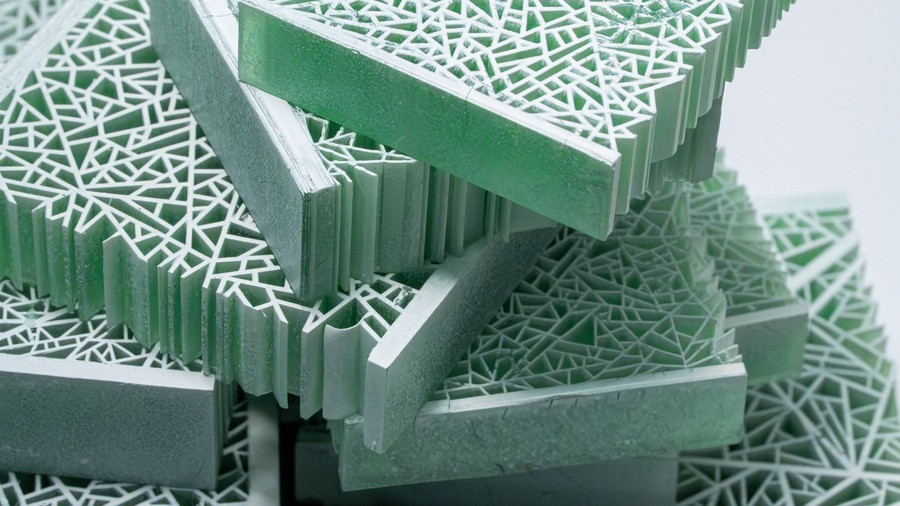
Research teams from the Massachusetts Institute of Technology (MIT) and Northeastern University have developed a new metamaterial incorporating network structures found in nature, such as leaf veins and dragonfly wings. Compared to traditional metamaterials with regular internal structures, these materials exhibit superior impact absorption performance and are expected to be applied to helmets, armor, packaging materials, and other uses.
Scale-rich network-based metamaterials | Nature
https://www.nature.com/articles/s41586-026-11191-2
Inspired by networks found in nature, engineers design stronger, more resilient "metamaterials" | MIT News | Massachusetts Institute of Technology
https://news.mit.edu/2026/engineers-design-stronger-resilient-nature-inspired-metamaterials-1111
Metamaterials are materials that achieve properties not typically found in conventional materials through artificially designed internal structures. General metamaterials are created by repeatedly arranging a basic structure called "unit cells," with square lattice structures and hexagonal honeycomb structures being representative examples.
Regular internal structures help increase material strength, but they have a problem where if one part is damaged, the surrounding same structures can deform chain reaction-like, causing the entire material to collapse rapidly. To address this, the research team focused on a "disordered structure with various sizes of cells," different from traditional metamaterials.
In nature, there are structures where elements with different lengths and thicknesses are complexly connected, such as plant leaf veins, dragonfly wings, and spider webs. For example, the length of the veins in a dragonfly's wings ranges widely from 0.1 mm to about 50 mm. To incorporate this structural heterogeneity into artificial materials, the research team developed a new design method called "Scale-Rich (SR) Metamaterials."
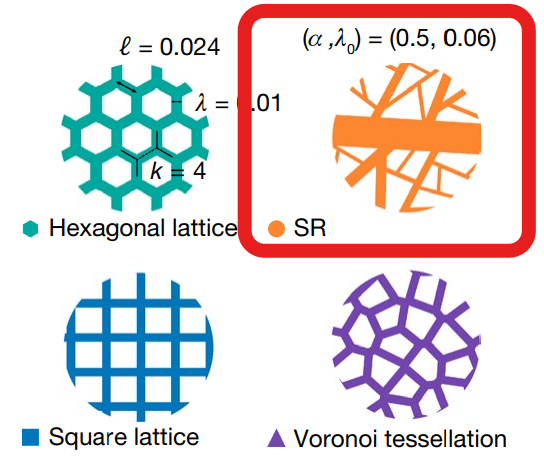
To design this SR metamaterial, the research team developed an algorithm. In this design algorithm, random points are set within a domain representing the material's outer shape, and lines are drawn through these points at random angles. Subsequently, lines drawn from another point stop either at an existing line or at the boundary of the domain. By repeating this process and gradually reducing the thickness of the lines, a network of countless beams with varying lengths and thicknesses is formed.
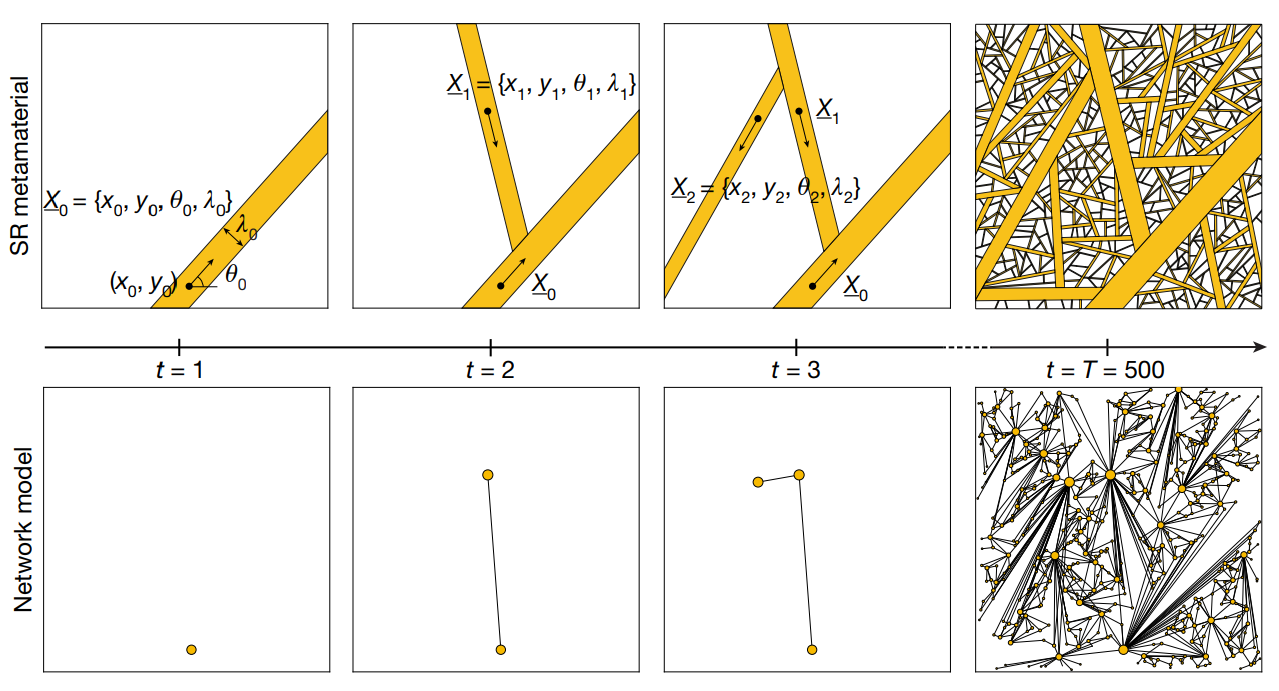
The algorithm can generate a wide variety of internal structures simply by adjusting two parameters: the initial thickness of the lines and the rate at which the thickness decreases for subsequent lines. Simulation results revealed that the anisotropy—where the material's resistance to deformation varies depending on the direction of applied force, in addition to its density and stiffness—can also be broadly adjusted.
The research team manufactured resin-based SR metamaterials using 3D printers based on the internal structures generated by the algorithm.
With metamaterials featuring lattice structures, honeycomb structures, and Voronoi structures composed of irregular polygons, we conducted compression tests and impact tests by dropping weights.
In the compression tests, materials with lattice or honeycomb structures showed deformation concentrated at specific points, with the internal structure collapsing into bands. In contrast, the SR metamaterial, which incorporates beams of varying lengths and thicknesses, prevented surrounding beams from deforming sequentially even when some beams deformed, dispersing damage throughout the material.
In the impact tests, the SR metamaterial also demonstrated excellent performance, absorbing the highest amount of energy per unit mass among the three types of comparison metamaterials, and generating the smallest maximum force during impact.
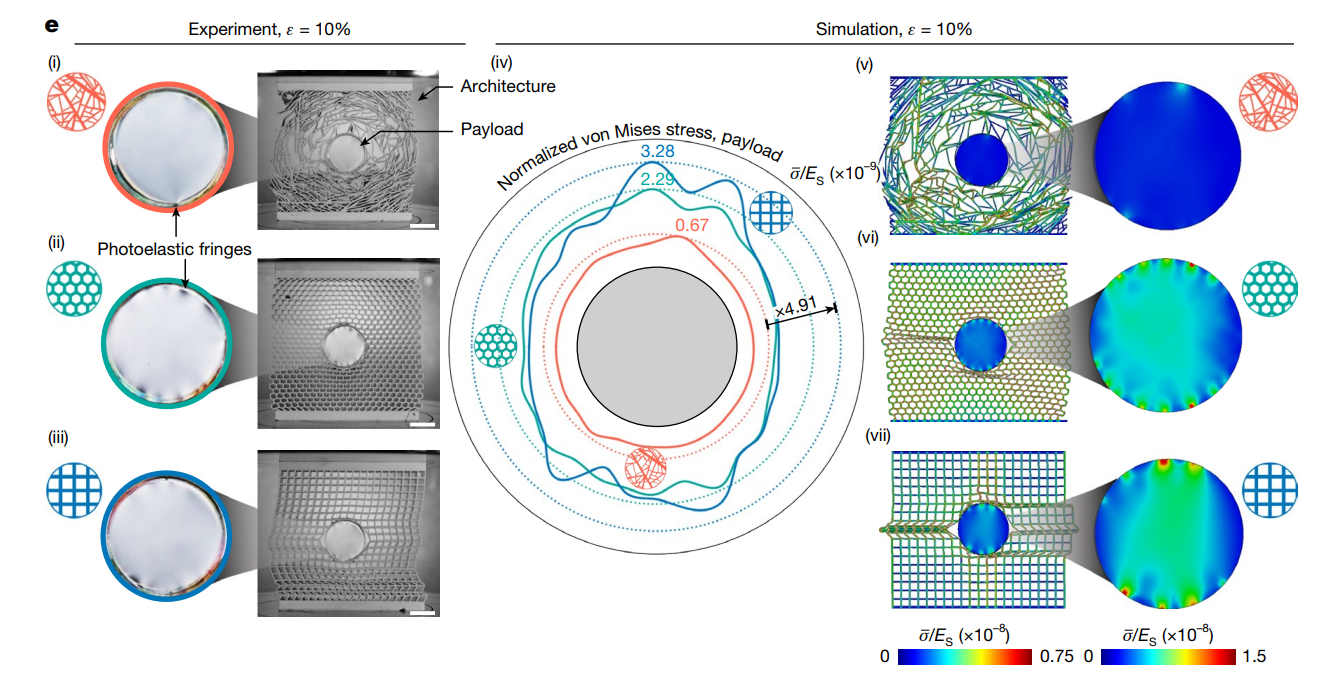
The research team further developed the SR metamaterial by drawing inspiration from the thick peel of citrus fruits that protects the pulp, designing it with higher beam density on the outer side. They performed compression tests by embedding fragile acrylic resin inside and demonstrated through simulations that the stress applied to the acrylic resin could be reduced to about one-fifth compared to conventional structures.
The applications of SR metamaterials are not limited to impact absorption; by adjusting the internal structure, the direction and speed of vibrations transmitted through the material can also be controlled. The research team has also demonstrated applications in acoustic lenses that focus vibrations at specific locations, and it is expected to lead to the development of materials that combine multiple functions such as load support, impact absorption, and vibration control.


