The AI market is expanding rapidly, and it is projected to reach $4.2 trillion (approximately ¥660 trillion) by 2030, but at the same time, there is a skeptical view that “the AI boom is nothing more than a bubble.” Against this backdrop, engineer Matteo Raso argues that “AI is not a bubble; AI companies still have room to grow.”
Matteo's Website – I'm Not Convinced The AI Bubble Exists
https://matteoraso.github.io/im-not-convinced-the-ai-bubble-exists
An “AI bubble” refers to a state in which investment is overheating beyond what actual revenue and demand would justify due to extreme overvaluation in the AI industry, and it is said that when the bubble eventually bursts, it could have serious negative effects on the industry. When expectations and investment in AI exceed what would normally be attracted, the boom will continue for as long as people remain overly confident in AI and the AI industry; however, once trust declines, its value will plummet.
How catastrophic would the damage be if the AI bubble collapsed? - GIGAZINE

By contrast, Raso stated, “Looking at online discussions about the financial health of the AI industry, it appears that the existence of an AI bubble and its imminent collapse are being taken almost as a matter of course. However, I do not think this is a reasonable assumption. No one can predict the future, but I believe the rapid growth of AI companies over the past few years is likely to be justified, and I think there is still room for further growth.”
The idea underpinning Raso's argument is that the unprecedented scale of investment by AI companies is directed toward “building data centers to run AI,” and that AI companies' spending will decline substantially once construction of the necessary data centers is complete.
According to the filing accompanying Anthropic's IPO, Anthropic earns a profit of $2.08 (approximately ¥330) for every $1 (approximately ¥160) spent on computing, and if infrastructure construction costs are ignored, AI is said to be highly profitable. Raso argues that this runs counter to the idea that the cost of building data centers is unsustainable.
Anthropic's revenue has also increased dramatically, from $41 million (approximately ¥6.48 billion) in 2023 to $386 million (approximately ¥61 billion) in 2024 and $4.585 billion (approximately ¥724 billion) in 2025, reaching $16.3 billion (approximately ¥2.58 trillion) in the first half of 2026 alone. Other AI developers, such as OpenAI, are thought to be in a similar situation, and AI-generated profits are likely to continue increasing.

One of the points often raised among those concerned about an AI bubble is that “the gap between the open-source community and leading AI developers is narrowing, and eventually the value of the cutting-edge AI models provided by companies will decline and become commoditized.” If the AI developers making enormous investments at the time of writing can no longer maintain their competitive advantage, they will be unable to recoup their investments, and the bubble will burst.
In contrast, Raso pointed out that fast-food restaurants, such as hamburger and sandwich shops, likewise do not, in practice, have a lasting competitive advantage over other restaurants. Nevertheless, various fast-food restaurants continued to generate profits.
It is true that AI users may switch to cheaper competitors or switch to open-source models. However, Raso argues that, in reality, ordinary users are very unlikely to build open-source models locally or switch AI models particularly frequently, so commoditization will not become such a major issue.
In addition, Raso pointed out that although it is generally clear that the valuations of the companies involved are obviously overvalued, the valuations of leading AI developers such as Anthropic and OpenAI remain within a healthy range. Many AI developers have not conducted initial public offerings (IPOs), and are also unlikely to collapse if fundraising stalls.
Raso said he cannot go so far as to claim that there is absolutely no AI bubble, and that serious risks to the financial sustainability of the AI industry nevertheless remain. He also noted that actual demand for AI could decline because of public backlash against data centers, regulatory hurdles, and hackers' misuse of AI.
Raso further explained that because he felt discussions about an AI bubble on the internet had become trapped in a kind of echo chamber, he decided to write this blog post expressing skepticism about an AI bubble.
Raso stated, "Even if AI is a bubble, just as the internet was a bubble, the underlying technology will continue to be useful. We will be living in the AI era from now on. Whatever happens as a result, I hope it will, at least, lead to a good outcome for the economy."
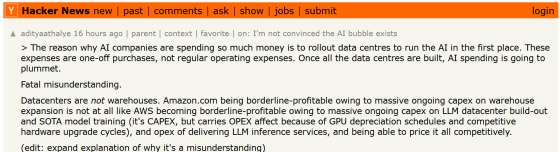
Raso's arguments are also being discussed on the social news site Hacker News. One user pointed out that data centers are not like warehouses that can be built and then used unchanged for a period; they require ongoing, large-scale capital expenditures and operating costs.