Zhidx (WeChat Official Account: zhidxcom)
Author | Bi Weihao
Editor | Mo Ying
To use an open-source project, someonespecifically bought an Android phone.
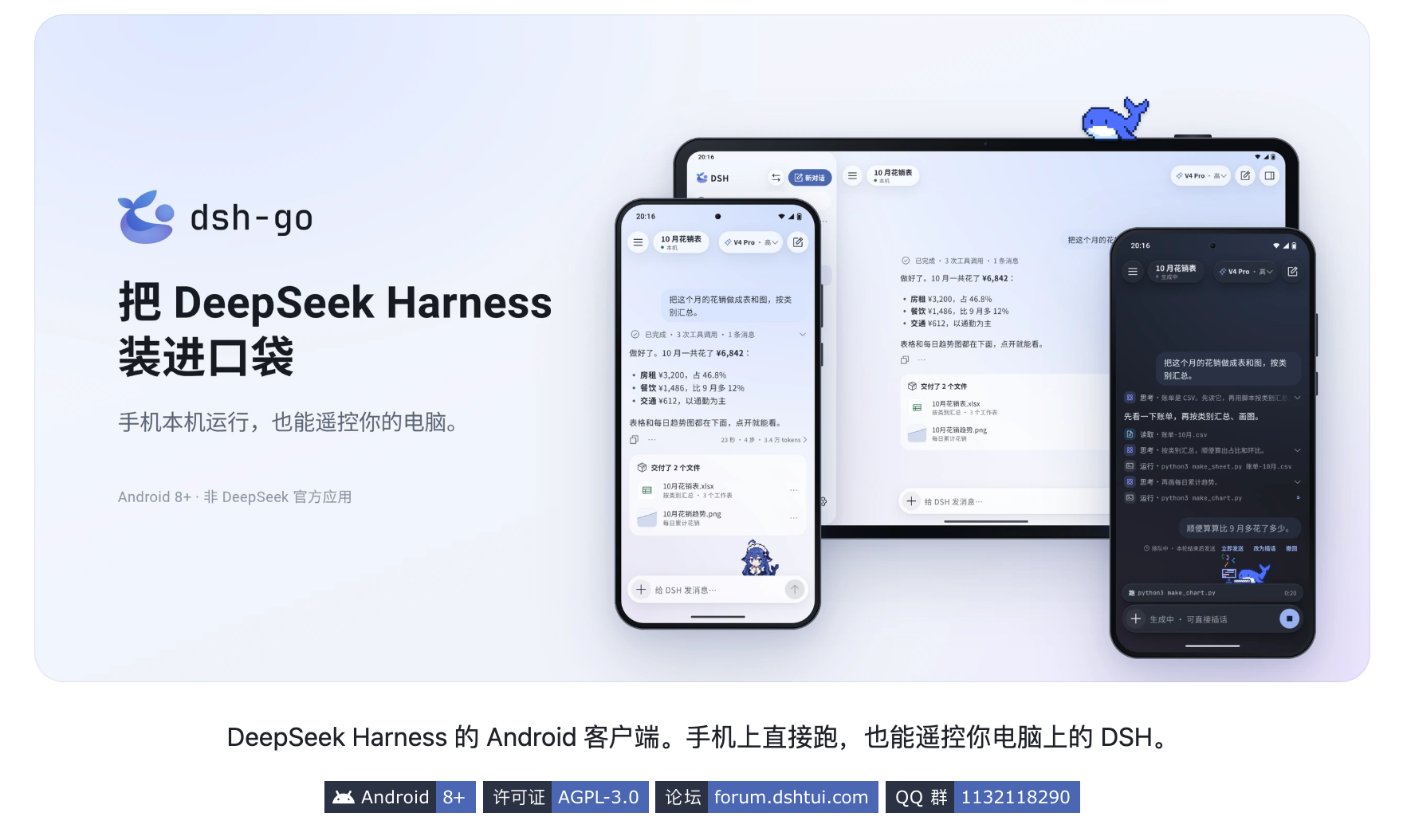
This app is called dsh-Go, a mobile app that canrun DeepSeek Harness on Android phones(abbreviated as DSH).
According to Xiao C, the author of dsh-Go, after the project was released, many users urged him to port it to iOS and HarmonyOS. Some even actually bought a used Android phone specifically to try the product.
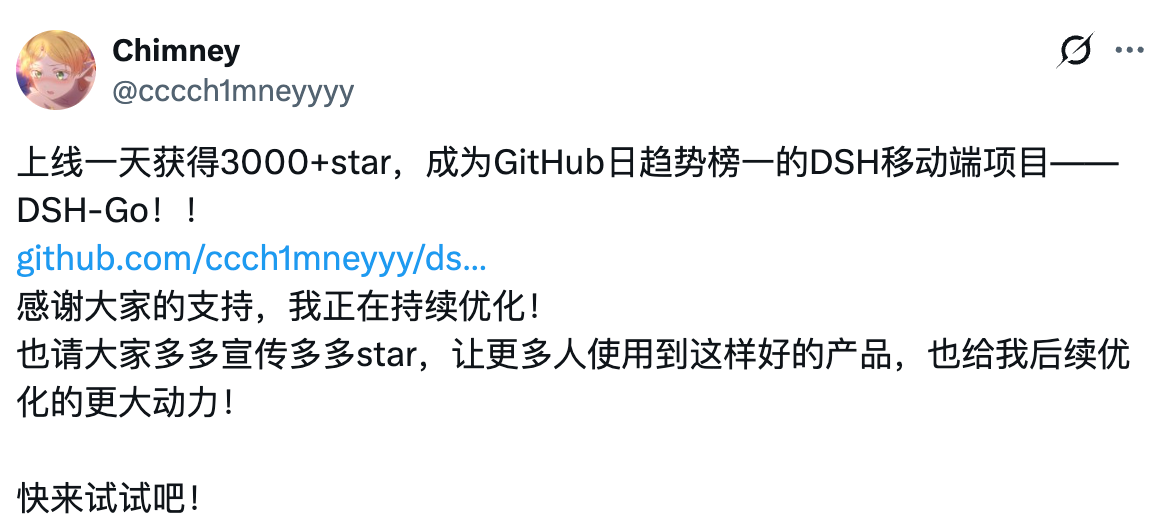
What happened next exceeded expectations. Just three hours after the app launched on October 30,its GitHub star count surpassed 1K, and as of now the star count hasreached 18K.
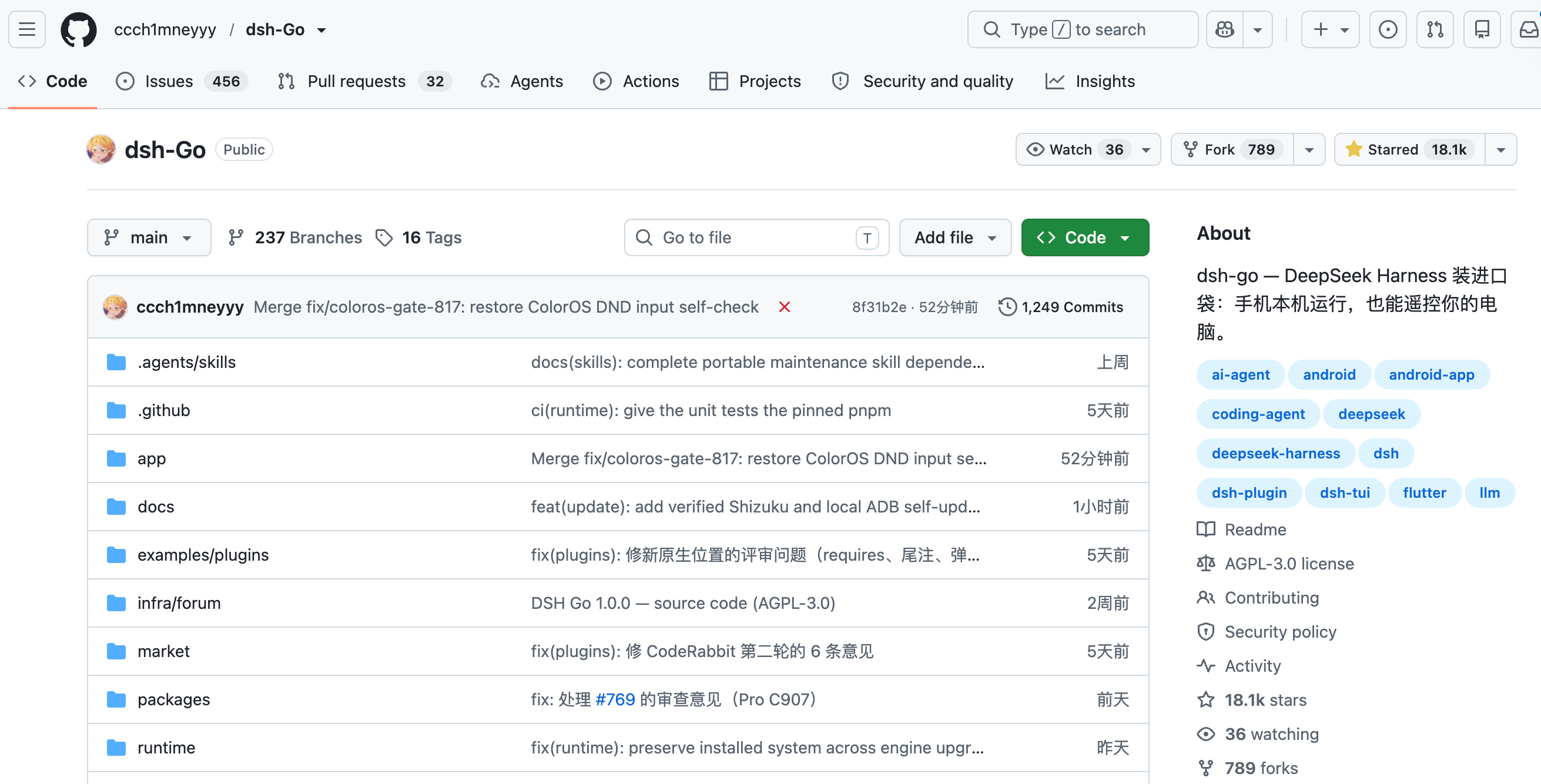
During the week around the public beta, Xiao C averaged only four hours of sleep a day, busy with testing and fixing bugs. The project's popularity evenoverloaded the server a friend had provided for free to the point of crashing it.
And this was only thesecond open-source project Xiao C had developed.
Before this breakout hit emerged, Xiao C had developed an interactive terminal interface called dsh-TUI during DSH's closed beta,earning more than 7.3K stars on GitHub and receiving a recommendation fromCui Tianyi, the head of the DeepSeek Harness team. The two projects have amassed more than 25K stars in total.
Xiao C's GitHub account contains only these two projects. In other words, his only two releases have both been hits.
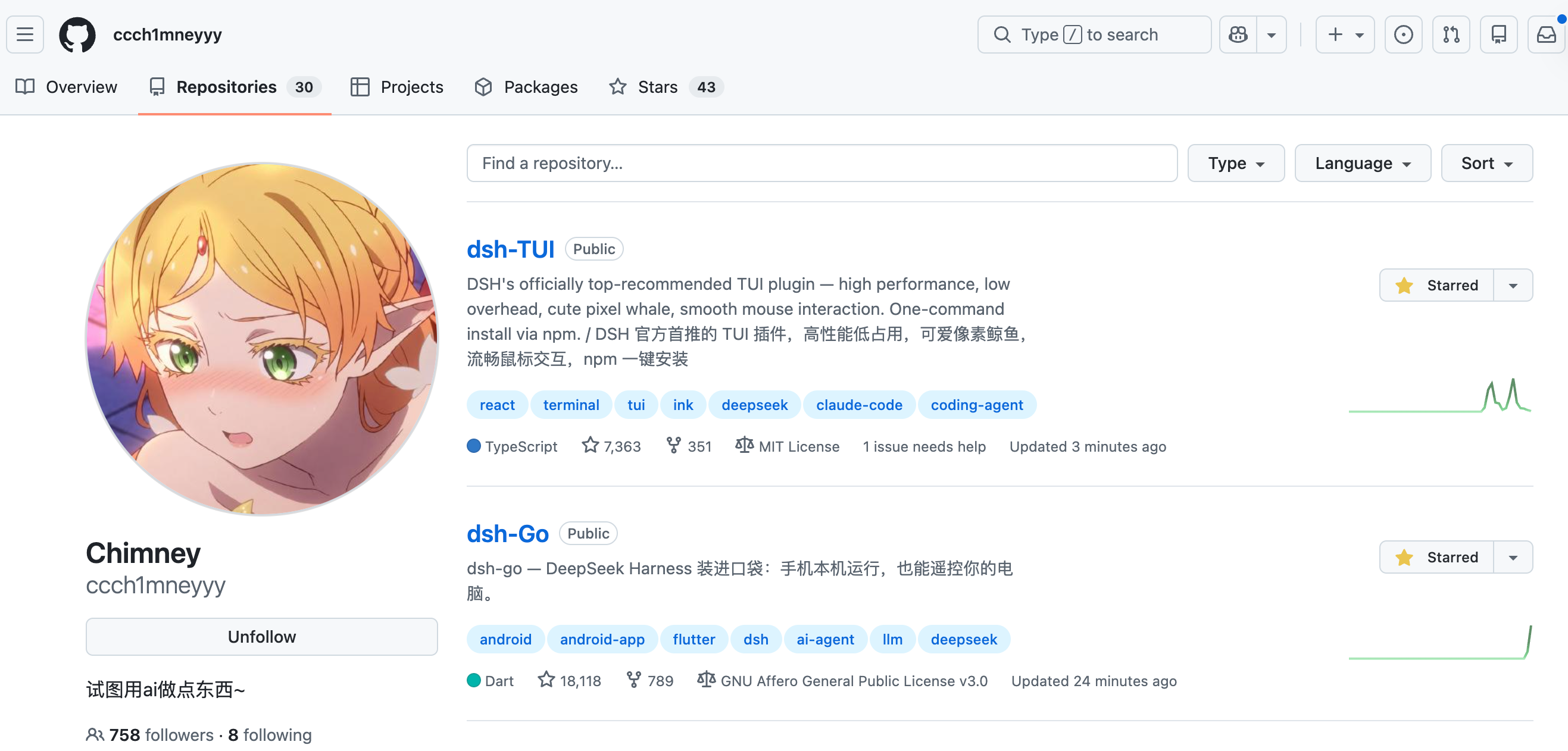
Xiao C's GitHub profile:
https://github.com/ccch1mneyyy
Out of curiosity, we had an in-depth conversation with Xiao C. To our surprise, Xiao C is only 22 years oldand is a fourth-year student
. He is an undergraduate majoring in International Economics and Trade at Jilin University and has already secured a postgraduate recommendation to Beijing Normal University's International Business program. Xiao Cwas not formally trained in computer science
. He frankly admitted that his programming foundations were still weak compared with those of traditional programmers, and that he still had a long way to go in hands-on coding and engineering practice.“Without AI, I don't think dsh-Go could even run,” he said.
Xiao C first came across AI when ChatGPT had just emerged. Later, because his major involved quantitative finance, he began trying to use AI to write quantitative algorithms and programs, gradually shifting from ChatGPT to agents.
In August,Xiao C was invited to join the DSH closed beta. At first, he only wanted to build a plug-in to test DSH's capabilities. Later, after finding that the early terminal interface was not mature enough, he set out to develop dsh-TUI.
After the project gained recognition, he realized that TUI users were still mainly geeks and developers.To make DSH usable by more ordinary people with no programming knowledge, he turned his attention to mobile phones and created dsh-Go.
In moving from the terminal to mobile phones, Xiao Ctwice in succession identified unmet needs among DSH users.
The breakout success of the two projects also gave us a glimpse of another side of the DSH open-source ecosystem. As an early beta tester, Xiao C personally witnessed DSH evolve from a product whose features were not yet complete, gradually giving rise to various community projects such as terminal interfaces, mobile clients, remote connections, Bots, desktop pets, and so on.
He described the process as “watching a relative’s child grow up”. In Xiao C’s view, DeepSeek’s own influence drew developers, but what truly made everyone stay was DSH’s “everything is a plugin” philosophy, as well as the freedom developers had to customize the product according to their own needs.
As for the relationship between the official side and the community, Xiao C sees it asone between a trunk and its branches and leaves: the official side is responsible for core capabilities and basic interfaces, building the “trunk,” while community developers develop plugins around different needs, allowing the ecosystem to grow more “branches and leaves.”
With regard to the changes AI Coding has brought to individual developers, Xiao C believes that AI has greatly lowered the barrier to software development, giving individual developers an opportunity to complete work that previously required collaboration among several people. But as the supply of software grows,homogeneous projects will also become increasingly common.
He believes that the most important ability for individual developers in the future is to “identify needs,” followed by “taste”; only by combining the two can they create products that truly earn users’ recognition.
Although he created two breakout hits in succession, Xiao C was not blindly optimistic about his own technical abilities or future plans. He frankly admitted that he still had a lot to learn, and that he might move in the direction of AI products in the future. For now, however, he still intends to finish his graduate studies first and continually build up his skills and experience.
Below is a transcript of the highlights of our conversation with Xiao C. To improve readability, Zhidong has edited and organized the transcript without changing its original meaning:
I. DSH is like a relative’s child; its product form has an irresistible appeal to developers
Zhidong: Hello, nice to meet you. Please give everyone a brief self-introduction.
Xiao C: My GitHub account is ccch1mneyyy; everyone can just call me Xiao C. I’m a senior this year, doing my undergraduate studies at Jilin University and majoring in International Trade within the economics category. I’ve just been recommended for postgraduate study in International Business at Beijing Normal University—basically, it’s all economics-related.
Zhidong: When did you first come across DSH, and how did you get involved?
Xiao C: I came across DSH quite early, because I was fortunate enough to be invited to take part in the beta test, probably around August. DeepSeek itself is a pretty strong presence among domestic foundation models and is something many people believe in, so I really liked DeepSeek. When I heard about the beta test, I was happy to join right away. I then decided to get involved and develop some plugins.
Zhidong: Do you remember what DSH was like when you first came across it? What made you feel it was worth continuing to tinker with?
Little C: I was very excited when I got access to the private repository for the closed beta, but DSH was still fairly rudimentary back then, with many simple features missing. As the official team released updates and improved it step by step, it was also a rather remarkable experience, kind of like watching a relative’s child grow up.
Zhidong: From when you joined the closed beta until now, what obvious changes have taken place in DSH and the community?
Little C: There are two most obvious changes.
First, DSH itself went from being a bit like an unfinished shell in its early days to gradually growing into a Harness that is genuinely usable and easy to use in practice.
Second, community plugins have changed. What people created shifted from some small plugins, gradually moving toward more mature products. In the past, people may have focused more on skins, but now there are projects such as terminals, mobile clients, remote connections, bots, and desktop pets.
The user base has also been changing. Early users leaned more toward developers. Although DSH is still in closed beta for developers, more ordinary people, such as many people who do not understand AI or programming, have started using DSH.
The recently popular “Big Fat Fish Invasion” incident on Bilibili is also a sign of DSH entering ordinary people’s lives and reflects the expansion of DSH’s user base. However, I think this development has both advantages and disadvantages; personally, I have not tried it out.
Zhidong: In your observation, do people participate in the DSH ecosystem mainly because of DeepSeek’s influence itself, or because the product genuinely meets developers’ needs?
Little C: I think both aspects are at play. First, DeepSeek’s influence is sufficiently strong, so when DSH was first launched, it attracted a great deal of attention and people were willing to learn about it.
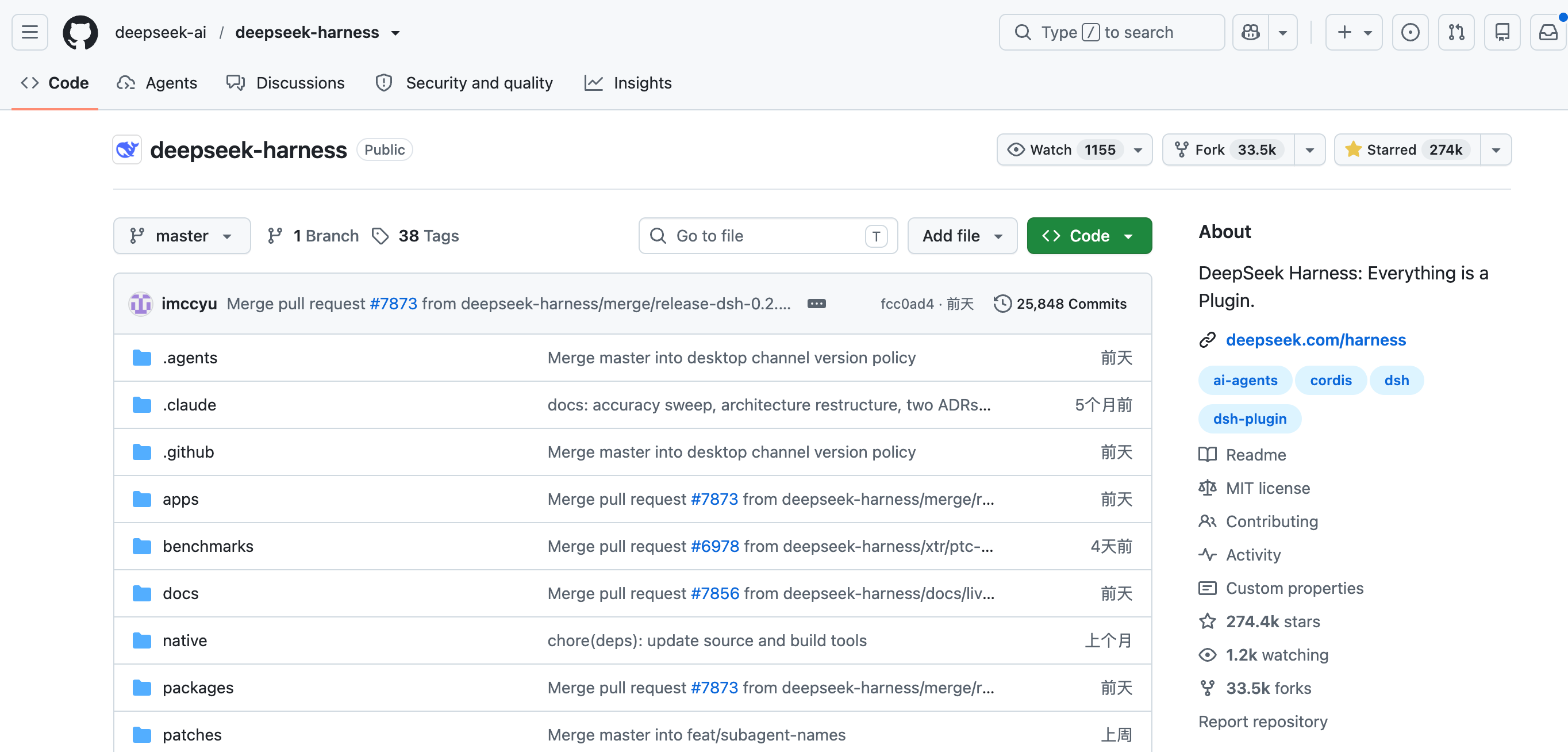
However, whether developers ultimately stay and are willing to continue building the ecosystem still depends on the form of the product. I think DSH’s philosophy of “everything is a plugin,” along with its core and extensibility, is highly appealing to developers. Whenever something is not easy to use, you can modify it yourself, and once you have modified it, you can open-source and share it. For developers, this is a highly appealing proposition.
Zhidong: As a product launched by a Chinese company, does the attention it receives also reflect a sense of identity?
Little C: I think there is some connection. DeepSeek is very popular in China; in addition to being open source, it may also benefit from some nationalist sentiment. But I won’t dwell on that; I am certain that there is such a factor.
Zhidong: From your perspective, what are DSH’s biggest differences and advantages compared with closed-source products such as Claude Code and open-source projects such as OpenClaw and Pi?
Little C: Compared with closed-source products, DSH’s greatest advantage is that it opens up the overall architecture and ecosystem of the Harness, leaving room for community developers to build their own Harness.
Compared with other open-source projects, I think DSH’s advantage is that it has its own model.It is the combination of the DeepSeek model and the Harness that gives it its greatest competitive strength; it is also its trump card..
First, the model’s influence attracted the attention of more developers. After the open-source release brought in this group of developers, what ultimately matters is still the Harness’s own architecture, openness, and extensibility.
Combining the two is necessary to build such an open ecosystem. I think this ecosystem may be an advantage that other vendors would find difficult to replicate, and it is also what makes DSH appealing.
II. The official team and community form the trunk and branches; Cui Tianyi recommends that developers work on vertical-domain projects
Zhidong: What relationship will there be between the open-source Agent ecosystem and closed-source commercial products in the future? Will ordinary users and developers prefer different types of products, respectively?
Xiao C: From a broad perspective, open-source and closed-source Harnesses will coexist for the long term; one will not replace the other.
For ordinary users, mature, ready-to-use closed-source products may be more appealing, which is an advantage of closed-source products. But there is also a group of developers, like me, who care more about what they can control, whether they can customize tools according to their needs, and build a toolkit that works well for them. An open-source Harness such as DSH can meet these needs. So I think each has its own users, and they will not replace each other.
Zhidong: What value do you think open-source projects have for ordinary users without a development background?
Xiao C: I think the value of open-source projects lies in the fact that others can modify them to suit their own needs.
For example, with dsh-Go, many mobile users may not know how to develop, but they want a mobile assistant or mobile Agent.Developers like us have identified this need, or happen to have a similar need ourselves, and can then build the product to serve this group of users. Closed-source projects find it difficult to do this.
Zhidong: What has the relationship been between the DSH official team and community developers since the beta began? Does the official team proactively seek everyone’s needs and suggestions?
Xiao C: I think the official team and community are more like the official team building the foundation and the community extending it outward, rather like the trunk and branches of a tree.
The official team is still quite willing to listen to community suggestions. However, they have their own roadmap and ideas, and the overall direction will not easily change just because of some voices from the community. But when it comes to minor details and design, they are more willing to listen and make improvements.
Zhidong: Do you usually communicate with Cui Tianyi, the person in charge of the DSH team, and other DeepSeek members? Do they participate in discussions or adjust the product direction based on feedback?
Xiao C: Yes. One of my previous projects was recommended by Teacher Cui, so we have also had some exchanges. Most of the communication still takes place in the beta group, where the official team solicits everyone’s opinions, and some good suggestions are adopted.
Zhidong: Are there any stories about the beta-testing atmosphere that people outside the community do not know about?
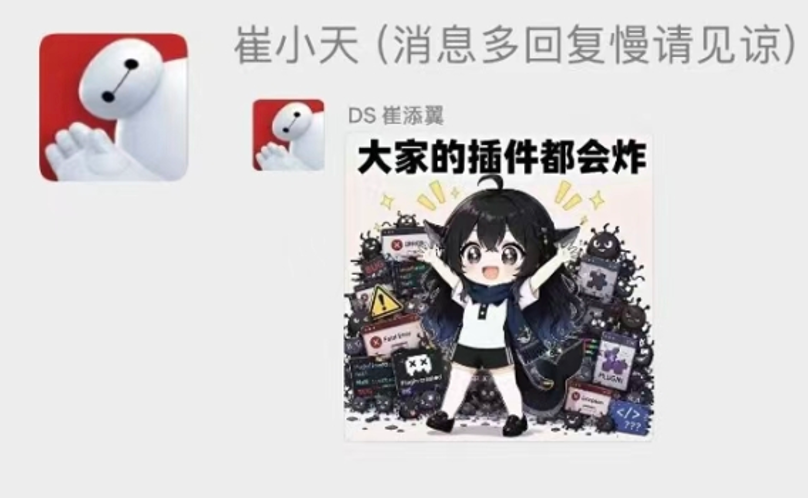
Xiao C: Yes. The atmosphere in the early beta group was lively and harmonious. At that time, DSH’s interfaces were not yet very stable and were updated frequently. Sometimes breaking changes would make many plugins unusable. Plugin authors would then create memes, such as “Everyone’s plugins are blowing up,” and flood the group with images. After seeing them, Teacher Cui would sometimes repost them, and everyone found it amusing.
Zhidong: Has Teacher Cui ever given you any opinions or suggestions?
Xiao C: They hope that plugin authors will create plugins for vertical, specialized fields. This is not just advice for me personally; it is also directional guidance for other plugin authors in the beta group. For example, people working in industries such as healthcare and finance can focus on those fields and develop more unique, specialized plugins.
III. Product usability needs to improve as DSH moves beyond its core audience; we recommend that the official team continue promoting community projects.
Zhidx: From the perspective of developers and long-term users, what aspects of DSH are still not mature enough, such as API stability, the plugin system, documentation, and so on?
Xiao C: I think DSH has been built very well, but it is still relatively young, so there are indeed some areas that need to be filled in and optimized.
First, API stability still needs to improve. The APIs changed relatively frequently in the early days, which is better now, but I still think a stable and comprehensive set of APIs needs to be provided and opened up to developers. Once the APIs are stable, people will be more willing to develop excellent and interesting plugins.
Second, the plugin standards need to be refined. I hope the official team can participate in establishing plugin development standards and impose requirements on matters such as plugin APIs and compatibility. When everyone develops according to unified standards, compatibility between plugins will also improve, which will be very helpful to the community ecosystem.
Third is the product and its user experience. For developers, DSH is already excellent, and they can modify anything they want. However, as the user base expands, more ordinary users are beginning to use DSH. They may encounter relatively complex interactions and may not have the ability to customize the Harness themselves.
In terms of the product and user experience going forward, DSH can learn from mass-market products such as WorkBuddy to further improve usability. Of course, the specific direction still needs to be defined by the official team.
Zhidx: If DSH is to grow from being driven by DeepSeek’s own traffic and developers’ enthusiasm into an ecosystem capable of operating stably over the long term, what efforts still need to be made by the official team and the community?
Xiao C: From the official team’s perspective, I think it comes down to the three points mentioned earlier: stable APIs, better plugin standards, and improved product usability.
In addition, I think plugin authors need more incentives. As you said, the ecosystem is currently driven mainly by developers’ enthusiasm and everyone’s recognition of DSH. But in the long run, enthusiasm alone is not enough.
If developers’ plugins receive official recommendations, are seen and used by more people, or generate some form of reward, people will be more willing to maintain them over the long term and develop more high-quality plugins, allowing the community to go further.
Zhidx: Some developers previously received grants provided by the official team. Do all plugin authors receive them?
Xiao C: Not all of them do; only some have received grants. Most members of the first beta test received them, while in later cohorts, the authors of some outstanding plugins will be selected and grants will be distributed on a scheduled basis. That is roughly the idea.
Zhidx: As a user, I personally think DSH still has room for improvement in product usability. What can it learn from Agent products such as WorkBuddy, Qianwen Office, and Doubao Workspace?
Xiao C: I think they have chosen a more approachable approach. If DSH wants to become more user-friendly, it may need to optimize its interaction logic and make operations simpler and more ready to use out of the box.
For example, with bundled plugin packages. This may not be suitable for the official team to do directly, but the community could handle it. That said, the official team can select or recommend some outstanding, useful plugins, enabling users to more easily find the plugins that suit them through official recommendations and enjoy an out-of-the-box experience. I think this is a direction worth pursuing.
Zhidx: In other words, the official team recommends outstanding community projects to reduce the cost of users making choices?
Xiao C: Yes, I think this is a promising direction.
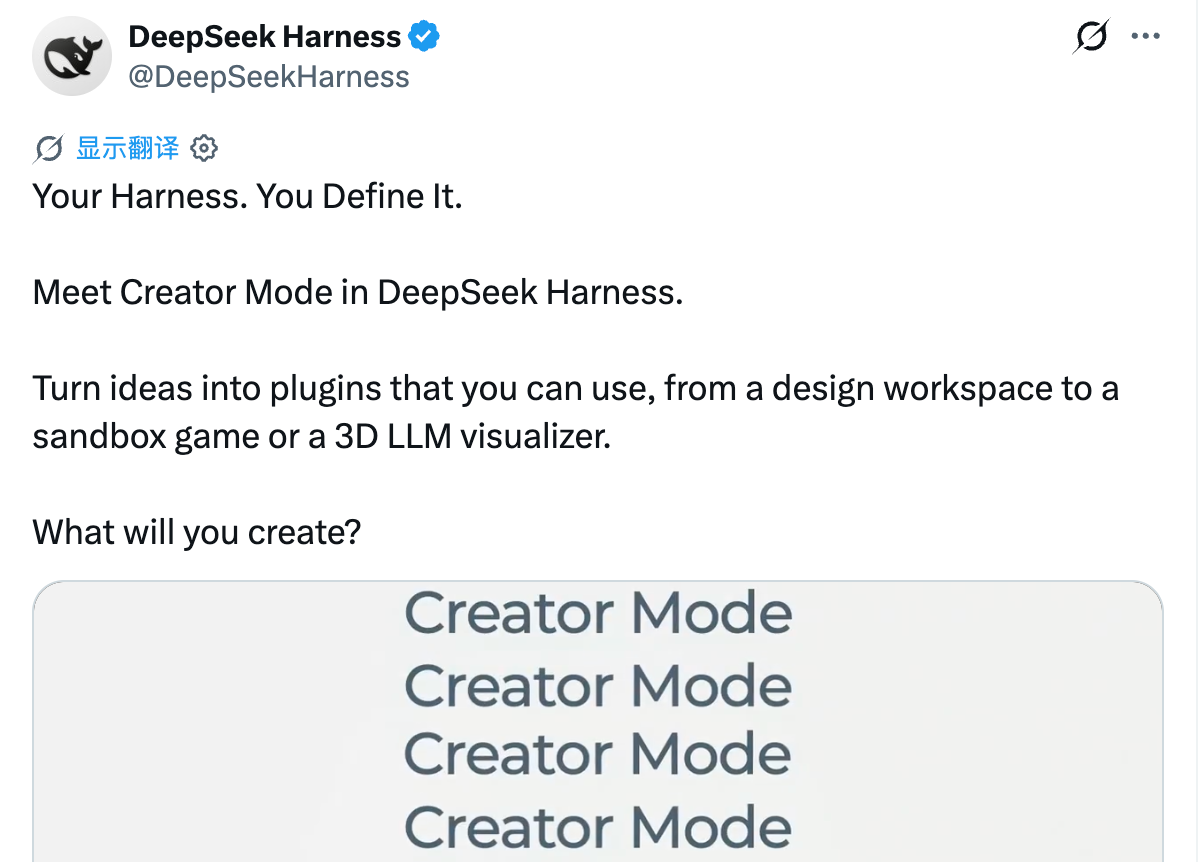
Zhidong: What do you think of the creation mode DSH recommended a few days ago? Besides being used for plugin debugging, it can also modify some front-end content.
Xiao C: I think this idea is very good and highly imaginative. It is related to the original purpose behind the DeepSeek Harness project: they wanted to make it a self-evolving AI or AI Harness. So I think the creation mode is laying the groundwork for the future.
On the other hand, though, it is not mature enough yet. At present, it is mainly used for front-end modifications; if you want to modify the kernel or deeper-level content, it may still not do exactly what you want. Nevertheless, I do think this direction is very good and has a promising future.
Zhidong: What do you think of SuperAgent, another project DSH recently open-sourced?
Xiao C: I don’t think it is particularly innovative, but it is highly significant from an engineering perspective and can indeed solve the problem of insufficient attention in practical use, helping manage more parallel tasks.
However, the idea itself is not unusual. Many people’s workflows have already subtly adopted a similar approach, namely an architecture that separates supervision and execution into different layers.
4. Delighted to receive official recognition; I never expected the project to go viral
Zhidong: What difficulties did you encounter when using DSH that led you to think of developing a better interactive interface, namely dsh-TUI?
Xiao C: At first, I was an internal beta tester and wanted to find a benchmark for testing DSH’s capabilities. After thinking it over, I thought I could make a plugin, especially since DSH already provided a relatively rich set of APIs.
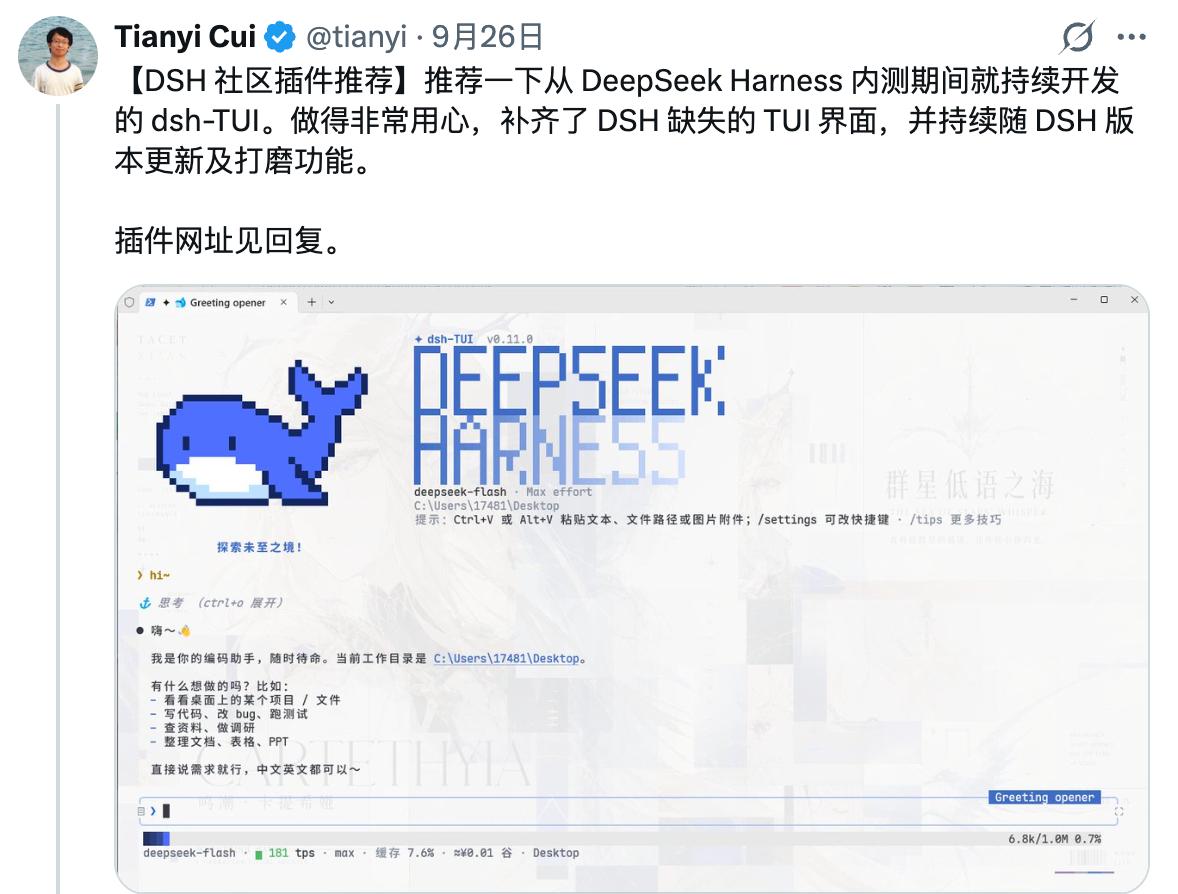
As for what kind of plugin to make, I saw that DSH had an early TUI version in internal beta, but it was rather rudimentary and not yet mature. I am also a heavy TUI user, so I happened to need this, and I thought others might have similar needs. I therefore decided to build a TUI that would meet my own needs and, hopefully, help other users too.
Zhidong: At the time, Mr. Cui even posted a tweet specifically saying that he would recommend one plugin every day, and dsh-TUI was the first one recommended. How did you feel at the time?
Xiao C: Very happy. It was a great encouragement to me. This was my first plugin, and it also happened to be the first plugin recommended by Mr. Cui. I was particularly happy when I heard the news.
Zhidong: What later prompted you to think of making dsh-Go? When you shifted from terminals to mobile devices, what need did you want to address?
Xiao C: Mainly for two reasons.
First, I thought the TUI had been done well and that I had put a lot of effort into it, but its audience was relatively limited. TUI users are still a small minority, mostly geeks and developers. After reflecting on this, I thought the problem might be the audience: the product wasn’t yet accessible to a broad enough audience.
I wanted to build a product that would make it convenient even for AI beginners to use AI and enjoy its benefits. After thinking it over, the most universally accessible platform was the mobile phone, or mobile devices, so I later began researching the mobile platform, and dsh-Go was born.
Zhidong: Before dsh-Go launched, did you expect it to attract so much attention? You also said at the time that once it reached 1,000 Stars, you would begin adapting it for HarmonyOS and iOS, but it surpassed 1,000 within just three hours of launch.
Xiao C: I never imagined that so many people would like this product. At first, I thought it was well made and had put a lot of effort into it, but I didn’t expect it to go viral. Thank you all so much for your support.
Alongside the happiness, there was also the pressure that came with it. I had originally said that reaching 1,000 Stars would let me take a break, but it surpassed that mark in just three hours. Once the project gained popularity, I didn’t feel right stopping, so I could only continue putting in the effort.
The busiest time was during the days around the public beta. That week, I slept an average of only four hours a day and tested continuously. There was also a closed-beta group where everyone helped test it.
Now that more and more people are using it, I don’t dare make even minor changes whenever I update it or add features, because I’m worried that problems could affect many users. So now, I’m continuing to iterate while being careful.
Zhidx: After the public beta, the project received a great many Issues and feedback comments. What was the most troublesome problem?
Xiao C: The most troublesome problems were performance and compatibility. Because it needs to run a complete Linux environment and the DSH kernel on a phone, it poses quite a challenge to the phone’s performance. To speed up cold startup and reduce heat and lag, I put a great deal of effort into optimization.
Zhidx: I saw that the remote connection feature drew on another developer’s project. Could you talk about that?
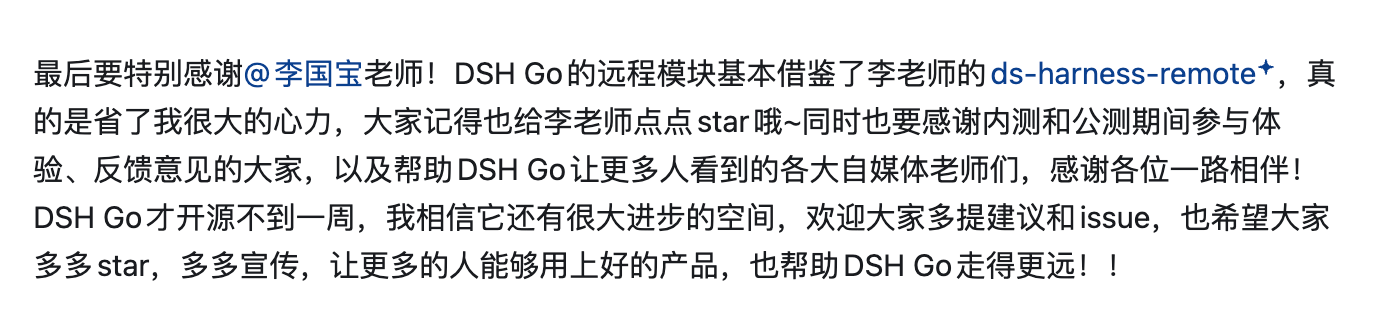
Xiao C: There’s a friend of mine named Li Guobao, who created the Remote project. With his permission, I rewrote it in another language and integrated it with dsh-Go as a remote connection module. I’m also very grateful to Mr. Li, who has provided the server free of charge.
In the first few days of the public beta, we didn’t expect the project to become so popular. It completely overwhelmed Mr. Li’s server. .
This also made me realize what makes the DSH community so appealing: everyone develops various plugins around DSH, creating some wonderful chemical reactions, and everyone helps one another. That’s the charm of open source.
Zhidx: Does running DSH locally on a phone place a considerable burden on it?
Xiao C: The burden is still fairly considerable, but I’ve done quite a lot of optimization. Now it can run on most phones. There’s also one rather unusual case: a member of the closed-beta group successfully ran DSH on a Xiaomi 6. .
Zhidx: Development and operation involve costs such as server expenses. Do you plan to recoup these investments, or is it mainly driven by your enthusiasm?
Xiao C: I haven’t opened the project to advertising or sponsorship yet. Many friends have also proactively sent me red envelopes, for which I’m very grateful. But at least for now, I can still afford it, so I’ll continue offering it as a public service for the time being.
For me, what I want from this project isn’t financial returns, but rather a sense of fulfillment. Every day, seeing the project grow, seeing people use my product and tell me it works well makes me happy. It’s also one of my biggest sources of motivation for working on the project.
Zhidx: What is the biggest technical issue with dsh-Go right now, and which aspects are you planning to focus on improving next?
Xiao C: The biggest problem is that the mobile ecosystem is too fragmented, with many different phone models and operating systems. Although they are all based on Android, manufacturers such as Xiaomi, vivo, and OPPO have all made varying degrees of modifications to Android, so full compatibility cannot be guaranteed.
Supporting different systems and versions, and even different phone models, is still quite challenging. I do not have that many phones, so I can only wait for users to send feedback, then examine the code and troubleshoot the specific issues. That is a major challenge.
Zhidong: Have you considered collaborating with other developers? For example, opening the project to pull requests so that everyone can participate?
Xiao C: I have. For now, I am still the only person developing it, and I have not accepted any external pull requests. However, once the project is stable, I may open it to pull requests so that everyone can participate in building dsh-Go, leaving more compatibility issues and the features people want to add to be completed jointly by the community.
Zhidong: Based on your assessment, will more agents migrate to mobile in the future?
Xiao C: I think they will definitely migrate to mobile in the future. As AI capabilities become stronger, many people may no longer need a large screen to view code, nor necessarily a physical keyboard for input. Often, all they need to do is say a sentence and have AI complete some lightweight tasks.
Lightweight, on-the-go usage may become a trend in the future, and phones and smart glasses may be the next-generation form factors. This is my personal speculation.
5. I am confident in my product—the official app will not kill dsh-Go
Zhidong: After receiving so many Stars, user attention, and official recommendations, has your life changed in any way? For example, have you gained job opportunities, technical exchanges, or other benefits?
Xiao C: The biggest change is that every day when I open GitHub, I see a large number of issues. Group chats are constantly flooded with messages, many people @ me every day, and I have to deal with all kinds of problems. That is the most obvious change in my life.
Second, I also feel great seeing the number of Stars on GitHub increase. There have also been some job opportunities, but I will not say much more about that.
In addition, through these two projects, especially the earlier TUI project, I met a large number of developer friends. Both their character and their technical skills are excellent, which is a gain I am particularly happy with.
Zhidong: Do users ever propose requirements that surprise you, or requirements that are particularly difficult to solve?
Xiao C: Yes, there are all kinds of requirements. For example, with roleplay, I did not expect there to be so many roleplay users, and many people want the related features to be better and more convenient. Support for iOS and HarmonyOS is also in huge demand. People urge me to do it every day, and it is genuinely difficult. Whenever I post a tweet or a video, someone below will inevitably ask when iOS or HarmonyOS support will be available.
Zhidong: You could tell them to switch to an Android phone (laughs).
Xiao C: Quite a few people have actually bought a second-hand Android phone just to use this product, and I have also received similar feedback from people around me.
Zhidong: Developing mobile apps for open-source agents has become a fairly common trend, with examples such as OpenClaw and Hermes, which is currently in beta testing. What do you think of such products? What are dsh-Go’s advantages compared with the mobile apps of other open-source agents?
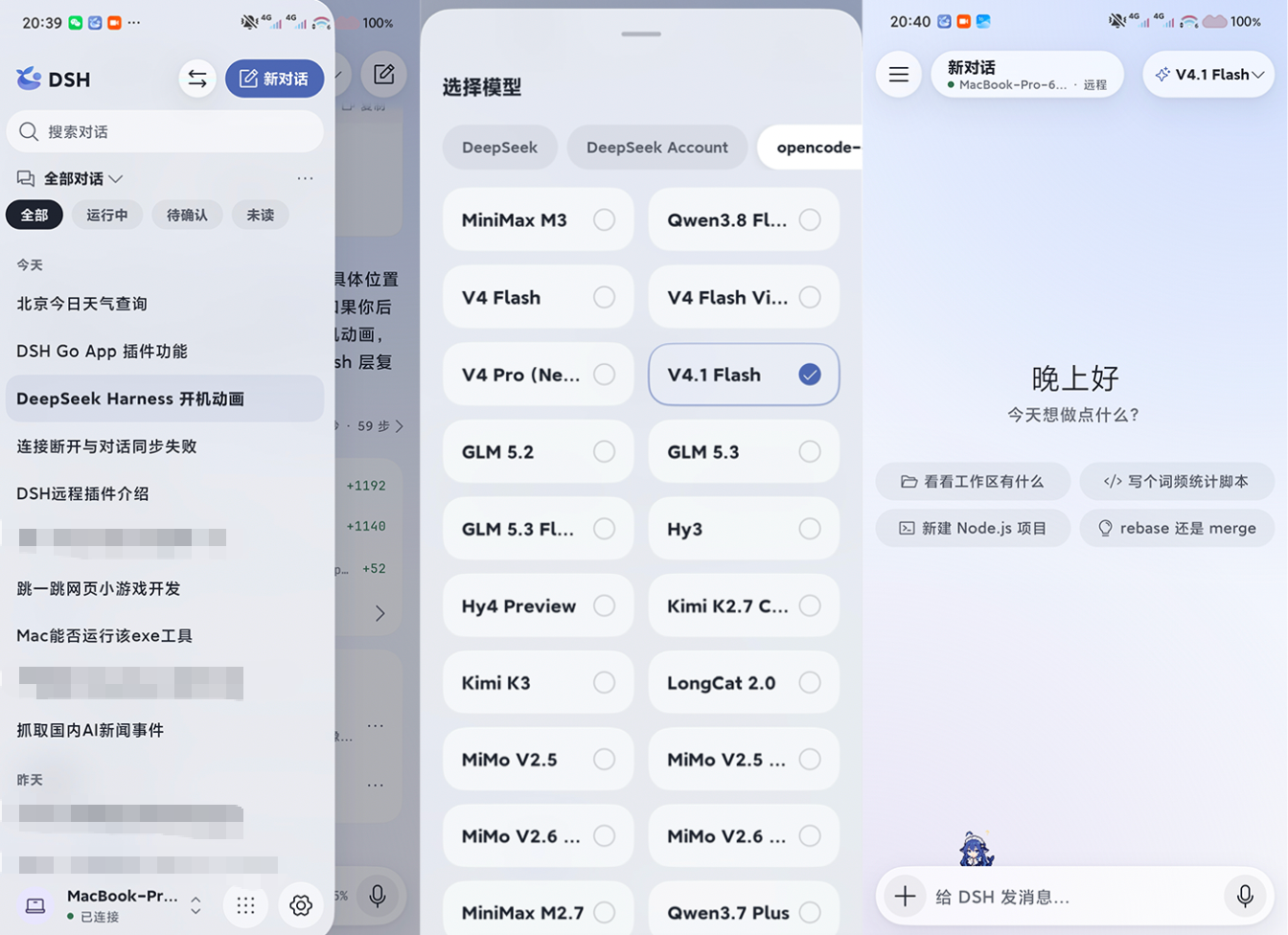
Xiao C: First of all, I think the UI is one of its advantages. For dsh-Go, I rewrote an entirely native UI, and I believe the overall design is quite polished. Many people were also inspired to try the project after seeing the UI, so I think its aesthetic appeal is one of the project’s advantages.
Second, compared with projects such as Hermes, dsh-Go is based on DSH while retaining compatibility with almost all DSH plugins. DSH’s rich plugin ecosystem and extensibility give it an advantage over other mobile agents.
Third, it has a relatively rich set of features. I can run a Linux container locally on a phone and boot up a complete DSH kernel without depending on a computer, serving users who do not have one. I can also use Remote to operate DSH on a computer remotely.
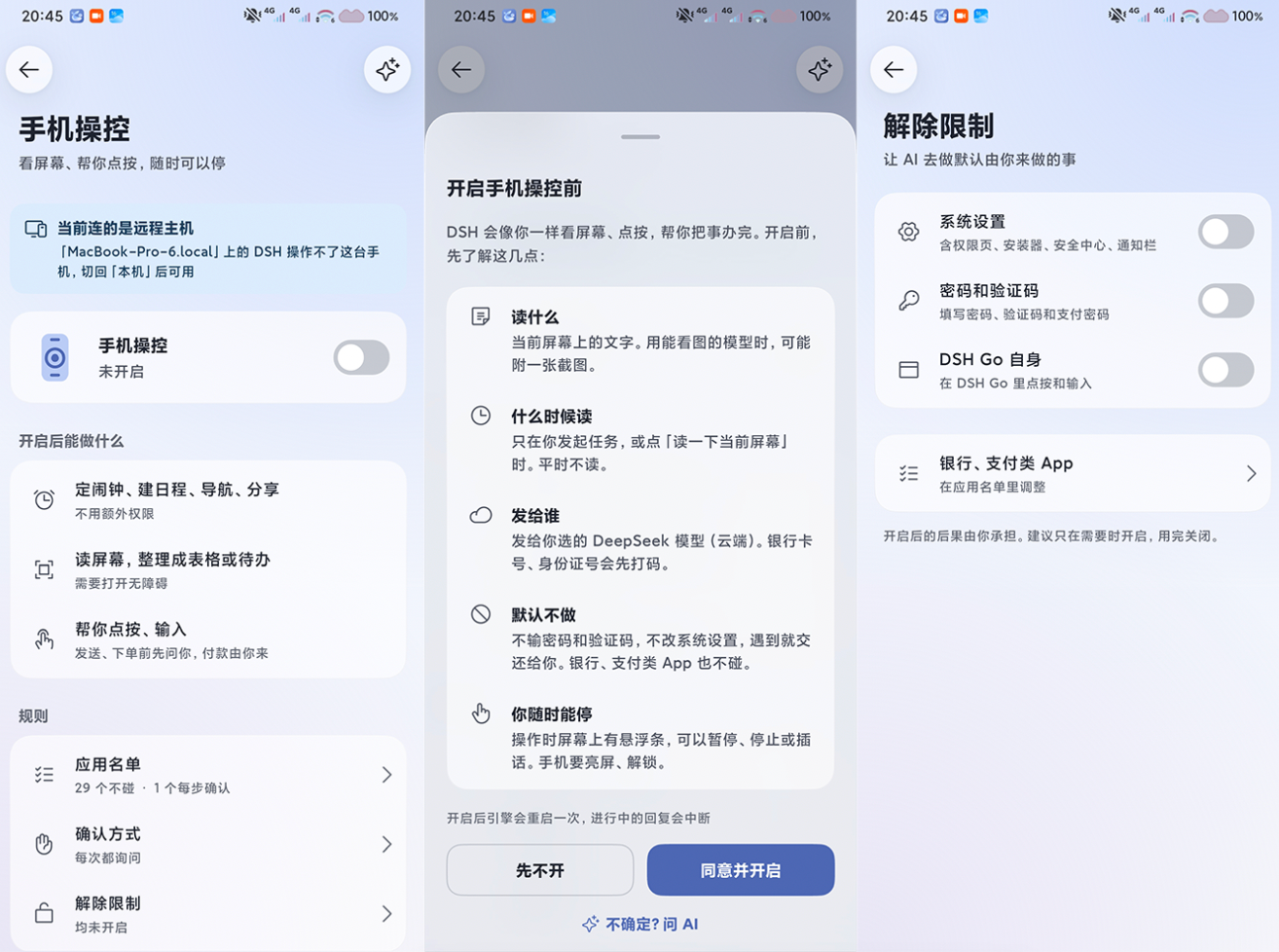
There is also phone control. This is another aspect that has attracted quite a few users.
Zhidx: Personal Agents have been very popular in recent months, and some closed-source products are also developing mobile agents and cloud agents. Do you think dsh-Go will eventually move in the direction of cloud hosts?
Xiao C: I’m still considering it. Once the existing features are polished, I may consider adding services such as cloud hosts. I’ve also received similar requests on Twitter. Some users do not have computers, and their phones do not perform very well either, so they hope to run tasks around the clock through a cloud host or use it as a life assistant to help manage certain aspects of their lives. There is indeed demand in this area, and I may try it in the future.
Zhidx: DSH’s official team may also launch a mobile app. If the official team releases a similar product, will your current project be affected?
Xiao C: There will undoubtedly be some impact. After all, official products have official influence,but I don’t think it would be a catastrophic blow.
First,I have confidence in the quality of dsh-Go. As a community project, it has its own characteristics. For example, I don’t think the official team is likely to create such a distinctive UI. They may still follow DeepSeek’s consistently simple and straightforward style.
Second, the official team may find certain features inconvenient or may not be willing to implement them. I suspect that if the official team releases a mobile version, it will most likely focus on remote connections and may not support both remote access and running services locally on a phone, as I do. Therefore, some features may be things the official team will not build and may be better explored by the community.
I will also continue optimizing the project and adding features that meet users’ needs. So I think its ecosystem niche may be affected, butit will not be completely replaced or wiped out; the project still has its own unique advantages.
6. Starting AI Programming Through Quantitative Analysis: Future Developers Will Most Need the Ability to “Identify Requirements”
Zhidx: Let’s talk about AI Coding next. You majored in economics. How did you first encounter AI and begin trying to use it to write software?
Xiao C: I first came across related videos on a video-sharing website. ChatGPT had only just been released— whether it was version 3.5 or 4, I can’t quite remember anymore. Suddenly, there was a tool that could chat with you and give you advice. I thought it was very novel, so I started following it, trying it, and learning about it. That was how I first encountered AI.
Zhidx: How did you later begin trying to use AI for programming and writing software?
Xiao C: This may have some connection to my background in economics. I already had some programming fundamentals, and economics also has a field of quantitative analysis.At the time, I wanted to try quantitative trading, and I happened to know a bit about AI, so I wondered whether AI could help me write quantitative trading algorithms or programs. I gradually started experimenting, gradually shifting from ChatGPT to agents; that was the turning point.
The more in-depth development probably still happened during the closed beta period, in August. Previously, I mostly made small personal projects.
Zhidx: As AI coding tools become increasingly mature, one person can now use AI to complete development tasks that previously required collaboration among multiple people. Based on your experience, what aspects of individual developers’ work specifically have been changed by AI?
Xiao C:First, it lowers the cost and difficulty for individual developers to turn an idea into reality. With AI assistance, efficiency has improved considerably. I might have an idea and, in about a week, turn it into a project that everyone can use.
This has also greatly expanded the boundaries of what individual developers can do. In the past, one person needed to understand the frontend, backend, and various programming languages to build a good product. With AI assistance, if the frontend does not look good, AI can help; if one encounters a backend bug and has difficulty troubleshooting it independently, tools such as GPT can help locate the problem. One person can now do far more, and there is much more room to exercise their abilities.
Zhidx: From an enterprise perspective, what changes do you think will occur in the developer skills companies need?
Xiao C:First, I should point out that I’m still a student and do not have a particularly thorough understanding of the job market. However, based on my own AI coding experience, I think the skills future talent will need may shift from hands-on coding toward identifying requirements and designing products.
Many of my programmer friends have told me thateveryone may end up becoming a full-stack engineer. Demand for specialists in a single field, or people with a relatively limited range of skills, may decline.Developers who can handle the entire workflow on their own and accurately identify requirementsmay be more in demand in the AI era.
Zhidx: As code generation becomes increasingly easy, what do you think is the scarcest and most important skill for individual developers?
Xiao C:I think it is still the ability to identify requirements.
The emergence of AI has greatly increased supply-side capabilities, but user demand has not changed in the same way. Faced with so much supply, what users ultimately choosewill still depend on which products truly capture user needsand turn them into actual products.
Whether someone can do this may determine whether they can build a recognized product in the AI era.
Zhidx: Such as the dsh-TUI and dsh-Go projects you developed?
Xiao C:Yes. I think I can summarize this based on my own experience.
TUI was a modest success because I identified geek users’ need for a TUI when using DSH and filled that gap. The product was also good, so people were willing to use it and give me some stars.
As for dsh-Go, it addressed mainstream users’ demand for a mobile solution. After finding a need, you also have to polish the project before it can gain recognition. So the core is still identifying requirements.
Zhidx: After AI lowers the barrier to development, will a large number of homogenized projects emerge? What do you think about this issue?
Xiao C:I think so. That trend is already emerging.Homogenized products are a bit like reinventing the wheel. I don’t think that is particularly good, but it is also an inevitable trend in the development of the AI era.
In this environment, what actually stands out even more is the ability to identify what people need and the taste of different developers or development teams.
What everyone builds—and the features they offer—may all be much the same. What ultimately determines whether a product is excellent is whether it can pick up on some nuanced needs and whether developers can repeatedly choose and make trade-offs among the many options AI offers,using their own taste to create products with a distinctive style. These two factors will be particularly important in an age of homogenization.
Zhidong: There are now voices arguing that many people without professional backgrounds are starting software development and may bring a flood of “software junk” to the open-source community. What do you think?
Xiao C: I think there are both advantages and disadvantages.
On the positive side, after the barrier to entry is lowered, more people without programming fundamentals can participate. This is a good thing for them personally, and it may also help uncover some talented Vibe Coding developers, giving them a chance to showcase their talents.
On the downside, the open-source community may accumulate a lot of low-quality code. My project has also received some pull requests generated entirely by AI, and dealing with them can sometimes be quite exhausting.
Zhidong: During this process, did you specifically study programming further? Or is the foundation you already have from your coursework enough?
Xiao C: Compared with traditional programmers, my programming fundamentals are certainly weaker. I understand some basic theory, but when it comes to actual code and hands-on practice, I still lag far behind traditional programmers. I think AI has helped me enormously—I can say I’ve really benefited from the rise of AI.
Zhidong: Specifically, how do you use AI during project development?
Xiao C: Let me give an example of fixing a bug. As the project grows, the codebase may reach tens of thousands or even hundreds of thousands of lines. If I had to inspect the code, troubleshoot, and fix bugs myself, honestly, I might not be able to do it.
With AI, I can have it run tests, hunt down bugs, and fix bugs around the clock on the server, which is a huge help to me. Without AI, I don’t think dsh-Go would even run.
Zhidong: After an AI-generated product is launched, it still has to deal with issues such as performance, compatibility, and long-term maintenance. In your actual development work, have you encountered any problems that AI finds difficult to solve? Based on your personal experience, what is the current bottleneck of AI Coding?
Xiao C: Definitely. You can’t rely on AI entirely,the so-called “programming by wishing” still falls short on relatively advanced, in-depth tasks.
Take frontend development as an example. Even when using a model with very strong frontend capabilities today, if you have no clear aesthetic direction and give the model no clear task, the pages it generates may look good, but in the eyes of others they may have a strong AI flavor—or the so-called “Claude style”—and may not represent excellent frontend design.
If the developer gives no detailed instructions, reference examples, or clear requirements, and simply gives the AI free rein, the end result may be something users do not accept. This is a fairly obvious bottleneck.
Zhidong: So technical expertise still needs to provide the foundation?
Xiao C: We need technical expertise, we need aesthetics, and we need the taste we just talked about.
7. Advice for students without a programming background: Keep learning, don’t limit yourself, make good use of AI, and improve your execution.
Zhidong: How will these development experiences affect your future studies and career planning? Will you continue studying economics, or are you considering entering the AI industry?
Xiao C: There will definitely be an impact, but for now, I've decided to finish my graduate studies first. In terms of career planning, I love AI and think I'm well suited to the industry. In the future, I may transition into the AI industry or work toward that direction.
I haven't yet decided on a specific position, but I do have a direction in mind. I think I may be better suited to product work, and in the future I'll strive to move in that direction and develop the relevant skills. For now, though, I need to gain more experience, keep learning, and further improve my abilities; only then will I have more opportunities in the future.
Zhidx: Will dsh-TUI and dsh-Go continue to be maintained in the future? What are your plans for the two projects?
Xiao C: I will probably keep maintaining both projects. Whether it's keeping up with version updates, listening to everyone's feedback, or adding better features, I'll keep working on them. One was my first project, and the other is my most successful project to date. I feel attached to both, and they genuinely meet real needs. I won't casually stop maintaining them for these users.
Later on, I'll also try to work on equally meaningful projects, and may start new ones. But my energy is limited, so if some mature and relatively stable projects can be handed over to the open-source community, I'm willing to have everyone maintain them together.
Zhidx: In an era of rapid advancement in AI agents, what advice do you have for people from non-computing backgrounds who want to enter the AI industry? If starting from scratch, what should one do first?
Xiao C: I think the first step is to download some AI software and start using it. I have a few main suggestions:
First, maintain the ability to keep learning. This ability is extremely important in the AI era. AI is developing rapidly, and the world is changing rapidly as well. Only by continuously exposing yourself to new knowledge can you keep up with the times. If you can keep up while others can't, that will become an advantage. It may also narrow the gap between you and people with computer science backgrounds, and may even allow you to overtake them.
Second, don't put limits on yourself. With the help of AI, many fields that used to have high barriers to entry and require extensive prerequisite knowledge can now be boldly attempted. Enter the field first, then learn through practice—that is, "learning by doing." Whenever you encounter a problem you don't understand, you can ask AI at any time.
Third, learn how to make good use of AI. I think AI is not just an assistant that does work for you; it can also be a great teacher. It has an extensive store of knowledge, so when you encounter something you don't understand, you can have it explain things step by step. I often do this while programming, and the knowledge you accumulate over time can be substantial. Still, while embracing AI, you shouldn't hand your brain over to it entirely; you need to maintain the ability to think independently.
Fourth, improve your execution ability. With AI's help, an idea can quickly become a demo, or even a mature product. If you have an idea but don't act on it, someone else with the same idea who acts first may seize the opportunity. So use AI to improve your execution ability and be brave enough to try. Even if you ultimately fail, the cost won't be high, and at least you'll gain experience. These are some of my personal insights from learning about Vibe Coding and AI.
Zhidx: If a student comes from a purely liberal arts background and wants to enter the AI industry, what efforts do they need to make?
Xiao C: I think you should still start by making a bold attempt. The first step could be to download an AI tool, configure the environment, and then try to build something.
If you have an idea,you can start with small needs in everyday life. For example, if you find translating academic papers while studying troublesome, you can write a small script, or ask AI to help you write a small program that translates papers. Start with small needs around you, experience the feeling of creating something, and then keep going step by step.
Of course, you still need to build a solid foundation in programming. Otherwise, if you merely give AI requirements, you may end up writing buggy code or being unable to manage your own project. Using AI to learn the basics of programming is also an important part of the process.
Zhidx: Thank you for accepting the interview. To wrap up, could you use a short paragraph to recommend dsh-TUI and dsh-Go?
Xiao C: Thank you for the invitation. Everyone is welcome to try dsh-TUI and dsh-Go.
I think dsh-TUI is an excellent TUI project in the current DSH ecosystem. It features a beautifully designed UI, an out-of-the-box experience, and a rich set of interfaces that allow users to customize plugins. It also provides comprehensive mouse control, enabling everyone to enjoy a GUI-like interactive experience within a TUI. Its performance is also solid, so TUI enthusiasts should give it a try.
The biggest advantages of dsh-Go are its beautifully designed UI and mobile-device control. Everyone is also welcome to try it. I’d be happy to hear your feedback. If you have any requests, you can share them in the Issues section or in the community group, and we can work together to build the ideal mobile app we envision.