Summed up by Washington to restrict access to its most advanced models for foreign nationals, Anthropic has disabled them for all its customers. The first known application of export control to a large language model, the incident turned into a public showdown and reignited, in Europe, the debate on technological dependency.
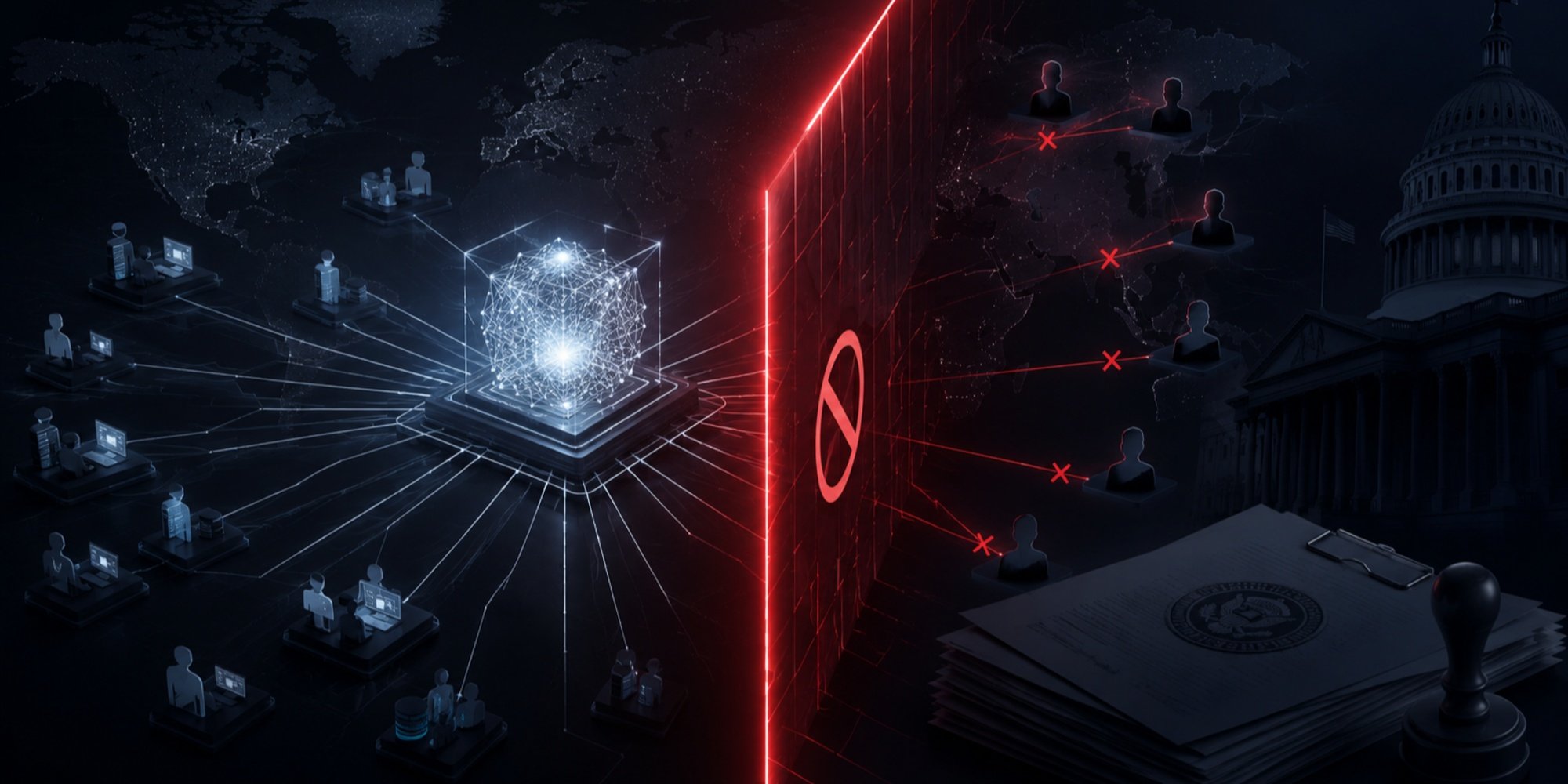
It is an unprecedented event in the recent history of artificial intelligence. On Friday, June 12, 2026, at 5:21 p.m. (Eastern Time), Anthropic received from the U.S. Department of Commerce an export directive ordering it to suspend access to its two most advanced models - Fable 5 and Mythos 5 - for all foreign nationals, whether located outside the United States or on American soil, including the company's own non-American employees.
Unable to reliably distinguish its users by nationality, Anthropic chose to simply disable the two models for all its customers, including Americans. Amazon Web Services, which hosts them, confirmed that access has been revoked for all users and all regions. The other models of the company, including Claude Opus 4.8, are not affected.
What makes this incident unprecedented
Until now, U.S. export controls targeted hardware - chips and computing servers - mainly destined for China. This is the first time, as far as observers are aware, that such a measure directly targets the access to a large language model, and by extension, all international customers of an AI provider.
The origin of the decision: a cyber-related concern. According to Anthropic, the government would have become aware of a method to « jailbreak » Fable 5 - a bypass of safeguards separating the public model from the unbridled cyber capabilities of Mythos, the model from which it derives. The company claims it examined the demonstration and found only narrow vulnerabilities, already known, and present, according to them, in other public models that are not targeted.
A standoff, two versions
Initially presented as a unilateral government action, the matter has turned into a standoff with conflicting narratives. On June 13, David Sacks, co-chair of the Presidential Advisory Council for Science and Technology and former « AI czar » of the administration, presented the executive's version: a trusted partner of Anthropic and the government - identified by several media as Amazon - would have discovered the jailbreak during testing; the administration would then have asked Dario Amodei to fix the flaw or remove the model, and the executive would have refused. The export controls were taken "against the grain," wrote Sacks, and the restoration now depends solely on a correction: "the ball is in Anthropic's court."
The company disputes this interpretation. It argues that a narrow workaround did not justify the withdrawal of a model used by millions of people, and according to a source cited by Fortune, claims it had only 90 minutes to react, without prior warning of a national security threat. In the background, Semafor's coverage links the decision to fears of Chinese access to Mythos capabilities — placing the incident back within the logic of export controls targeting China, rather than a simple product security dispute.
As of June 15, access has still not been restored. The incident occurs at a sensitive moment for Anthropic, which submitted a confidential IPO filing in early June, valuing the company around 965 billion dollars; regulatory risk now enters the narrative of the valuation.
Europe reacts, from the left to the right
In Europe, the incident triggered a wave of converging political reactions across ideological divides, compiled notably by Euronews. In France, Bruno Retailleau (former Interior Minister, candidate for the 2027 presidential election) sees it as an alarm signal: a nation dependent on others for its technology can be "unplugged overnight"; he calls for "rearming" national technological power by relying on Mistral, OVHcloud, Scaleway, or ChapsVision. Benjamin Haddad, deputy minister in charge of Europe, believes that Europe cannot be content with being « an open market dependent on technologies designed, funded and controlled » elsewhere. Édouard Philippe (former Prime Minister, mayor of Le Havre) describes AI as a critical infrastructure « as essential as electricity or the Internet ». Jordan Bardella (president of the National Rally, European Parliament member) calls for accelerating support « for the Mistral AI startup ».
Why this concerns companies
Beyond the case of Anthropic, the incident moves a long-standing theoretical question into concrete reality. As long as access to models was a matter of commercial contracts, AI sovereignty remained an abstract debate. The directive shows that in the absence of a contingency solution, an European organisation can lose access to a critical tool overnight, at the decision of a foreign administration, without notice or immediate recourse.
The proper framing is not « should we leave American suppliers? » - which would be caricatural - but rather : what critical uses can be affected by an interruption, restriction, or unilateral change in access? This episode fits into a broader trajectory : eleven days earlier, a presidential decree had established a government review of the cyber capabilities of « frontier » models ; and as early as 2025, an initial attempt at regulation (the « AI Diffusion Rule », since repealed) had considered controlling not only chips but also certain model parameters. Leading AI enters the realm of strategic assets, on par with semiconductors.
Going further To place this episode in the broader context of dependencies on models, the cloud, chips, and export controls, IntelligenceArtificielle.com publishes a reference note on the new dependencies of artificial intelligence - mapping critical layers, European alternatives, China's position, and a risk grid for decision-makers.
Primary sources : Anthropics' statement and technical status (directive received on June 12, 2026) ; Reuters, Fortune, Time, CNBC, Semafor, BleepingComputer, Tom's Hardware ; David Sacks' publication (June 13, 2026) ; Euronews, « Wake-up call: Europe reacts to Anthropic halting access to its Fable 5 and Mythos 5 AI models » (June 13, 2026).
Analysis and context : reference note from IntelligenceArtificielle.com on the new dependencies of artificial intelligence (mapping of critical layers, European alternatives, China's position, risk grid).
 Add ActuIA to my Google favorite sources
Our articles will be prioritized in Google's "Top Stories".
-
 Authority decision (CNIL, CE…) Anthropic forced to suspend Fable 5 and Mythos 5 after a directive from the U.S. government
June 13, 2026
-
 Pedagogy / explanation AI export control: what the Pentagon's threat implies for European clients
Oct. 21, 2026
-
 Decision by Authority (CNIL, CE…) Washington restores Fable 5, but the risk of dependence on American models remains intact
1 July 2026
-
 Files Did you catch up this summer? Eight facts to get back on track with AI
2 September 2026
- 30 October According to Dexerto, Anthropic adds to Claude Code on Opus 5.5 a directive that prevents it from recreating existing video games, after the influx of clones
- 4 November India: according to CNBC-TV18, CERT-In gains access to Claude Mythos, Anthropic's unpublished model, for its cybersecurity Nov 3 Amended S-1 by Anthropic: 17 billion dollars in revenue for the third quarter, 895.4 billion compute engagements, warning about recursive self-improvement


