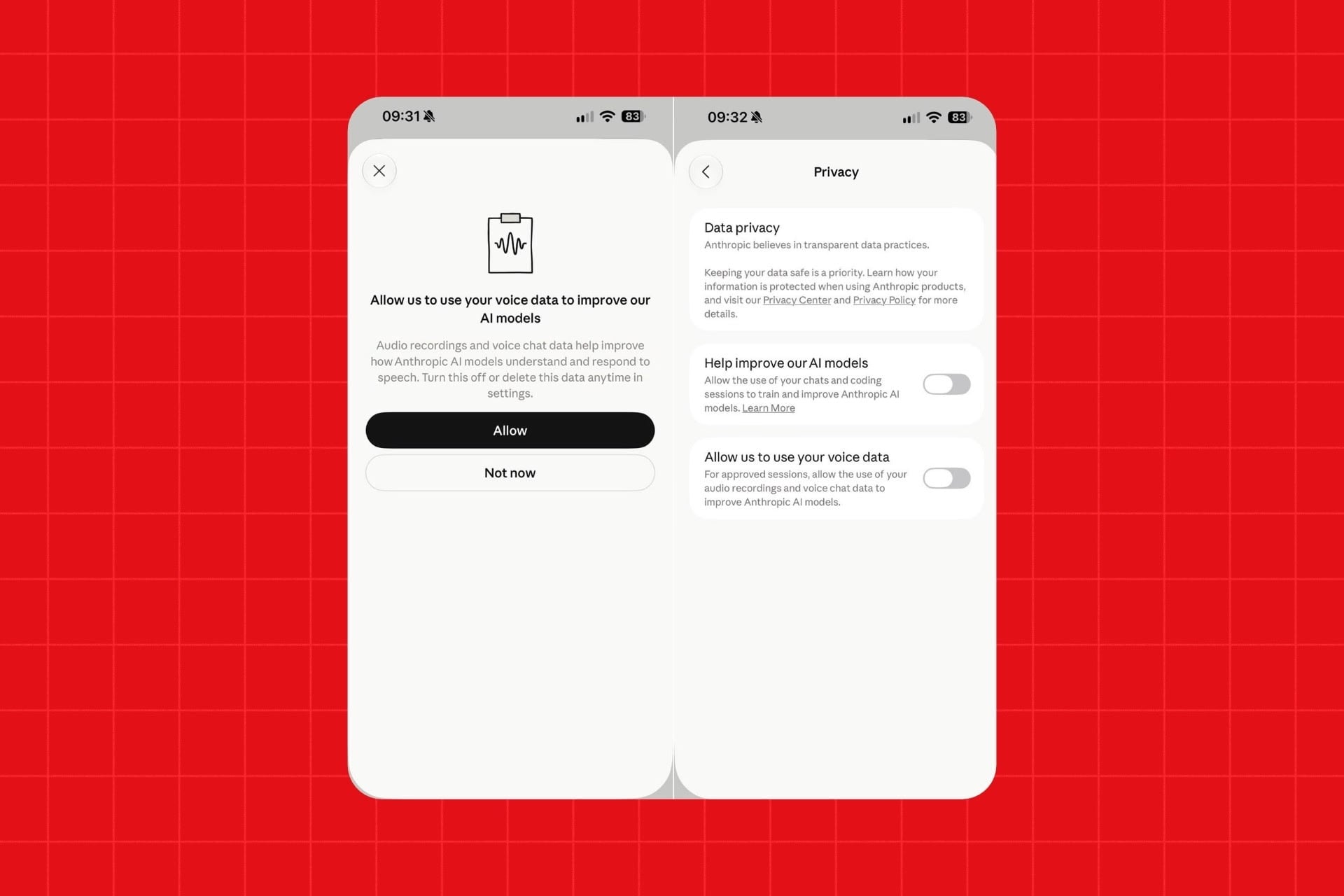
 The option is not yet available in Europe, probably for legal reasons related to the AI Act and the GDPR. © Bleeping Computer
A new warning appears in the Claude apps: the assistant now asks for permission to use your voice recordings to train Anthropic’s models. Yet the company’s privacy pages promised the opposite as recently as six months ago.
Claude started speaking in May 2025, and its voice mode has since become available on all plans, from the free tier to professional subscriptions. This weekend, screenshots from the app revealed a new window upon launching these conversations.The message: “Allow us to use your voice data to improve our AI models”, with two buttons, “Allow” and “Not Now.” The collection would be disabled by default, controlled by a dedicated toggle in the privacy settings, separate from the one that already governs written conversations and code.
A promise in black and white, still online
The help page dedicated to mobile dictation, updated on March 16, 2026, states plainly: “We do not use your voice to train our models”. The same document specifies that the audio is deleted as soon as transcription is complete. The new prompt would instead target voice conversations: a closely related scope that is absent from this documentation, which remains online unchanged.
The privacy policy that entered into force on September 10, 2026, for its part contains no clause concerning voice. In the European Economic Area, it lists consent among the legal bases for training, and the window appears tailored to this framework. Anthropic has so far confirmed neither the rollout, nor its timetable, nor the retention period for recordings, which is why conditional wording is still required.
After your conversations and your code, your voice
On August 28, 2025, Anthropic had already overhauled its consumer-facing terms: conversations and code sessions from the Free, Pro, and Max plans were sent to training unless the user opted out.Those who accepted saw the retention of their data extended to five years, and the deadline for making the choice, initially set for September 28, had eventually slipped to October 8. The window of the time came with a toggle preset to “on.” Today’s would work the other way, remaining off as long as the user had not touched anything.
In France, as early as 2020, in its white paper devoted to voice assistants, the CNIL described the voice as “a sort of sound image” of the person. The data watchdog classifies it as biometric data as soon as it is used to identify someone. An audio file indeed carries much more than words: an accent, a state of health, sometimes the sounds of the home. That is what makes it valuable fuel for models that learn speech, and a more sensitive piece of data to entrust than text.
For now, nothing leaves your microphone without your consent: the window closes with a “not now,” and the setting can be checked at any time in the app’s privacy settings. A control worth revisiting after major updates, as the precedent from 2025 showed. History nevertheless invites you to keep an eye on these toggles: between a promise in March and a prompt in October, the company’s policy on your data lasted six months.
👉🏻 Follow tech news in real time: add 01net to your sources on Google, and subscribe to our WhatsApp channel.
Source: Bleeping Computer






- Google Play Store
- 4K Video Downloader Plus
- VLC Media Player
- Adobe Reader
- uTorrent
- WinRAR
- Xender
- Google Chrome
- CCleaner
- Mozilla Firefox
- Avast Free
- ChatGPT
- Microsoft 365
- Opera One
- Avast One








Download
- Google Play Store
- 4K Video Downloader Plus
- VLC Media Player
- Adobe Reader
- uTorrent
- WinRAR
- Xender
- Google Chrome
- CCleaner
- Mozilla Firefox
- Avast Free
- ChatGPT
- Microsoft 365
- Opera One
- Avast One