"AI Daily Digest November 12: AWS emulator entirely written by AI agents, Gemini Decisions API released"tags: [AI, programming, robotics, startups]
- AI
- programming
- robotics startups
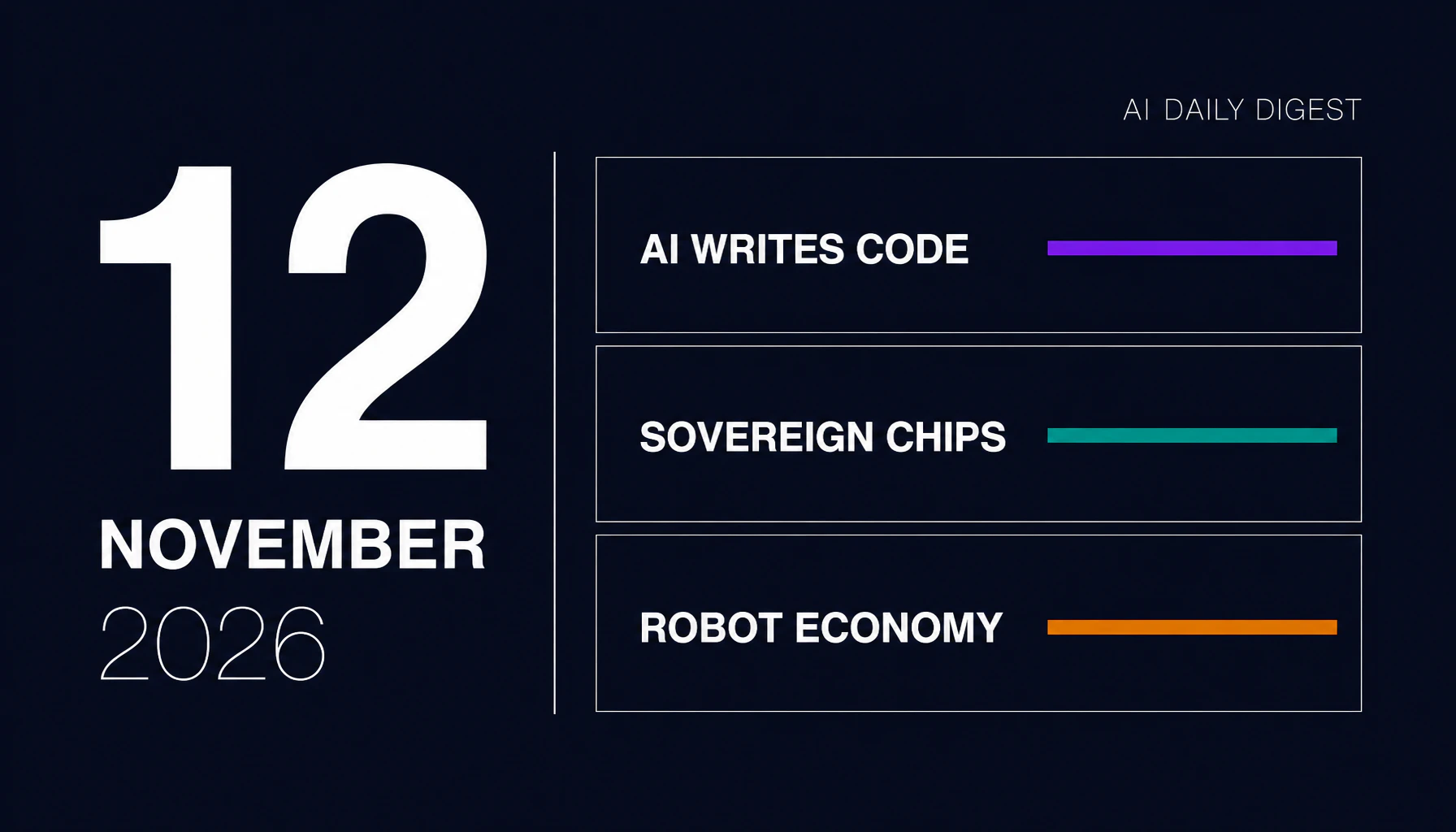
Two major product-related news stories and five funding rounds came in today. AWS released a tool whose entire codebase was written by autonomous AI agents, Google turned closed-set decision-making into a paid API, and investors poured hundreds of millions of dollars into chips, welding robots, and even orbital mirrors. Here is a summary and explanation of seven developments from the past 24 hours.
1. AWS releases an emulator whose entire code was written by agents
On November 11, AWS released “AWS Emulator,” a free, open-source tool that recreates more than 200 AWS cloud services locally. Developers can complete tests of agent code without connecting to the live cloud. What was particularly noteworthy was not the feature list but the development method. AWS officially revealed that “thousands of autonomous AI agents wrote every single line of the code, and the team neither wrote nor reviewed the code.”
The idea was conceived by AWS Senior Principal Engineer Matt Goldberg. His inspiration was “Alf,” a Paxos-based distributed locking service built more than 20 years ago that had supported S3 and DynamoDB. He provided the published Smithy API model as the official specification and asked the Kiro agent to reproduce Amazon SQS, using the production cloud as the source of truth; a spec-compliant replica was completed in 15 minutes. To scale this to hundreds of services, dozens of agents were divided into three teams working on Amazon Bedrock AgentCore. Team 1 generated large numbers of end-to-end integration tests from the API model and validated them against the production cloud, Team 2 ran the tests against the local emulator and reported behavioral differences to GitHub as structured bug reports, and Team 3 wrote the patches. Before a patch could enter the main branch, it had to pass an automated merge gate overseen by an adversarial security agent that probes for vulnerabilities.
The distribution formats are a single binary written in Rust and a Docker container. Developers only need to point AWS_ENDPOINT_URL to localhost on port 4566 for existing CLI and SDK calls to resolve locally as before. The license is CC0 1.0, and even the raw commit history has been made public. An issue repository labeled “things-that-do-not-work” has also been set up to track edge cases in the specification. The motivation is economics.The write–compile–test loop of coding agents causes hundreds of resource creations every hour. Remote round-trip latency takes 150–600 milliseconds, while local latency is under 5 milliseconds. AWS explains that moving the validation loop to a local environment makes agent iterations more than 20 times faster and reduces cloud costs to zero. Swami Sivasubramanian, vice president responsible for Agentic AI, said the role of engineers will shift to that of orchestrators responsible for defining system boundaries, formal specifications, and designing adversarial tests. This architecture, in which simulators are automatically regenerated whenever the Smithy model changes, could provide a practical foundation for teams running agents in production.
— AWS · AINewsToday
🔗 AWS · AINewsToday
2. Google’s Decisions API: Grade 1,000 Questions in a Single Inference
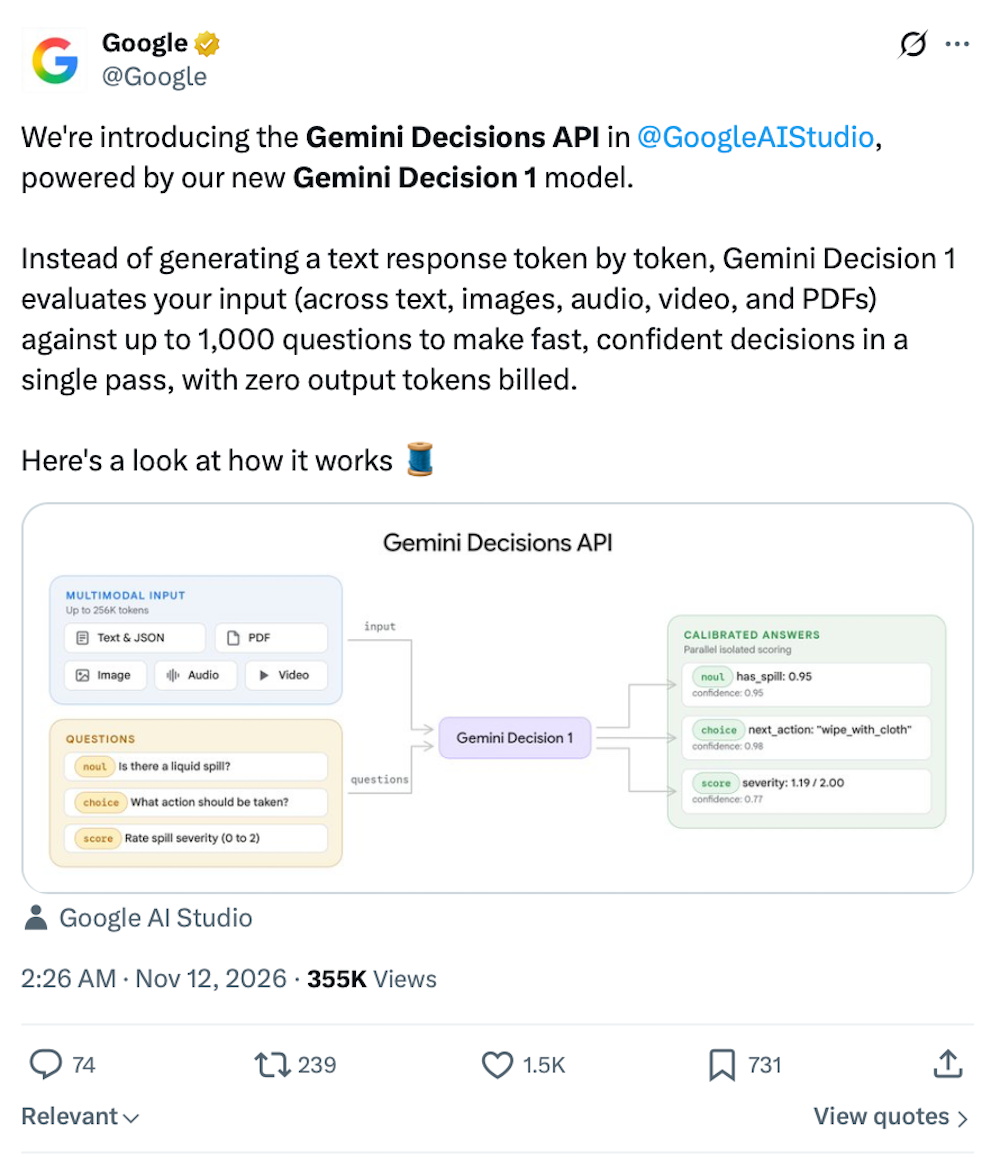
On November 11, Google announced a new endpoint, the “Gemini Decisions API,” and a dedicated model, Gemini Decision 1 (gemini-decision-1). It is available through the Gemini API via Google AI Studio. Rather than generating tokens one at a time and constructing response text as before, it scores candidate choices in a single forward pass and returns probabilities along with a confidence score from 0 to 1.
With a single request, users can submit shared multimodal input spanning text, images, audio, video, and PDFs, up to 256K tokens, and have up to 1,000 independent questions evaluated against it. There are three types of questions: Yes/No probability, multiple choice with 2–255 options (returning a normalized probability for each candidate), and multi-level rubric scoring (returning a continuous weighted score and the probability for each level). Every answer includes a confidence score, and ambiguous cases can be routed in code to a fallback or human review.
End-to-end latency is 150–250 milliseconds, with a median model computation time of 50–100 milliseconds for contexts of up to 16K tokens, and remains nearly flat even when the number of questions per request is increased from 1 to 100. Pricing is $0.10 per million input tokens, with no charge for output tokens. According to the company’s shared benchmarks, a configuration using Gemini 3.5 Flash-Lite through the Interactions API is approximately five times cheaper, and AI Studio also has a free tier.
It is already being used internally for dynamic model routing in Notebook (reducing latency for routine queries by up to 40%), Stitch wireframes, selecting emojis from more than 200 options, and Google Search’s MCP tool safety layer. External integrations with OpenRouter, LangChain, Vercel AI SDK, LiteLLM, Pydantic AI, Pipecat, LiveKit, and OpenCode are being rolled out gradually. We recently reported in the November 6 issue that OpenAI released its own Decisions API at the end of October, but now that two frontier labs have turned closed-set judgment into paid endpoints, routing, ranking, and policy checks are shifting from prompt-tuning work to infrastructure calls with predictable costs and latency.
— Google · Sundar Pichai
3. Mercor Doubles Its Valuation to $20 Billion in a $750 Million Series D
AI data company Mercor announced a $750 million Series D on November 10 at a $20 billion valuation. That is a doubling in roughly one year from the $350 million Series C in October 2025, which valued the company at $10 billion. The round included a tender offer for existing shares held by employees. Benchmark, Felicis, Fundomo, an Apollo-managed fund, G Squared, General Catalyst, Glade Brook Capital, NVIDIA, Salesforce, Sapphire Ventures, StepStone Group, XTX Ventures, and Zoom participated. The lead investor is undisclosed.
The company has built its reputation by supplying human expertise to frontier labs. Its expert network numbers more than five million, and there are more than 800 occupational workflows in the United States on which models have not yet been evaluated. This time, the aim is to extend that foundation to the corporate side. The process starts with capable open models, creates custom evaluations from companies’ real-world workflows, lowers costs through post-training, and then trains models for customers. Earlier this year, it acquired Deeptune, which reproduced hundreds of enterprise applications as reinforcement-learning environments.
The numbers are also impressive. As of July, its annualized revenue run rate had exceeded $2 billion, while spending on inference had reached three times its employee payroll. Co-CEO Brendan Foody argues that if this ratio spreads across the broader economy, GDP growth over the next five years will move closer to double-digit rates. Competitors include Scale AI and Surge AI; this year, Mercor also opened offices in New York and London. The round’s fundamental signal is that buyers of evaluation and post-training infrastructure are expanding beyond the small number of frontier labs to every company that wants to “own its intelligence.”
4. UK Government Backs Fractile’s £500M+ Series C
On November 11, the UK government announced its support for AI chip startup Fractile, headquartered in London and Bristol, through a Series C totaling more than £500 million at a valuation of more than £5 billion. The government’s Sovereign AI Venture Fund and the British Business Bank participated, while founder Walter Goodwin said the fundraising had raised $720 million. Reuters reported a valuation of approximately $7 billion. Thrive Capital, Founders Fund, Lightspeed, and Redpoint led the round, with CapitalG, Shopify, Balderton, Dragoneer, and BlackRock also included.
Fractile is targeting the bottleneck in inference. In conventional architectures, data moves back and forth between the processor and a separate memory module, whereas the company’s design keeps data on the chip. It frames this as the constraint governing inference costs and speed, and claims it can run LLMs up to 100 times faster than existing hardware while reducing operating costs by 90%. However, all the figures come from the company, and proof will have to wait for next year’s data-center rollout and initial shipments in 2027.
The pace of the revaluation itself is generating attention. The Series B in May raised $220 million at a valuation of approximately £820 million, but within six months the valuation surged to more than £5 billion. For the government, this is industrial policy, and AI minister Kanishka Narayan emphasized the intention of changing the landscape in which the UK’s scientific breakthroughs become industries in other countries.The autumn budget added £140 million for Sovereign AI, split between fund investment and R&D procurement, and the initiative is also expanding into robotics and autonomous systems. For buyers of AI compute, what matters is not the announcement but the deployment date.
— GOV.UK · Reuters
5. Path Robotics raises $300 million for physical AI in manufacturing
Welding robot maker Path Robotics announced a $300 million Series E on November 10 at a post-money valuation of $2.45 billion. The round was led by AI growth equity firm Georgian, with existing investors Addition, Drive Capital, IronArc Ventures, Tiger Global, and Yamaha Motor Ventures, alongside new participants D. E. Shaw Ventures and NAVER Ventures. Georgian partner Emily Walsh will join the board of directors. Cumulative funding raised has reached approximately $610 million.
The Columbus, Ohio-based company develops physical AI for manufacturing, choosing welding as its starting point because it is one of the hardest factory processes to automate. Its welding model, Obsidian, operates using real-world welding data and a trained welding world model. Even when static programs break down because of heat-induced distortion or part-to-part variability, the robot identifies weld seams on its own, plans and executes the welds, and adapts in real time. In April, it unveiled Rove, a mobile welding system mounted on a quadruped platform, targeting shipbuilding and large-scale manufacturing.
The commercial traction is substantial enough to justify the round. Annual recurring revenue (ARR) grew 17-fold over the past 18 months, headcount rose 97% year over year, and the company aims to have 400 employees by year-end. Customers include HII, the largest shipbuilder in the United States, as well as Lockheed Martin, Saronic, and numerous mid-sized manufacturers. Earlier this year, it signed a $600 million outcome-based production contract with HII for the U.S. Navy’s shipbuilding program. CEO Andy Lonsberry said, “The goal is not to automate one process, but to automate the entire factory,” pointing to expansion into the processes before and after welding and into new robot configurations. It is a noteworthy funding round, showing that the company has moved beyond the demo-video stage and that deployment is advancing on production lines backed by defense budgets.
— Path Robotics · Bloomberg
6. Plurai: $13 million seed round and GA for agent-simulation platform
On November 11, Plurai announced a $13 million seed round and the general availability (GA) of its platform. A free tier is also available to all agent developers. The round was led by Team8, with U&I, Velocity, and Mercer participating, and was backed by more than 20 angels, including CyberArk founder Udi Mokady. Eyal Carmi, CTO of Microsoft 365 Copilot, joined as an advisor.
The company is targeting the perennial challenge in agent development where an agent passes internal evaluations but fails in production. It builds a digital twin of the agent and its world from the customer’s own knowledge bases, tools, and policies, then runs thousands of realistic, adversarial simulated users in a sandbox.This exposes policy violations, hallucinations, mistaken actions, tool-call failures, and sensitive-data leaks before they reach real users. It then automatically generates fixes for the failures and trains a dedicated small language model (SLM) for each agent using simulation data. This synthetic-data methodology, BARRED, was accepted to ICML 2026.
In production, the SLM serves two roles. One is to operate agents in place of frontier models, substantially reducing costs; the other is to act as an always-on evaluator and guardrail, checking every action against corporate policies, so that new failures flow back into simulation and drive continuous improvement. According to published figures, design partners’ development time was reduced from several months to several hours, failures reaching real users fell by 82%, and the cost of operating reliable agents fell by 97%. In joint post-training work with NVIDIA and Nebius, it outperformed OpenAI’s and Anthropic’s frontier models in accuracy while costing approximately 40 times and 44 times less, respectively. Founders Ilan Kadar and Elad Levi, who came from autonomous-driving company Nexar, argue that agents require the same validation, citing Waymo’s precedent of building trust over 20 billion simulated miles before entering real roads.
— Plurai · PR Newswire
🔗 Plurai
7. Reflect Orbital Raises $73.5 Million to Sell Sunlight on Demand
Reflect Orbital announced a $73.5 million funding round on November 10, bringing its cumulative funding to more than $100 million. Sequoia Capital, Lux Capital, and Starship Ventures reinvested, while Buckley Ventures, Convective Capital, The Uncommon Group, and Salesforce Ventures participated as new investors. The round’s stage and valuation remain undisclosed. The founders, former SpaceX and Zipline engineers Ben Nowack and Tristan Semmelhack, are developing satellites that reflect sunlight toward specific locations on the ground.
Here’s how it works. Each satellite is launched in a folded configuration and deploys an approximately 60-foot-square mirror in orbit, directing sunlight to a spot about 5 kilometers wide on the ground. The brightness is comparable to that of the full moon, and a single satellite can illuminate one point for only about four minutes per orbit, so a constellation is needed for commercial service. The company says it manufactures quadrants of a reflector one twenty-eighth the thickness of a human hair every 3.5 days and can assemble a 12,000-component satellite from scratch every two months. Applications include extending solar-power output after sunset, providing illumination for nighttime disaster search-and-rescue operations, and supplying work lighting at remote industrial sites.
Its first demonstration satellite, Earendil 1, has received FCC clearance and is scheduled to launch in the second quarter of 2027. On October 14, the company secured a dedicated launch for two spacecraft, Vikram 1 and Vikram 1U, from Indian company Skyroot Aerospace. The concept remains controversial: the American Astronomical Society expressed disappointment with the FCC approval, while the FCC determined that a single satellite was unlikely to affect astronomy or the environment and declined to evaluate the constellation as a whole. The company says it has established exclusion zones for astronomical observations and sensitive environments, and its roadmap depicts two spacecraft in 2026 growing to more than 50,000 by 2035. Whether sunlight can become a billable utility will not be known until 2027, but investors are committing new capital, and the FCC proceedings have already made it the most closely watched mirror in orbit.
— Reflect Orbital · SpaceNews
KD Agentic · AI Daily Digest
Go to list of users who liked
Go to list of comments
Register as a new user and use Qiita more conveniently
- You get articles that match your needs
- You can efficiently read back useful information
- You can use dark theme