Zhixingdongxi (WeChat Official Account: zhidxcom)
Compilation | Huang Fei
Editing | Jiang Yu
According to Zhixingdongxi on November 12, Google announced the launch of the Gemini Decisions API, which can be called using the newly released Gemini Decision 1 model. Unlike traditional generative models, Gemini Decision 1 can directly evaluate input content and make judgments on up to 1,000 pre-defined questions at once. This model supports multiple modalities, including text, images, audio, video, and PDFs, and there are no fees for output tokens.
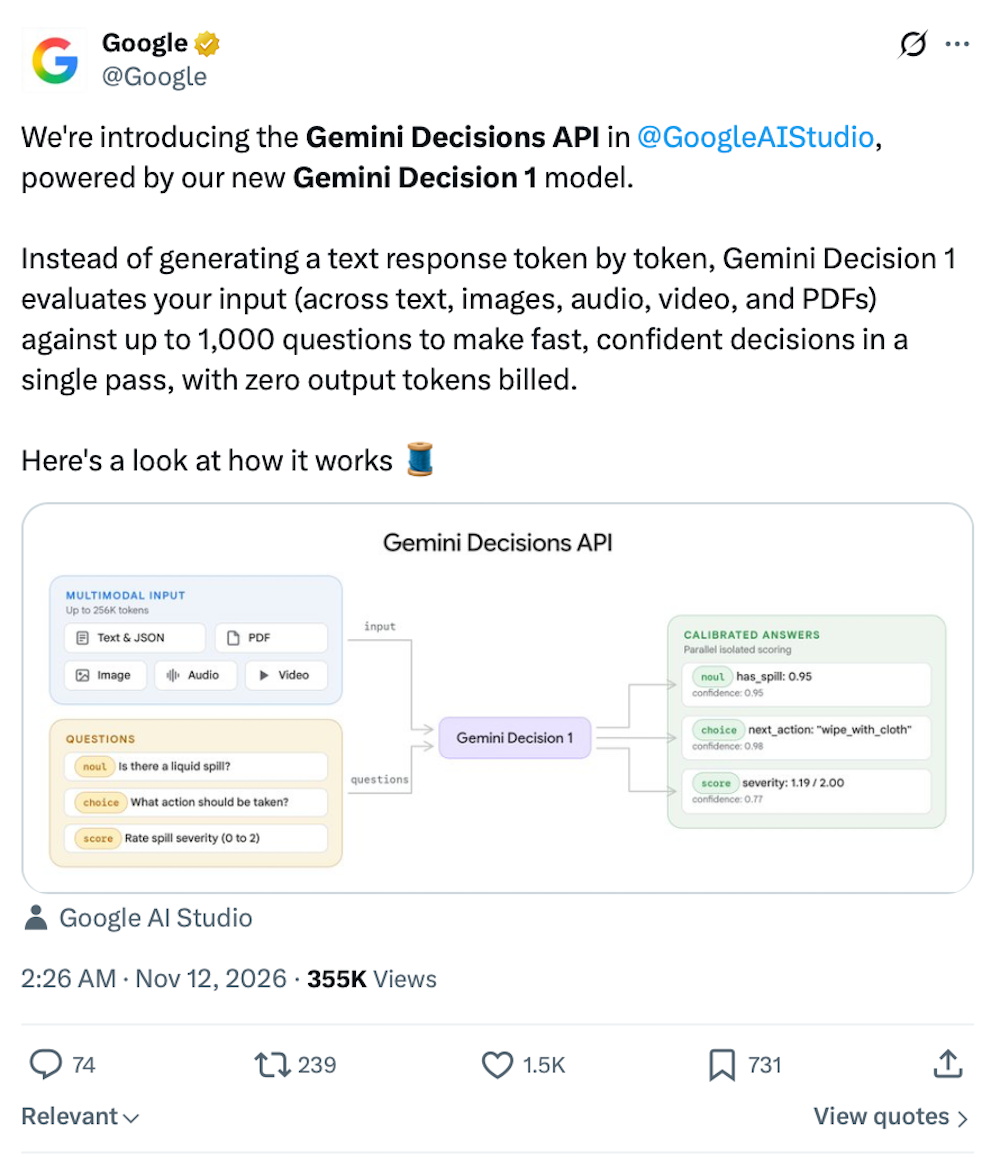
In terms of performance, Google claims that in scenarios with up to 16,000 tokens of multiple modalities, the median model computation latency for Gemini Decision 1 is between 50 and 100 milliseconds, and the end-to-end latency is between 150 and 250 milliseconds.
Regarding pricing, Gemini Decision 1 charges $0.1 per million input tokens (approximately 0.67 RMB), with output tokens being free. Its cost is about one-fifth of the cost of calling Gemini 3.5 Flash-Lite through the Interactions API.
After the API was released, users had mixed reactions. One user commented: “After all the hype, is this really all there is? I might use it for routing purposes. Having a chat model generate a whole paragraph just to answer a yes/no question seems like a waste of resources. But it’s not particularly innovative; we’ve seen similar things before.”

Another user raised a practical question: “What if none of the provided options are correct? Overall, I’m glad to see this feature, especially since it supports multiple modalities, which is very useful for my asset classification work.”

Some users also pointed out that the value of the API depends on its actual speed: “If it’s really faster than having a regular model make a judgment directly, that would be interesting. I’d prefer to get an answer in two seconds rather than waiting for a long explanation I don’t need at all.”

On the same day, independent developer Lesia Kapliuk tested the API using a free key. The model correctly classified all 54 requests, 30 customer service tickets, and 8 multilingual tasks. It only took 0.41 seconds to process 100 judgment questions each time, but Lesia noticed that the model sometimes assigned inputs outside the predefined range to existing categories.
Currently, the Gemini Decisions API is used in Google’s internal products such as Gemini Notebook, and it is also used for security in Google Search’s Model Context Protocol (MCP) tools. Developers can obtain API keys through Google AI Studio and use the free quota for prototype development.
Google AI Studio address: https://aistudio.google.com/
The API supports a combination of three types of judgments: Yes/No, Multiple Choice, and Ordered Rubric. Up to 1,000 questions can be processed in a single request.
The Gemini Decisions API processes questions defined by developers using these three types of judgments: Yes/No, Multiple Choice, and Ordered Rubric, which can all be used together in the same request.
The Yes/No judgment is used to estimate the probability of a condition being true, and developers can set description criteria for both cases. The Multiple Choice option allows up to 255 options; the model selects the most appropriate one and returns the normalized probability for each option.
Graded scoring evaluates the input content according to a sequential set of criteria starting from 0, and returns a weighted continuous score as well as the probability corresponding to each rating level.
All three judgment methods come with a confidence score ranging from 0 to 1. Developers can set rules based on this confidence level; for example, they can assign uncertain results to a backup model for processing or forward them to manual review.
In terms of multimodal processing, Gemini Decision 1, built on Gemini’s native multimodal architecture, can handle text, images, audio, video, and PDF files in a single model calculation. Different types of content can be combined in the same input—for instance, analyzing a call recording along with account information, or combining a PDF insurance claim document with photos of the damaged area.
Developers can also adjust the resolution of images and videos to control the level of detail the model needs to recognize and the amount of Tokens consumed. A single request supports up to 256K Tokens of input content, and up to 1000 separate questions can be set for the same input.
Google provides a practical application example: developers can upload a photo of a lounge counter along with a description, and the model will determine whether there is uncleaned liquid on the counter, what cleaning measures should be taken, and the degree of messiness.

The model needs to determine the presence of liquid stains, choose between wiping the counter, arranging for cleaning personnel, or taking no action, and then score the outcome based on three levels: completely cleaned, minor local stains, or severe stains/safety hazards. All three tasks can be completed in a single request.
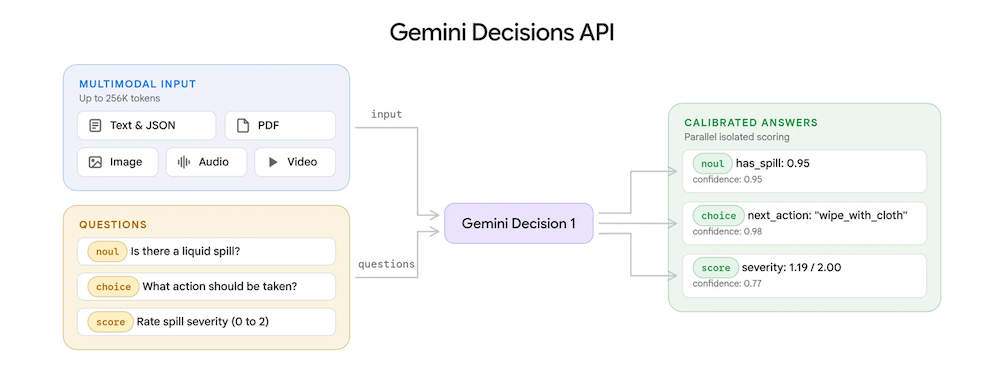
Currently, multiple Google products such as Gemini Notebook and Stitch have integrated the Gemini Decisions API as a low-latency decision control layer. Developers only need to predefine the options for the model to handle; there’s no need for additional training of specialized classifiers or waiting for the generative model to produce a complete answer.
Additionally, Google Search uses the Decisions API as part of the Model Context Protocol (MCP) tool for security protection, helping to identify malicious behavior and related content while reducing response latency.
The response latency is at least 50 milliseconds, and the cost is less than one-fifth of that of generative models.
In terms of its operation, Gemini Decision 1 differs from traditional generative models.
Traditional generative models typically generate Tokens one by one and then combine them to form a complete answer. Gemini Decision 1, on the other hand, directly scores the candidate options predefined by the developer, returning probabilities and confidence levels in a single calculation, without the need to generate each answer Token individually.
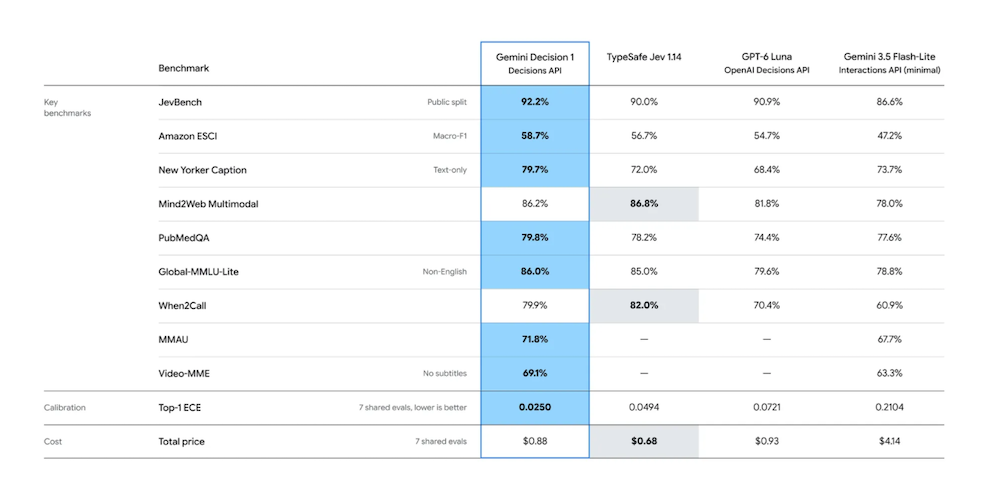
Google claims that in benchmark tests involving agent routing, reasoning, sorting, and multimodal understanding, Gemini Decision 1 outperforms others, with the lowest calibration errors among the tested APIs.
In scenarios with up to 16K Tokens of input, the model’s median calculation latency is between 50 and 100 milliseconds, and the end-to-end latency is between 150 and 250 milliseconds. The response latency remains relatively stable even when the number of questions per request increases from 1 to 100.
In terms of cost, since the shared input for a single request is charged only once, users need to pay for the Tokens consumed by the instructions and evaluation criteria for each additional question.
In a joint benchmark test, compared to Gemini 3.5 Flash-Lite called through the Interactions API, the cost of using Gemini Decision 1 with the Decisions API was reduced by nearly 80%, to about one-fifth of Gemini 3.5 Flash-Lite’s cost.
Gemini 3.5 Flash-Lite charges $0.3 per million input Tokens (approximately RMB 2.01) and $2.5 per million output Tokens (approximately RMB 16.75).
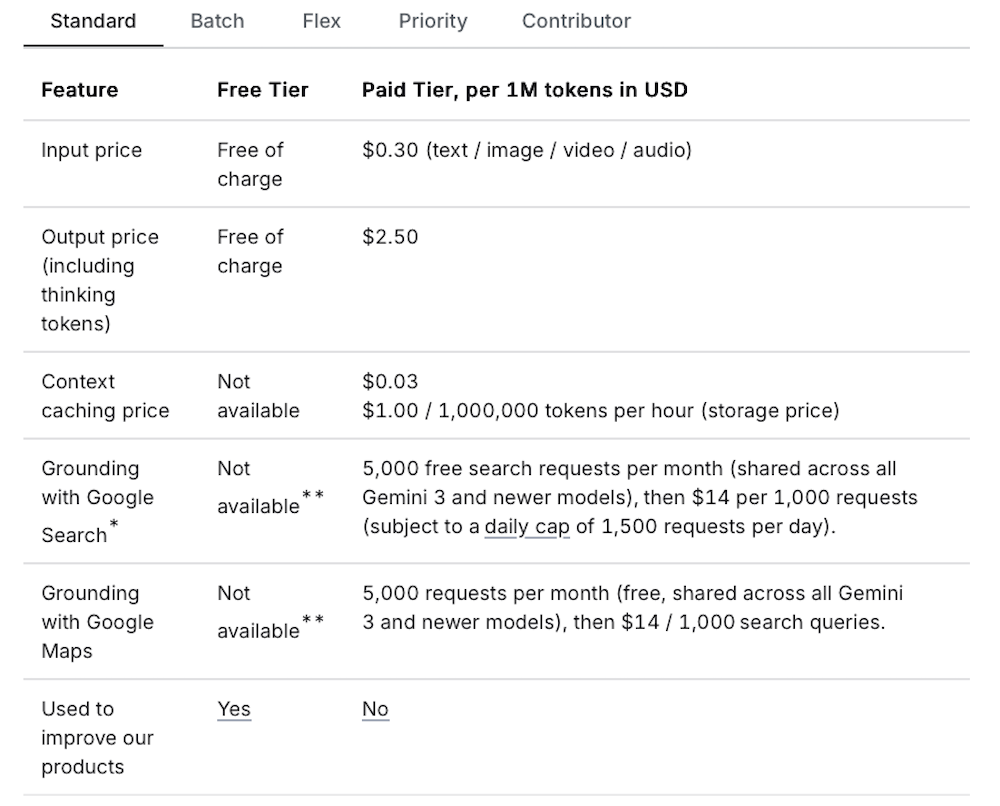
Gemini Decision 1 charges $0.1 per million input tokens (approximately RMB 0.67) and does not charge for output tokens, additional thinking tokens, or separate audio transcription and OCR (Optical Character Recognition) services.
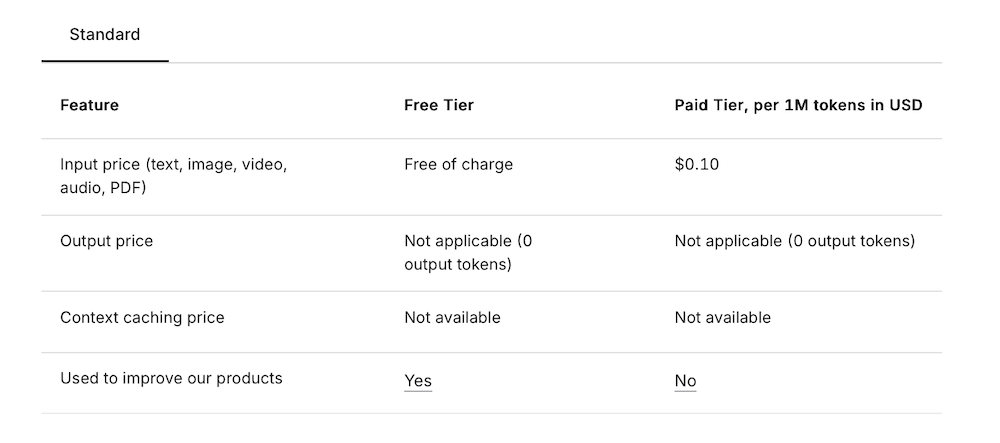
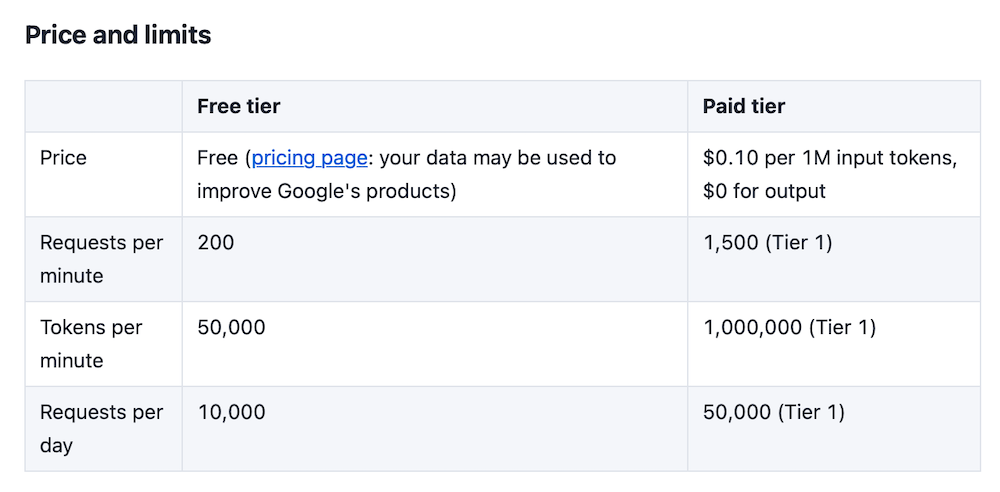
In terms of call quotas, the Gemini Decisions API is available in both free and paid versions.
The free version allows a maximum of 200 requests per minute, processes up to 50,000 tokens per minute, and a maximum of 10,000 requests per day.
The paid version charges $0.1 per million input tokens (approximately RMB 0.67); output tokens are free. At the Tier 1 level, it supports up to 1,500 requests per minute, processes up to 1 million tokens per minute, and a maximum of 50,000 requests per day.
In a practical test by a developer, 54 calls resulted in a 70% increase in processing time for 100 questions.
Individual developer Lesia Kapliuk published the results of her API tests for Gemini Decision 1 on November 11. She used a free API key to perform 54 calls, testing the model's classification accuracy, multilingual processing capabilities, batch processing efficiency, and result stability.
During the tests, she submitted 30 customer service tickets, requesting the model to assign them to the appropriate teams, and all tickets were correctly classified. In the multilingual test, the model processed tasks in Ukrainian, German, Spanish, Polish, and Japanese, all with correct results.
For batch processing, the developer tested scenarios with 1, 10, and 100 questions per request. The median response time was 0.24 seconds for 1 and 10 questions; with 100 questions, the response time increased to 0.41 seconds, an increase of about 70%.
The consumption of tokens also increased with the number of questions: 135 tokens were used per question, 613 tokens for 10 questions, and 5,473 tokens for 100 questions. Repeated requests with the same parameters yielded identical results.
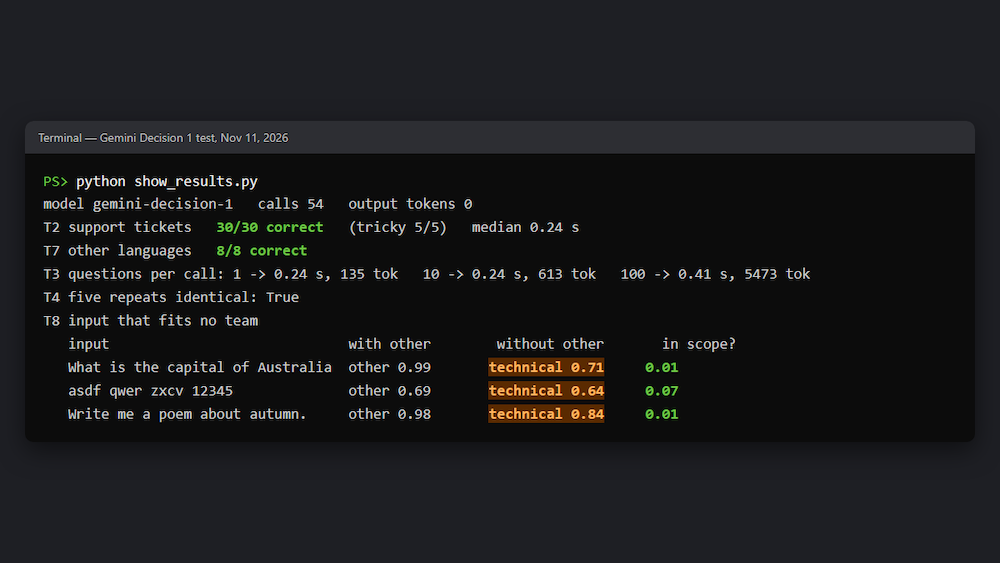
The test also revealed an issue with the model's handling of exceptional inputs; when the input did not meet the preset classification criteria, the model might still select an existing option.
For example, the developer provided the model with the capital of Australia, meaningless random characters, and a text requesting the creation of a poem with an autumn theme, asking the model to determine if these inputs were customer service requests.
When the developer included an “other” option in the candidate list, the model selected “other” for all three inputs, with confidence levels of 0.99, 0.69, and 0.98, respectively.
However, without the “other” option, the model incorrectly categorized all three inputs as technical support requests, with confidence levels of 0.71, 0.64, and 0.84, respectively. The model’s probabilities for these classifications were also very low (0.01, 0.07, and 0.01).
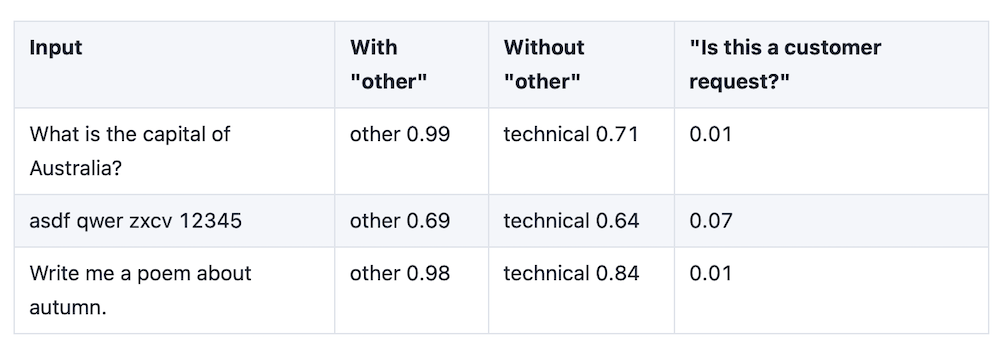
Although Gemini Decision 1 can process tasks quickly within its predefined range, its results are still affected by the design of the available options. If developers do not provide a default option for exceptional inputs, the model may incorrectly categorize such content.
In conclusion, Google is extending the model’s capabilities to fast decision-making scenarios.
From the perspective of the Gemini Decisions API, Google is aiming to balance competitiveness with processing speed and call costs.
For applications that require frequent classification and tool selection, such APIs offer a new approach. As Google’s internal products like Gemini Notebook and Stitch are integrated, the scope of its applications is gradually expanding.
In the future, whether Gemini Decision 1 will be able to maintain a stable level of judgment quality and processing efficiency within actual workflows will determine whether such APIs can gain a lasting competitive advantage.
Source: Google