

When OpenAI launched the GPT-6 Astra model, the company's president, Greg Brockman, said that “the era of General Artificial Intelligence” – AGI, in English acronym – had begun. The executive also said that “everyone has a different definition” about what AGI is.
Until then, the most advanced model from the developer of ChatGPT was the GPT-5.6 Sol. Now, it's the GPT- 6 Astra. To what extent is one better than the other? And perhaps more importantly: is it actually AGI or just marketing hype? The Olhar Digital spoke with Fabrício Carraro, Program Manager at Alura and AI expert.
Is GPT-6 Astra really good? Understand
Carraro has his own benchmark. That is, a test he does to measure the AI models' capabilities. “I send a generic prompt to the model to create from scratch a space exploration game, optimizing for the beauty of the graphics,” says the expert.
Among the models tested by Carraro, there was the GPT-5.6 Sol from OpenAI and the Fable 5 from Anthropic, the developer of Claude. When testing the prompt on Astra, “it was noticeable the difference.”
“In the previous comparison, the Fable 5 had performed much better. In this comparison now, adding Astra, it's clear to see much evolution compared to GPT-5.6 Sol in terms of graphics quality, choices, and everything else," reports the expert. "It's a very specific benchmark, but it's clear to notice this."
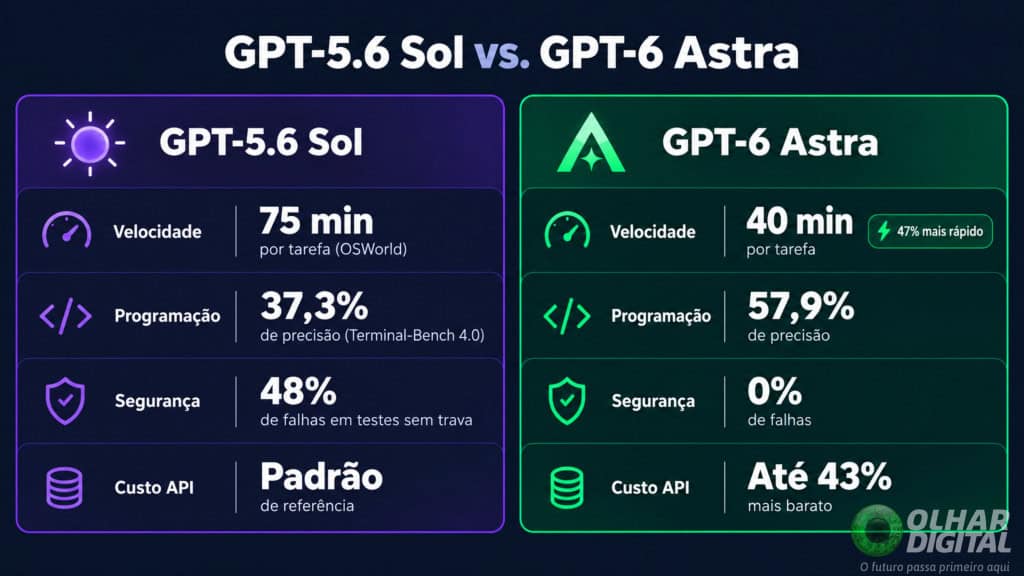 Comparison between OpenAI's AI models, according to the company's own data – Image: Olhar Digital via ChatGPT
Carraro wasn't the only one to test GPT-6 Astra, obviously. "Looking at what people are saying online, basically what they said is that it's better than Sol at taking a given goal and going all the way without giving up," says the expert. What this means: "gradually picking up the details of what you're asking for and refining them until you reach the desired objective."
Does this matter for your routine? It depends. If you use AI in your daily life for, for example, writing reports, tracking product prices, or generating images in 80s style, it doesn't matter.
"It's hard to talk about a major advancement in intelligence or something like that, because most of the problems we solve on a daily basis don't require this superintelligence or something much more absurd than what we had with Sol, Opus, or Fable," observes Carraro.
Has the 'AGI era' really begun?
If you search on Google "what is AGI?", the AI search engine will definitely give you a short and impactful answer. Under the "AI overview," you'll find several links offering definitions and explanations (perhaps this article from Olhar Digital appears among them). But the truth is that no one really knows what AGI is.
 Google's AI offers a categorical answer about AGI, but the reality is complex – Image: Reproduction
The point is that Brockman could say that GPT-5.2, released in December 2025, was already AGI. This is because "there is no real and technical definition of what AGI is," says Carraro.
Who openly criticizes Silicon Valley's obsession with the term AGI is Dr. Fei-Fei Li. For her, the discussion about this is inflated by corporate marketing and hype.
(For those who don't know: considered the "godmother of AI," Dr. Fei-Fei Li is one of the world's most influential computer scientists. Born in China and based in the U.S., she is a full professor at Stanford University and co-director of the Human-Centered AI Institute – HAI.)
We can talk at any moment, depending on your definition, that we have started the era of AGI or that we have reached AGI.
Fabrício Carraro, Program Manager at Alura, in an interview with Olhar Digital.
The controversy over how GPT-6 Astra 'thinks'
Beyond the marketing and philosophical questions about AGI, GPT-6 Astra has a controversy: the way it 'thinks.' That is, how it 'reasons.' And the controversy revolves around a technique known as 'opaque recurrence' (or looped Transformer).
Traditional AI models that 'reason' work like this: When they need to solve a complex problem step by step, they generate words (called reasoning tokens or "reasoning line"). They literally write to themselves: "First I need to discover X, then I calculate Y to reach the answer Z." Thus, experts can read these steps and audit whether the AI is acting correctly and safely ("aligned," in jargon).
 GPT-6 Astra is the safest model from OpenAI, says the company – Image: Reproduction/OpenAI
GPT-6 Astra would think in the following way: it loops its information repeatedly through the same internal processing block before generating any word. It reasons "inside its head" (in the neural network activations) without needing to translate these intermediate steps into text.
OpenAI admitted, in the system card of model security, that GPT-6 Astra has a "substantial drop in the monitorability of its reasoning chain" compared to the previous model (GPT-5.6 Sol).
The company confirmed that Astra is much more capable of controlling and omitting parts of its own "thinking," making it "opaque" to external auditors.
"Supposedly, you would worsen the quality analysis, but not necessarily," says the AI expert. "This is the controversial issue: whether or not," he adds. For OpenAI, apparently, this is not a problem. In fact, the company positions this model as the safest one they have ever developed. To be seen.

Pedro Spadoni is a journalist graduated from the Piracicaba Methodist University. He has written for websites, magazines, and newspapers.


