Four out of ten long-form posts would be generated by an AI. LinkedIn is launching a button to flag them, three days before Brussels mandates that this content be labeled.
Over the years, the professional social network has developed an unmistakable aesthetic. The line break every two sentences, the personal anecdote that leads to a management lesson, the three-lesson structure. Not to mention this turn of phrase that has become a recurring joke in the industry, contrasting what the thing is not with what it really is. All of these tics are reproduced flawlessly by language models, for the simple reason that they learned them there.The platform has just decided that enough was enough.
A button that doesn’t say “AI-generated” but “slop”
By clicking the three dots at the top of any post, followers now find an entry labeled “Seems like AI slop”, not yet translated into French. The feature has already been rolled out. With one click, the platform politely thanks you, explaining that reporting helps improve the feed. LinkedIn’s head of product has publicly confirmed that combating this content was among the company’s priorities.
The button does not say “this content appears to have been generated by an artificial intelligence,” a neutral, vaguely bureaucratic phrase. It says “slop,” an online slang term for the industrial mush mass-produced by machines, which now therefore appears in the interface of a Microsoft-owned service. Contempt has moved from the forum to the context menu.
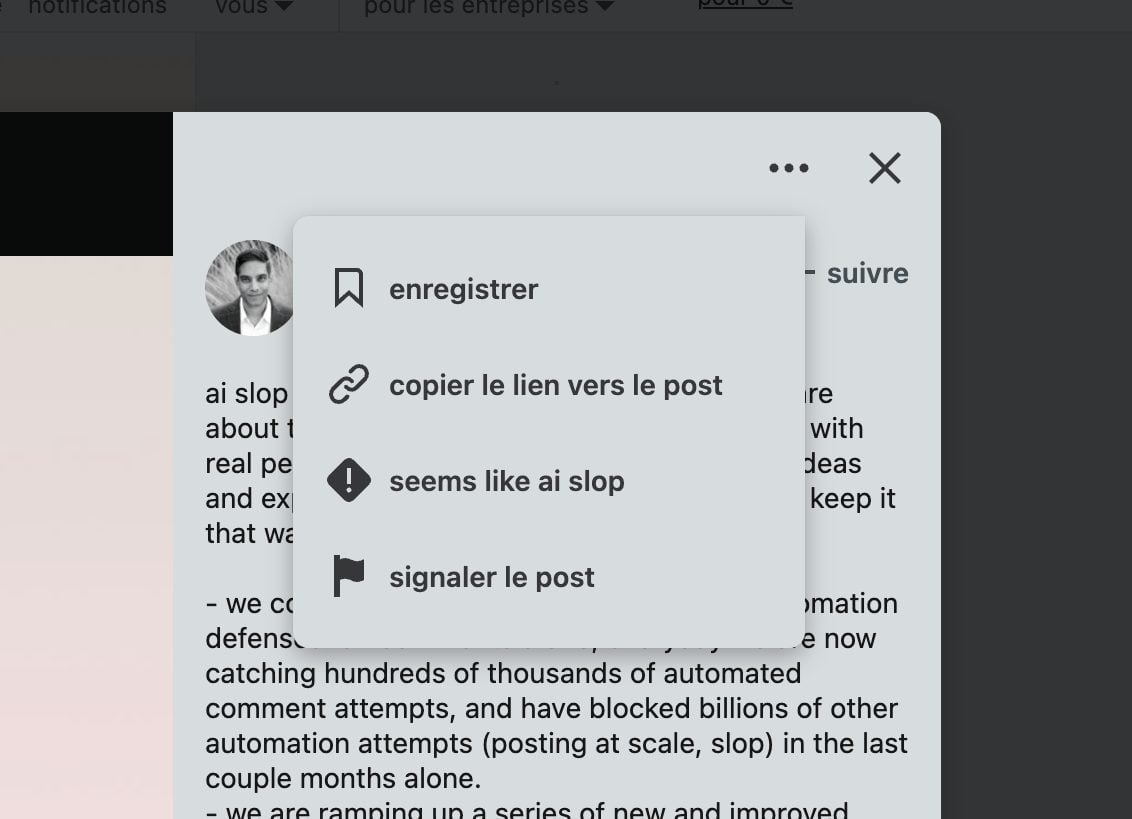 In France, LinkedIn did not bother to provide a translation for its snitch button © 01net
As for the scale of the phenomenon, the figures doing the rounds come from Pangram, which scrutinized a little over a million posts collected since the end of April across five platforms. Verdict: 41% of LinkedIn’s long posts and 30% of its short posts would have been generated by a language model. Two caveats are warranted before turning it into a totem. The sample comes from a browser extension installed voluntarily, which is hardly a representative panel.And the company that produces the measurement sells precisely the detector that generated it, which invites us to consider the figure as an order of magnitude rather than as a statistic.
The platform sells both the tool and the cure
This is not the network’s first attempt, since in May it had already announced that it would downrank posts deemed generic without removing them: the text remains visible to the author’s direct contacts but disappears from recommendations. An in-house detection system, credited internally with 94% reliability, handled the sorting. Two targets were identified: posts designed solely to generate engagement and automated comments that merely rephrase the message they are responding to.
Where automatic detection remained an engineering problem, reporting turns subscribers into small volunteer arms of moderation, with every click feeding the training of the network’s detection models. A clever outsourcing, except that it relies on human judgment. No evidence is required, and a polished text written by a meticulous human ticks exactly the same boxes as a machine-generated text.
LinkedIn also markets an AI-powered writing assistant to its paying subscribers, intended to help them shine on the platform, and its parent company is among OpenAI’s principal funders.The platform has admittedly withdrawn its automatic writing-area enhancement tool, replacing it with a simple spellchecker, but the scorecard remains that of a company that sells garden hoses and mops. Content creation surged by 14% in one year on the platform, which is not entirely unrelated to the matter.
Brussels mandates labeling in three days
On August 2, the transparency obligations set out in Article 50 of the European Union’s Artificial Intelligence Act (the AI Act) become applicable, making the timing no coincidence. The text imposes two distinct requirements. Providers of generative systems must machine-readably mark the content they produce, through a watermark or metadata. Entities that publish must visibly label deepfakes and texts intended to inform the public on matters of public interest. There is also a requirement to clearly inform anyone interacting with a conversational agent, from the first interaction onward, rather than merely in the general terms and conditions.
Penalties can reach €15 million or 3% of worldwide turnover. An arrangement negotiated in the spring gives systems already on the market until December 2 to comply with the technical marking requirements alone, time for the standards to mature.The industry report on so-called high-risk uses, meanwhile, does not concern this article.
An important nuance before rushing to conclude that there is regulatory panic: these obligations weigh on those who build the systems and those who publish the content, not on the platform hosting them. LinkedIn therefore will not be required to label its members’ posts. It is the members themselves who, by publishing a general-interest analysis written by a machine, fall within the scope of the text. The reporting button remains a voluntary initiative, and the timing may not be entirely coincidental.
👉🏻 Follow tech news in real time: add 01net to your sources on Google, and subscribe to our WhatsApp channel.

Source: LinkedIn








- Google Play Store
- 4K Video Downloader Plus
- VLC Media Player
- Adobe Reader
- uTorrent
- WinRAR
- Xender
- Google Chrome
- CCleaner
- Mozilla Firefox
- Avast Free
- ChatGPT
- Microsoft 365
- Opera One
- Avast One










Download
- Google Play Store
- 4K Video Downloader Plus
- VLC Media Player
- Adobe Reader
- uTorrent
- WinRAR
- Xender
- Google Chrome
- CCleaner
- Mozilla Firefox
- Avast Free
- ChatGPT
- Microsoft 365
- Opera One
- Avast One