What Are the Requirements for Product Engineers / Product Engineers
If you look at the Y Combinator website and their specialized job listings hub for the Product Engineer role — 1, 2, 3 — a candidate must have product thinking, communication skills with potential product users, the ability to identify a business problem and find a solution for it, as well as technical full-stack skills to independently implement that solution and deliver it to the end user.
Other SourcesA list of vacancies and extended analytics for this role in the United Kingdom
An article in which the MWS / MTS team describes its process for introducing this role and the requirements for it
PostHog’s requirements for this role
Thus, this is still a technical role and falls under product development. However, unlike the developer we are accustomed to, who writes code based on predefined tasks and is often isolated from users, a Product Engineer has a broader scope of responsibility. They are personally responsible for identifying user problems, defining the desired outcome, writing the code, and delivering the innovation to users, and they must always assess the final impact on the product through metrics or a feedback loop.
It looks like a symbiosis of two roles, combining the roles of engineer and product manager. From a business perspective, the intent is understandable and not new. It sounds promising to equip an engineer with product manager skills, or conversely, to teach a product manager to write code and deploy.Let’s examine how feasible this ambition is in practice. First, let’s compare the software development process before the emergence of AI with the process involving AI.
The classic software product development process
Everything has its own lifecycle—a product, a company, a person. For now, we will focus only on the product. Depending on the stage of the product’s lifecycle, the product manager is given different goals, tasks, and measurable results. For example, at the stage of the product idea, it is important to talk to the target audience, create a prototype, and test hypotheses quickly in order to find PMF (Product Market Fit). At the growth stage, it is important to talk about the product extensively in the market, increase the user base, and improve the product itself. And at the maturity stage, it is important to retain users and monitor their loyalty (NPS) and churn. Products, by the way, are not only commercial ones, so monetization is not always required. Of course, I am presenting this very concisely, quickly, and roughly. The important point here is that there is an accountable product manager whose direct task is to launch new products and develop existing ones, sometimes even to kill off unsuccessful ones.
It is important that the manager does not work alone. He has a product team reporting to him either directly or functionally. And they all work according to an assembly-line model with clearly separated areas of responsibility. Within it, the product manager is responsible for collecting and interpreting data and subsequently defending it before management, while upon success he prepares the product documentation and passes the tasks down the chain to his team.They already create the design, align the technical contracts between different components, test the new feature, set up analytics collection, prepare to launch the A/B test, and organize the code deployment and the A/B test itself. They review the A/B results, and the product manager, analysts, and other stakeholders decide the feature’s future. They may roll it back and abandon it if the metrics turn out to be poor, take additional time if they have doubts, or keep it if it has a positive impact. Thus, the product manager’s efforts are focused mainly on the preparatory and final stages of the cycle.
The team that the product manager works with depends on the scale of the new feature. The smallest team includes a designer, developers, and QA testers. However, the larger the feature, the more people and roles it requires. At VKontakte, I usually had to bring additional analysts, lawyers, marketers, moderators, support staff, copywriters, and PR specialists into the working group. When I was launching the integration between VKontakte and Ozon, our working group included more than 100 different specialists and managers. Structurally, it more closely resembled a cluster structure with mirrored roles and areas of responsibility. So, everything can be very individual when it comes to teams. Nevertheless, the team is primarily responsible for implementing the product concept it receives from the product manager and for the speed of that implementation—TTM (Time-to-Market).
As can be seen, the process of creating a software product has clearly defined blocks: preparing the product concept, implementing it, and evaluating the result. After that, the product manager must make a deliberate decision about whether this feature should continue to exist.And then everything starts over, and so it goes round and round.
The process of developing a software product with AI
With the emergence of ChatGPT, Claude, and other generative models, the process of developing a software product has changed. Absolutely all participants in the cycle have been able to delegate some of their responsibilities to co-pilots. Today, almost every product manager and developer uses AI in one way or another in their workflows. As a result, AI is gradually taking over some of our job functions. In the table below, based on my personal experience, I have highlighted several core functions of the roles and indicated which of them have already shifted from humans to AI
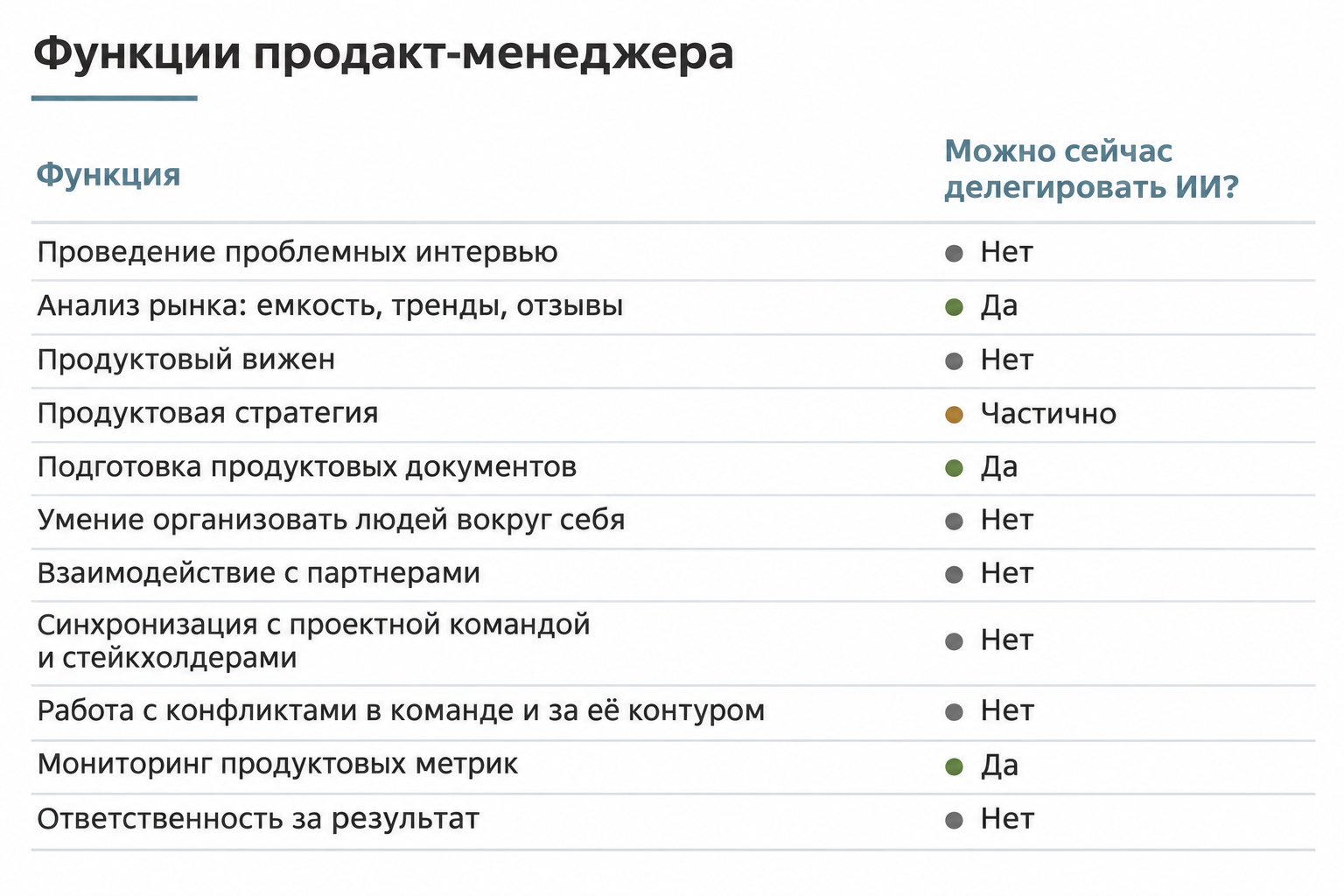
A recent domestic study confirms that AI is currently used primarily by product managers for finding information, analyzing data, and generating requirements for developers. The next most popular tasks are preparing product documents and analyzing the competitive environment.
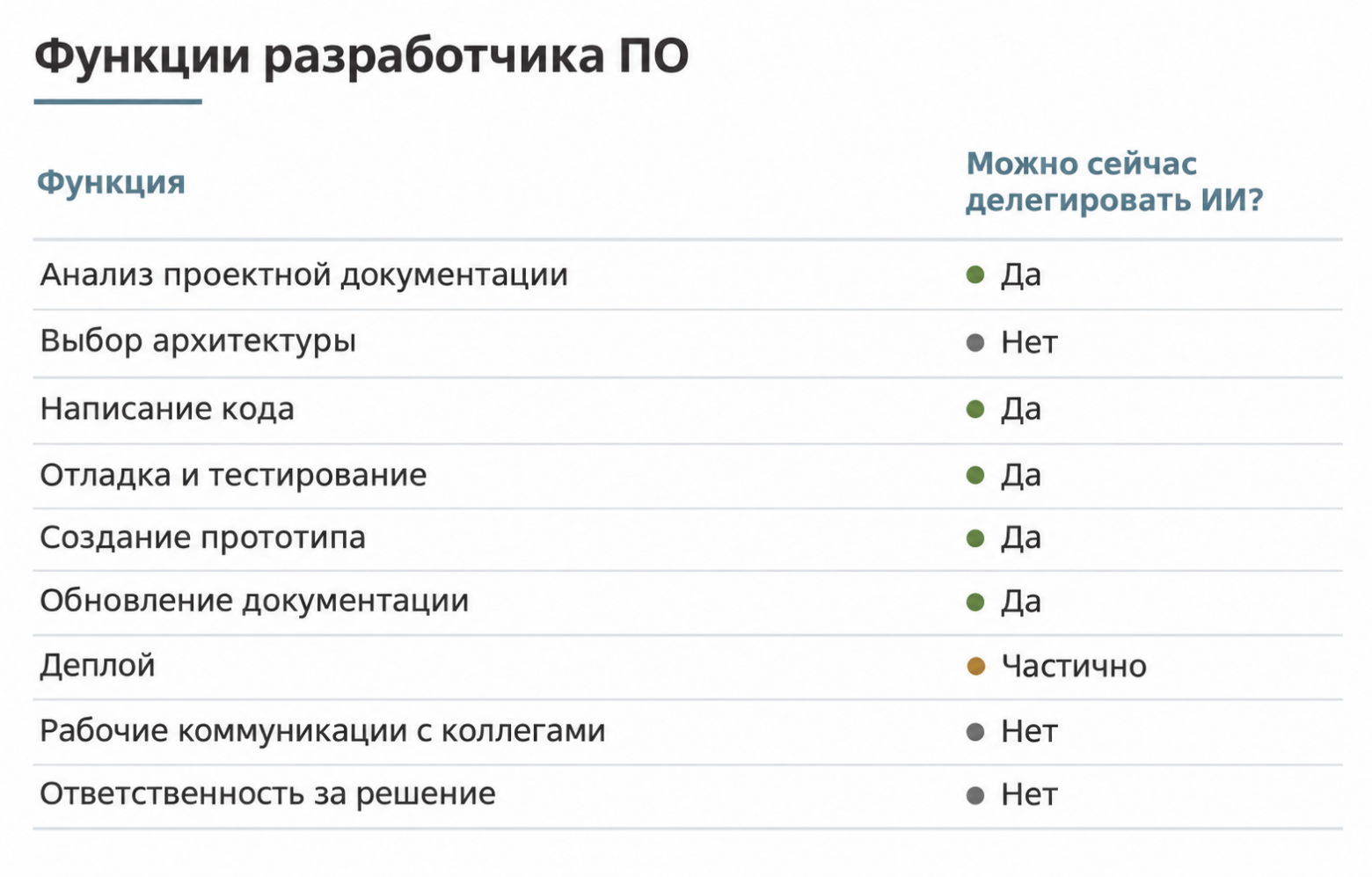 Software developer functionsTAG62@@A recent Stack Overflow study shows the top five categories of tasks for which developers use AI. These include code generation and refactoring, debugging, writing and improving tests, and working with documentation.
Thus, overall, we get a picture in which both roles have handed their routine tasks over to artificial intelligence. It completes straightforward tasks dozens of times faster than a human, does not sleep or get tired; finds patterns where it would be difficult for a human to find them; and analyzes volumes of information that the human cognitive apparatus cannot handle.
At the same time, we can also draw conclusions about which functions remain with the human in this case.
First, it involves communication with colleagues, partners, government agencies, users, and the market. This can probably be easily explained by the fact that communication with other people is the foundation of our shared human nature, and the “human-to-human” interface remains critically important to us.
Second, responsibility remains with the human being. The person checks the result, chooses the release date, explains the decision to users, and resolves incidents.
Third, leadership also remains with the human being for now. Ultimately, the human being sets the agenda. He defends his ideas, budgets, and strategy on a figurative stage before other people. It is he who brings together the other people around himself, with whom this strategy will be brought to life.
Let us now move from comparing the software development lifecycle process to industry signals and their implications. This will help us identify important mutations and understand why the market needs new specialists such as Product Engineer.
A period of transition. The preconditions for major changes.
When I reflect on the transformations occurring as a result of AI development, I feel as though I am in the eye of a powerful hurricane. It shatters old paradigms, shackles me, muddles my plans, and narrows my perspective on my future. The only thing that brings me calm here is an understanding of the present and an ability to model the future context. I have tried to identify and record industry signals in order to broaden my perspective on software development somewhat.So, here is what changes.
Team structures are changing — right now, we are seeing changes in organizational structures. Today, AI has become a copilot and assistant for many specialists. However, some OpenAI engineers believe that in the foreseeable future, the structure may undergo radical changes. For example, AI will become a full-fledged colleague. It is an interesting point of view, so feel free to share your thoughts in the comments.
Autonomous AI agents are evolving. This year, the skills / SKILLS.md system received a significant boost. It enables agents to be transformed into specialized assistants, equipping them with work instructions, memory, and behavioral scenarios. Most likely, the further development of autonomous AI agents will eventually lead us to see autonomous specialist agents. These could be designer agents, legal agents, programmer agents, QA agents, doctor agents, and so on. Honestly, I already use Harry Tan’s package of skills in my work today — the CEO of Y Combinator, who partially replaces my development team and demonstrates the beginnings of autonomy.
Frameworks for orchestrating AI agents are evolving. Today, there are already CrewAI, Google ADK, OpenAI Agents SDK, and Claude Agent SDK. Enthusiasts and solo developers are trying to build pipelines and prototypes of companies of the future. And big tech and smaller companies are already integrating them into their processes and products for documentation support, customer service operations, development and testing, and recruiting.
So, if something can be described through algorithms and specifications, then sooner or later it has a high chance of becoming an autonomous AI agent.
The rise of T-shaped and Slash specialists. There has always been a shortage of full-stack developers on the market, but with the advent of AI, this problem is shrinking. Moreover, more and more specialists with skills from different, even unrelated, fields are emerging today. For example, now every developer can acquire additional skills: those of an artist, business analyst, marketer, lawyer, or copywriter. In reality, the range is limited only by their own curiosity and goal-setting.
Abandoning bloated workforces. Big Tech is cutting staff. Oracle, Amazon, Dell, Cisco, Atlassian, and others have laid off hundreds of thousands of employees in total, explaining it as workforce optimization. In other words, large companies seem to be increasingly losing interest in specialists who continue to mechanically write code or perform work that can now be offloaded to AI. It somewhat resembles the First Industrial Revolution, when manual labor began to be replaced by factory production.
A transitional period. The birth of a new role.
So, we see that with the arrival of AI, the world of software product development is changing. And if the world changes, the business operating model must change too. Otherwise, a business cannot win in competitive struggle. And if the business operating model changes, businesses will need specialists who match the spirit of the times. Let’s explore what this new role looks like and what skills it should have.
This will be an all-round specialist
The idea of having an all-round specialist—or at least compact teams—is not new. Businesses have always longed for it.The problem in our industry was that combining an engineer and an entrepreneur in one bottle was an almost impossible task. The required skill sets and temperaments are too different and too broad. But with the advent of AI, it has become possible to compensate for the missing stack of skills. Therefore, businesses now need not just Fullstack developers, but people capable of independently handling tasks at every stage of the software development cycle—from interviewing people to writing code and deploying it to servers.
Have AI tolerance
You will have to accept the fact that an AI agent is becoming not just a funny toy; it is becoming your companion. Therefore, you need to quickly learn and maintain new skills for working with it, as well as develop your tolerance for collaboration. For example, build the product environment in such a way that it is convenient for both of you to work. Even today, project documentation and access permissions are needed not only by you, but also by the agent.
Have the skill of task delegation
With the emergence of autonomous, narrowly specialized agents, you will have to learn to delegate work to them. In the old reality, delegation was a managerial skill, not one for rank-and-file developers. It means that someone else carries out the task, but the person who delegated it bears responsibility. To delegate properly and accept the work, a person must be able to ask the right questions and develop their perceptiveness.
Be able to reach agreements
I know firsthand that many technical specialists have difficulty communicating. Usually, a product manager and a team lead take on this part of the job. They organize meetings, gather people, present their ideas, follow through on agreements, and also participate in resolving conflict situations.It is obvious that in the new product environment, whoever knows how to negotiate and collaborate wins over whoever does not.
Seeing through the lens of marketing
AI has devalued the manual skill of writing code. Yes, we still need elegant and robust architectures, but businesses no longer need developers who simply know how to write code. With AI, every third person can now write code—yes, clumsily for now, but they can.
Conducting research and understanding the needs of users of their product, crafting value propositions for them, determining the product’s development direction, and having a product sense—this is becoming an integral part of the new role and of the value for businesses in the near future. Businesses are willing to pay well precisely for this combination of disparate skills. We will have to accept that marketing and technology are becoming part of one whole in the new paradigm.
Design products, not code
Seventy years ago, everyone wrote in assembly language. Since then, C and C++ replaced assembly language. Later, Perl and Python appeared, followed by JavaScript and PHP. Along the way, new paradigms for creating code emerged, and the development environment itself changed (we are talking about IDEs). Today, much more radical changes are underway—IDEs are turning into AI chats, developers are delegating manual coding to agents, and therefore the primary task of the modern developer is to think not just in terms of classes and models, but in terms of architectures and entire products.
Hidden textIt would be interesting to see in the comments what people think about whether this will lead to less restraint in the code and higher hardware requirements.Or will people nevertheless be able to use AI to design less resource-intensive solutions instead?
Conclusions
It is time to wrap things up. As we see it,product engineers must combine engineering and product thinking, have advanced software skills, and at the same time be able to write code and work with the technical side of the product. It sounds very ambitious. Finally, a few thoughts on this subject.
Demand for specialists
First and foremost, I would expect demand for such specialists from small teams and growing IT companies. I mean startups. That is where people are needed who can both speak with potential users and knock together code to build a prototype. I assume our domestic accelerators will soon follow Y Combinator’s example and create demand in the market for such specialists.
Big Tech needs such people too. Despite the bloated headcounts at the companies we know, within these companies people are often grouped around pilots and existing products, rather than being organized solely around functional skills. For example, when I launched new social media products—Store 2.0 and VK Market—in 2020, our product team had roughly 10 people with formally different roles, all deeply involved in the product itself. By comparison, at the same time, the mature Yula product had around 600 specialists.
What I want to say with these comparisons is that, regardless of the size of the business, everyone needs small cross-functional teams and specialists. They are still in short supply on the market.
The shortage of versatile specialists will persist
Russian educational institutions graduate approximately 130,000 IT specialists annually. However, according to the Ministry of Digital Development, there is still a shortage of experienced professionals. Considering that a product engineer is a T-shaped specialist who will need time to mature, the shortage will persist in the foreseeable future.
Developing product skills
Finally. If you have read to the end and you are an engineer eager to develop product thinking, I can give a few tips on where to start:
I would recommend first looking at Yandex’s lectures in this area;
I highly recommend familiarizing yourself with Alex Osterwalder’s book “Value Proposition Design”;
then I recommend exploring various concepts and product frameworks: https://gopractice.ru/, https://productlab.ru/blog
I wish us all to go through the stages of transformation with ease and remain in demand in the market!