The U.S. company OpenAI began a limited preview of its next-generation “GPT-5.6” model series on June 26 (local time). It consists of three models: the flagship “Sol,” “Terra” for everyday business tasks, and the fast, inexpensive “Luna.” The names are said to represent a “hierarchy of capabilities” (OpenAI has not explained the origins of the names, but Sol, Terra, and Luna are Latin words referring to the sun, Earth, and moon, respectively). The models are said to have improved capabilities in coding, biology, and cybersecurity.
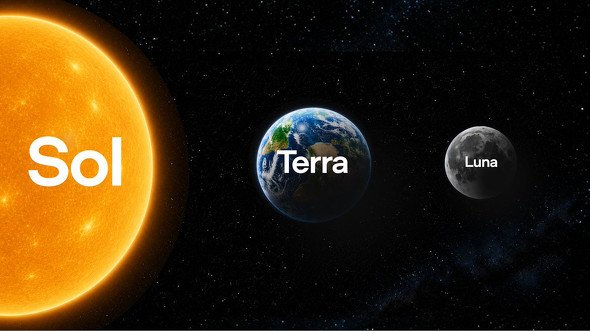 (Image: OpenAI)
OpenAI said in a press release that, as part of its ongoing engagement with the government, it had briefed the U.S. government on its rollout plans and the models’ capabilities ahead of the announcement. It explained that, at the government’s request, it was beginning with a limited preview for a small number of trusted partners, sharing details of their participation with the authorities, before expanding eligibility.
General availability is planned “within a few weeks.” OpenAI argues that this kind of “government-led access verification process” should not become a permanent standard. It warned that such mechanisms would put the best resources out of reach of users, developers, companies, cyber defenders, and partners around the world who need the tools.
OpenAI characterized the initiative as a short-term measure toward “broad availability within a few weeks” and said it would work with the government to develop a framework under the cyber-related executive order and establish procedures that could be reused for future model releases.
The backdrop is an executive order signed by U.S. President Donald Trump on June 2. It requires federal agencies to establish by August 1, 2026, a “voluntary framework” under which the government can obtain advance access for up to 30 days to a “covered frontier model” with advanced cyber capabilities before wider availability.
U.S. Axios reported on June 25 that the Trump administration had asked OpenAI to restrict the public release of GPT-5.6 because of security concerns. According to the outlet, the government became involved because it was concerned that GPT-5.6 would have capabilities comparable to U.S. company Anthropic’s “Mythos.” OpenAI is cooperating with the executive order, and CEO Sam Altman posted on X that the new executive order was “balanced.”
On the same June 26 that the GPT-5.6 preview began, Anthropic resumed making “Mythos 5” available to select trusted organizations following a suspension.
In terms of features, GPT-5.6 introduces a new “max” mode for deeper reasoning over longer periods and an “ultra” mode that uses subagents to accelerate complex tasks. OpenAI said Sol set a record on “Terminal-Bench 2.1,” which measures command-line work, while emphasizing that it had not reached the “cyber-critical” level in the company’s own preparedness framework. In evaluations using Chromium and Firefox, the model found footholds for attacks but was unable to autonomously construct a fully functional chain of attacks under the tested conditions.
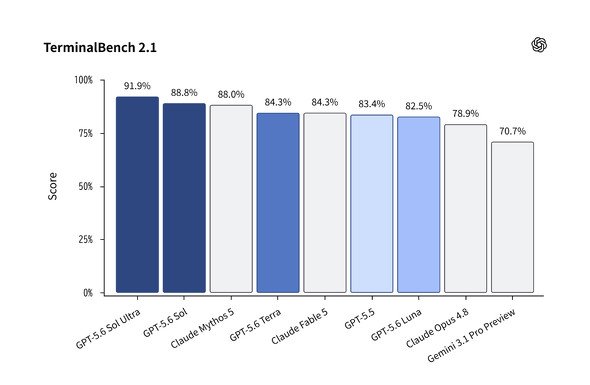 A comparison of performance and efficiency on cybersecurity benchmarks. OpenAI says Sol achieved performance on “ExploitBench” comparable to Mythos Preview while using roughly one-third the output tokens (Image: OpenAI)
During the preview period, the GPT-5.6 series will initially be made available exclusively to selected trusted partners and organizations through the API and the developer support tool “Codex.” Broader availability through ChatGPT, Codex, and the API is scheduled to begin soon. However, at the time of the announcement, OpenAI has not specified the eligible regions or which ChatGPT pricing plans will be able to use it. API pricing per 1 million tokens is $5 for input and $30 for output for Sol, $2.50 for input and $15 for output for Terra, and $1 for input and $6 for output for Luna.
OpenAI says Terra maintains performance comparable to the previous-generation “GPT-5.5” while cutting the price in half. The prompt caching feature has also been revamped, with support for explicitly specifying cache breakpoints and a minimum retention period of 30 minutes. From GPT-5.6 onward, cache writes will cost 1.25 times the standard input rate, while cache reads will continue to receive a 90% discount. OpenAI also announced plans to offer GPT-5.6 Sol in July on the infrastructure of U.S.-based Cerebras Systems, achieving speeds of up to 750 tokens per second. For now, it will be limited to select customers as capacity expands.
The model naming convention has also changed. Starting with GPT-5.6, the number represents the model’s “generation,” while Sol, Terra, and Luna refer to “capability tiers” that each evolve independently at their own pace. Sol is positioned as the top tier, Terra as the balanced option, and Luna as the high-speed, low-cost option, with the aim of clarifying the choices in terms of intelligence, speed, and cost. The tier names were designed as enduring names that continue across generations, and future models are expected to follow the same framework.
(empty)


