New Intelligence Yuan Report

AI, is going to go underwater.
This company doesn't compete with others on who can dive deeper or have a harder shell. What it wants to build is the "brain" of underwater equipment.
Its goal can be summarized in one sentence:
The machine is deployed, it doesn't need people to watch the screen, it completes the task on its own and returns, delivering a report that says "what was seen and where are the problems."
Rather than the traditional way, which is not only costly and risky — people need to operate onshore, and underwater divers have to take risks; the key issue is that the data collected is "dead data," and the subsequent analysis is an endless pit.
The core breakthrough of Lingyuan Intelligent lies in: not only eliminating the high cost of human risk, but also achieving a direct delivery of analysis results from "only responsible for data collection" to "directly delivering analysis results."
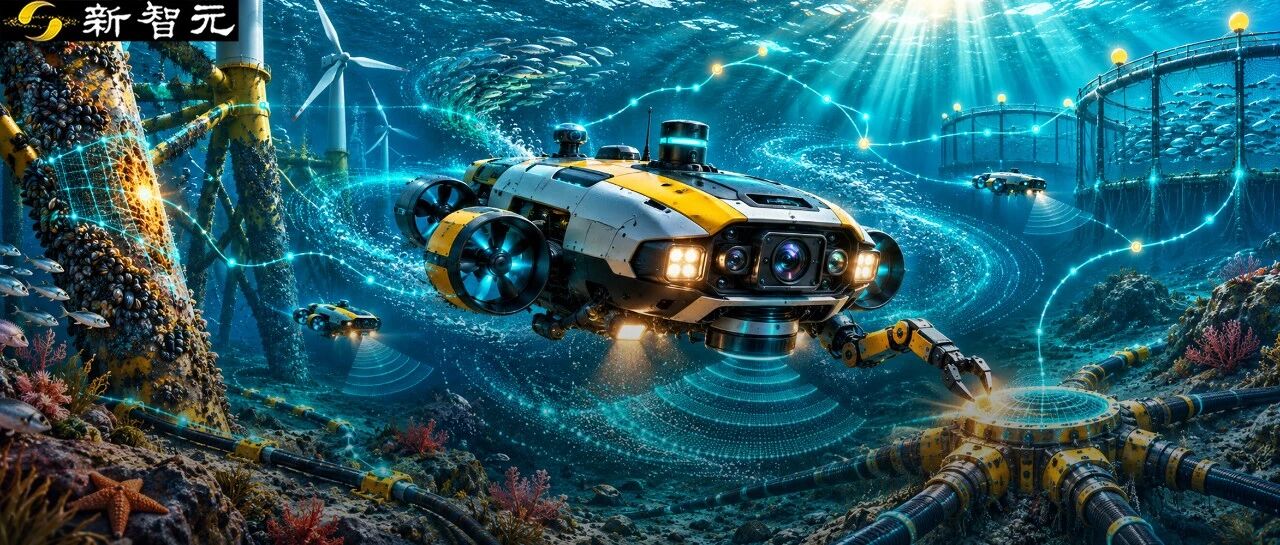
3D animation of autonomous underwater robot operation
Sounds obvious?
But in underwater environments, this has yet to be accomplished by anyone.
AI has learned to see, to speak, and to walk, but has never truly been able to "sink down."
What Lengyuan Intelligence wants to do is let AI for the first time operate underwater without human intervention, completing tasks in places humans can't reach.

The sky and the ground are both in a frenzy.
Underwater, it's still blank.
This year, embodied intelligence has become one of the hottest terms in the investment circle.
Everyone is trying to get AI out of the screen. But the farthest it has gone is the land and the air hundreds of meters above the ground.
In other words,AI in the physical world has completed the "two-dimensional spread," but hasn't yet achieved the "three-dimensional descent."
The hardest dimension in the three-dimensional world is water.
Difficult doesn't mean there's no demand. On the contrary, the demand underwater is exploding.
"Marine power" and "deep-sea technology" are repeatedly written into plans. Wind farms, cross-sea passages, undersea cables, and deep-sea aquaculture are all moving from "construction" to "maintenance."
Construction is a one-time thing; maintenance is something that can't stop for decades.
The most expensive and hardest to scale item in this long-term operational cost is 「human diving」.
These tasks are numerous, expensive, and dangerous. Today, they either rely on humans to go down personally or use a cable to tether the machine, with humans monitoring the operations continuously from the ship.
Whoever can turn 「human diving」 into 「machines diving on their own」 will control the most cost-intensive segment of the entire industrial chain.
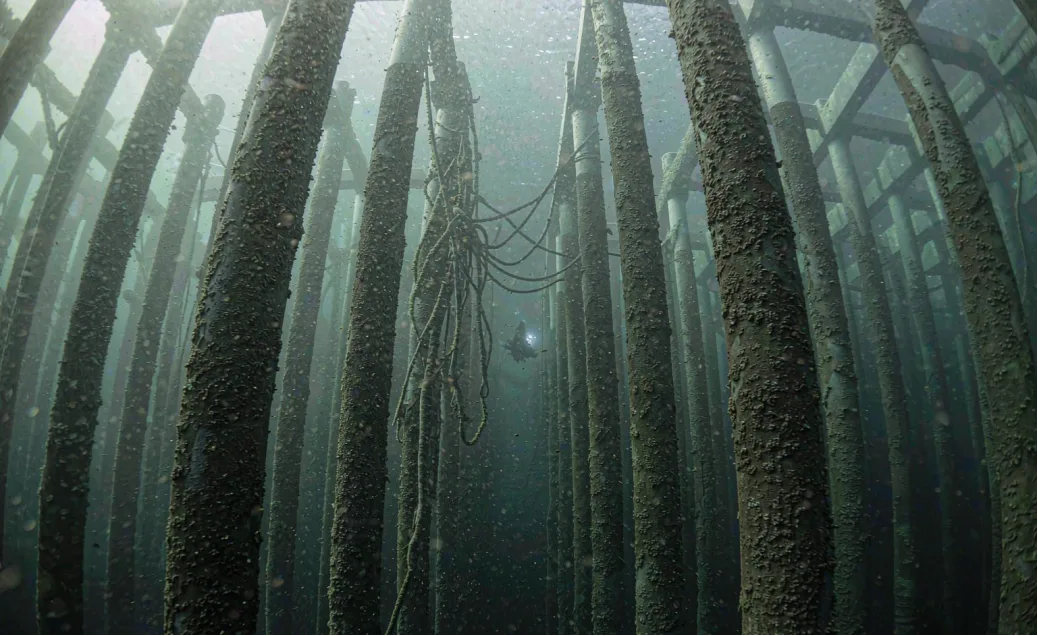
Hardware is the ticket to enter, and intelligence is the pricing power. Pressure-resistant shells and propellers can be compared in price, 「the ability to work independently once deployed」 is hard to replicate.
What makes underwater work so difficult?
Why does AI that works well on land fail underwater?
Imagine this: driving with your eyes closed in murky water.
Navigation has no signal because there's no GPS underwater. Vision is unclear because light decays rapidly with water turbidity. All you hear are echoes because sonar becomes distorted in reverberation.
More critically, the eyes say left, the ears say right—you have to first determine which one to trust.
This is the first hurdle, perception distortion . The perception models matured on land basically fail underwater.
The second hurdle, data is extremely scarce .
The data for land robots can be collected repeatedly in the lab. Every piece of data for underwater operations requires a real trip to the sea: a boat, people, and waiting for the window period.
The paired samples that can match sound, image, and motion are naturally scarce. The gap between simulation and reality has not been filled yet, and each set of data remains isolated.
The third challenge,, is that large models don't understand the physics of water..
The upper-level brain responsible for planning and the lower-level limbs responsible for control have long been two separate systems, and the gap in between has never been filled.
The fourth challenge,
, is entirely dependent on the craftsmanship of experienced operators.Today's underwater operations are highly dependent on manual control. Whether they are done well or not depends on the operator's personal experience. To move from "human-assisted" to "fully autonomous," the entire control and decision-making chain needs to be rebuilt from scratch. .
There is another fundamental and counterintuitive issue:
Every movement of the machine underwater is the result of the叠加 of "the current is pushing it" and "it is moving on its own."
The machine thinks it is moving forward, but in reality, it is being pushed sideways by the current.「」
These two factors are inseparable.
Just this one issue makes the experience accumulated on land completely irrelevant.
Dynamic Demonstration of the Underwater World Model
Four barriers stacked together became a high wall.
You can't flatten it by spending money, and even using a general-purpose large model won't help you get around it. To get over it, the team needs to beunderstandunderwater engineering, physical modeling, and actually have experience diving underwater.
The higher the wall, the more valuable the time window is for those who get there first.
The "brain" focused on underwater intelligence
Faced with this wall, Lingyuan Intelligent chose a very practical path:
Not competing in hardware, but focusing on the aspect of "letting machines make decisions on their own underwater."
This is the most valuable and least well done part of the whole thing.
While others are competing on depth, pressure resistance, and propulsion power, the layer of intelligence that allows "machines to do their own work underwater" is almost entirely absent from systematic offerings.
Therefore, Lingyuan Intelligent positions itself asthe general intelligent foundation layer for underwater equipment,which is essentially an AI Infrastructure layer.
To put it another way: while others are building various "bodies," Lingyuan Intelligent is building a "brain" that can be used by all bodies.
This choice is backed by a clear calculation.
The whole machine is a series of isolated projects, sold one by one. The intelligent layer is different; it can be charged repeatedly and continuously generate compound interest.
Single whole machine project has a ceiling, but the infrastructure layer does not.
Historically, every time the AI Infra layer appears, it reshapes the industry value distribution. Many do applications, few do the foundation.
Underwater intelligence is currently at a special stage: demand has exploded, but the foundation is still missing.
At this stage, the pioneers not only gain market share, but also the right to define. It is they who define what a "hard-working underwater machine" is, and also who define to whom underwater equipment should purchase "brains".
Low-altitude economy has already been written into valuation models, but deep-sea intelligence has not. The gap between them is the generational opportunity.
Whoever builds this foundation first will become the layer that underwater equipment cannot avoid.
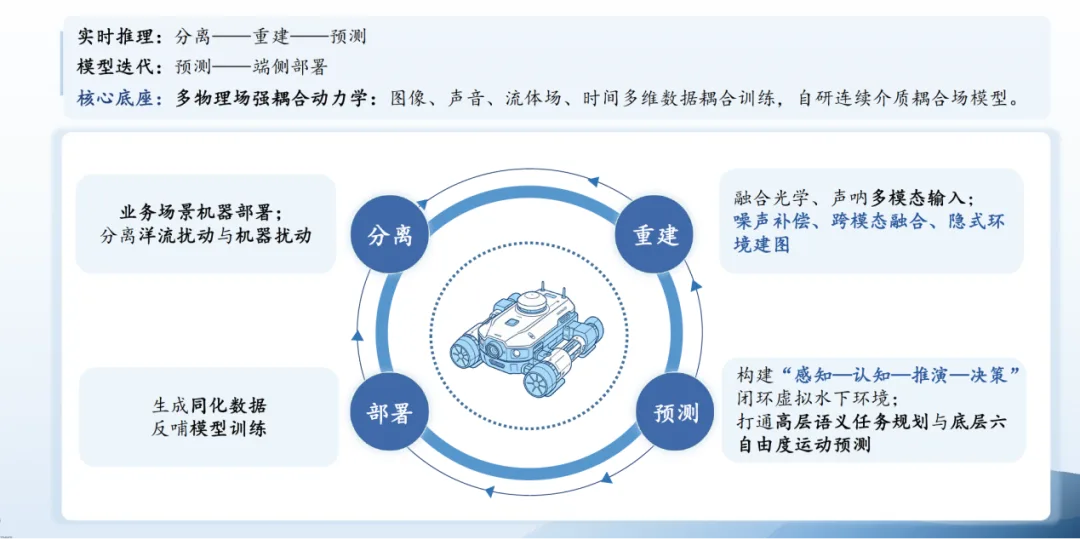
Lingyuan Intelligent builds a closed-loop system for underwater autonomous models.
So what can this "brain" do? The core is two things.
First, stability.
Water is not air. Currents, waves, and undercurrents change every second. Traditional equipment drifts and loses position when encountering strong currents, and can only be corrected by people one by one.
Lingyuan allows machines to have prediction of water flow. It knows where the flow is going, and where it will push the machine. The machine calculates and responds on its own.
The second point: self-operation.
Stabilizing is just the starting point. In Lingyuan's system, the machines themselves decide which path to take, where to hover, and how to act.
When encountering unfamiliar situations, it will judge on its own: to bypass or to retreat first.
Comparing the two makes it clear:
In the past, with one cable, one boat, and an operator constantly watching the screen, only one machine could be served at a time.
Now, people only need to set the target, without giving step-by-step instructions. Operators have transitioned from 'hands' to 'commanders', one person can manage multiple machines at the same time..
From the capital's perspective, this is a 'removal of human constraints'.In the past, underwater operations couldn't expand because the shortage of skilled operators was the bottleneck. Once this bottleneck is eased, the scale of services that can be provided is reopened.
Only things that can be scaled are worthy of valuation.
Equipment that used to require constant human supervision can now operate on its own.
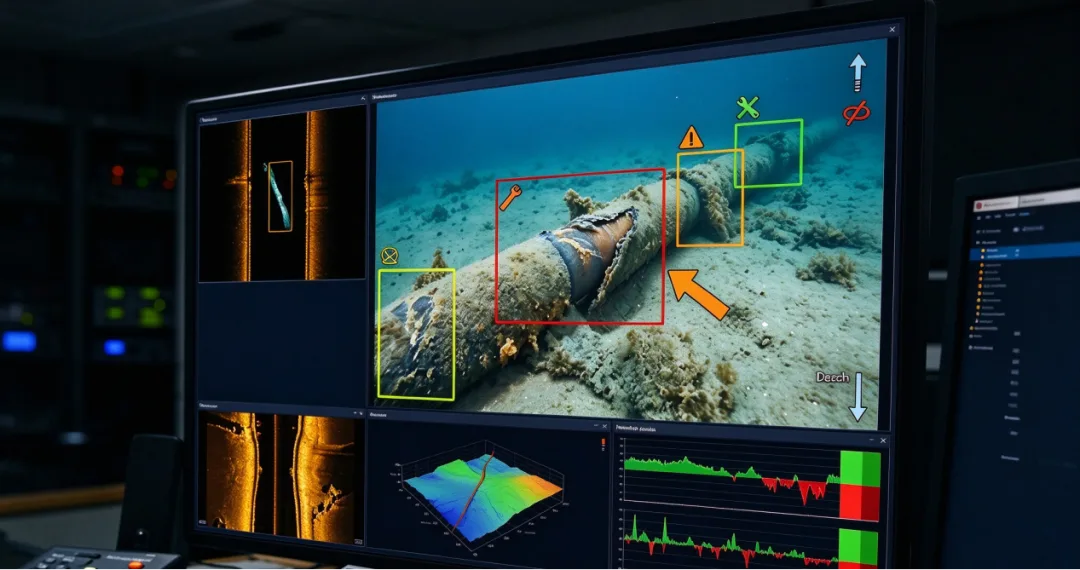
Submerged for nearly twenty years
This team arrived decades ahead of capital
Underwater AI cannot be developed by just assembling a team on the spot.
The core team of Leading渊 Intelligence comes from Hong Kong University of Science and Technology, Tsinghua University, and Georgia Institute of Technology, covering the entire chain of R&D, productization, and commercial operations, and is one of the earliest entrepreneurial teams in China focusing on underwater unmanned systems.
Their accumulation in the direction of underwater intelligence can be traced back nearly two decades.
They have worked on strong current operations at the Gulf of Mexico oil spill site. They have also conducted tracking of ocean fronts between the Atlantic and Pacific.
The time this team has spent underwater is several decades earlier than when this field was noticed by capital.
Money can make a company run faster, but it can't conjure up two decades of sea trial experience out of nowhere.
This also explains why the funding in this round comes from a group of particularly discerning people.
The investment partners of this million-level seed round are entrepreneurs who have been deeply rooted in manufacturing for decades.
These people have always been picky about hard technology: they don't listen to stories, only care about whether it can be implemented, whether it can enter real scenarios, and whether it can become actual productivity.
Underwater, concepts are worthless, and each hour spent underwater counts.
When the most pragmatic group starts to invest in the most cutting-edge things, it often indicates that the matter has moved from "can it be done" to "who will do it."
Written at the end
In the past two years, the entire AI industry has been chasing "looking human-like."
Can chat, can draw, can walk, can dance. Demonstrations can be copied, but infrastructure can only be occupied.
The previous generation of infrastructure was based on steel and concrete. The next generation is intelligence that can operate reliably even when no one is present.
AI doesn't just need to enter the physical world; it also needs to be able to complete tasks alone in places humans can't reach.
This is exactly the question Lianyuan Intelligence wants to answer.
Just like the team has always insisted:
Wisdom starts with people, and action goes to where there are none.
Editor: YHluck
Like, share, and mark as read in one click⭐
Star it, lock in New Intelligence Yuan's ultra-fast updates!