 Reason for Recommendation
Drawing on 15 years of field experience as a PwC consultant, the author diagnoses why work does not improve even after AI is introduced and presents concrete ways to translate a company’s existing knowledge and processes into practical AI capabilities. Readers can systematically learn everything from an execution strategy for the first 90 days to actual application cases from five departments and organizational change management, enabling them to build an AI agent operating system tailored to their company.
Many companies introduce AI, yet their workloads do not shrink. Program installation is blocked by security policies, the necessary data is inaccessible due to permissions, and automatically generated reports are manually copied back into Excel.
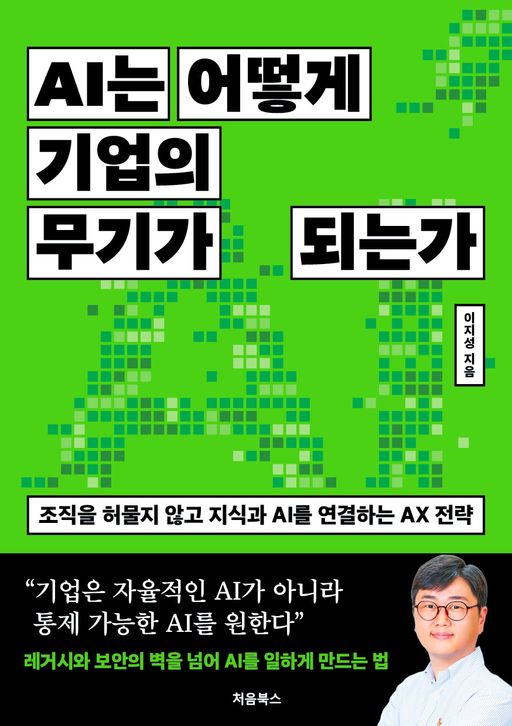
The Youngpoong Bookstore bookmaster chose 『How AI Becomes a Company’s Weapon』, a book that begins with this familiar frustration, published by Chajeonbuk on October 1. The author, Lee Ji-sung, is an AI, data, and AX consultant at PwC Consulting and a certified information management engineer. For the past 15 years, he has worked on AI projects in finance, manufacturing, and engineering.
The first thing the Youngpoong Bookstore MDs underlined was the case of a distributor’s document repository. The book puts it this way: “The company succeeded in building a vast document repository. But the more the repository grew, the less clear it became which documents could be trusted. (…) The existence of a record and the organization’s consensus that its contents constitute official knowledge are entirely different matters.”
Kwon Gi-won, head of Youngpoong Bookstore’s book team, said, “This passage looks for the reason why an in-house RAG chatbot gives nonsensical answers not in the technology, but in organizational consensus,” adding, “For a practitioner in charge of AX, this single paragraph could change the direction of the meeting.”
Compared with books on similar subjects, this book’s place becomes even clearer. If 『The Practical AX Report』 is the vector through which a large corporation’s AX team expanded AI to 52 subsidiaries, then 『AX Management Where Humans and Bots Collaborate』 is a work of organizational theory that examines the “augmentation” of humans and bots from a business scholar’s perspective. 『How to Control AI』 designs governance in the language of internal control and auditing. This book asks how to navigate the first 90 days amid all this. It categorizes work into four types, establishes five principles for choosing the first project, and organizes interdepartmental terminology, approval structures, and security controls through “harness mapping.”
Lee Won-jun, MD of Youngpoong Bookstore’s technology division, said, “The implementation examples from five departments—HR, marketing, sales, operations, and finance—enable the technology team and business teams to look at the same picture and discuss.”
The latter half covers the period after implementation.It explains “invisible automation,” which embeds automation into familiar work screens; the three stages of change management that progress from fear to curiosity and then to reliance; and how to redesign middle managers’ KPIs. It concludes with a one-year implementation roadmap and a maturity self-assessment, while following what an AI project that does not reduce headcount must demonstrate to prove its return on investment.
■ Recommended Books
- 『How AI Becomes a Corporate Weapon』
- Lee Ji-sung
- Chachoem Books | Published October 1, 2026 | 272 pages | List price: 21,000 won
- ISBN 9791170223351
Youngpoong Bookstore has connected books and readers for 34 years since opening its doors in Jongno in 1992. It currently operates 46 branches nationwide and an online store, providing books and cultural content to 1 million members.
AI Times news@aitimes.com

