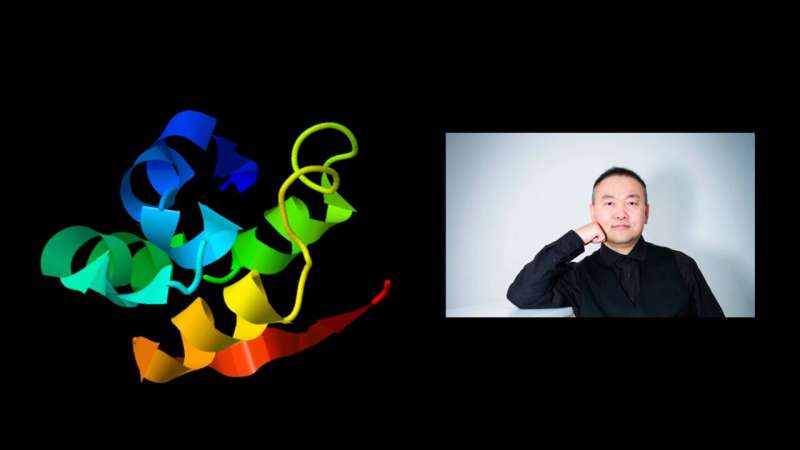
A structural model of a protein (left) predicted by D-I-TASSER, a computational tool developed by Prof Zhang Yang (right) and his team. The tool uses deep learning to forecast three-dimensional protein conformations from amino-acid sequences. Credit: National University of Singapore Artificial intelligence (AI) is transforming how scientists understand proteins—these are working molecules that drive nearly every process in the human body, from cell growth