 @
Google has launched 'Gemini 4 Hydrogen', which is specialized in fast processing speed and AI agent tasks. The completion speed is 2.5 times faster than previous lightweight models, and it recorded better performance than the top model 'Gemini 4 Argon' in external comprehensive performance evaluations.
Google announced the release of Hydrogen through its official blog on the 12th (local time), and began providing it through Google AI Studio and API, Gemini app, and search. This is adding a model specialized in handling coding and repetitive tasks, following Carbon and Argon.
Hydrogen is the successor to the existing 'Gemini 3.8 Flash', developed based on Gemini 4 Carbon. It supports up to 1 million tokens of context and generates text from inputs of text, images, audio, and video.
The basic maximum output is 64,000 tokens, and with an additional long-generation mode, it can output up to 1 million tokens. The total parameters and internal structure have not been disclosed.
Google's new Gemini 4 Hydrogen has Intelligence just below Claude Sonnet 5.5 and GPT-6.1 Sol, at a third of Sonnet’s cost but ~2.5x that of GPT-6.1 Sol@GoogleDeepMind has released their third new model in six weeks. Gemini 4 Hydrogen introduces an xhigh reasoning level and… pic.twitter.com/mtn4GzkVVq
— Artificial Analysis (@ArtificialAnlys) November 12, 2026
The most notable aspect is performance. In the Artificial Analysis Intelligence Index (AAII), it scored 51 points in the basic reasoning setting of High, surpassing Argon's 50 points. In the highest reasoning setting of Xhigh, it reached 54 points. Compared to the previous 3.8 Flash's High setting of 31 points, the performance has significantly improved.
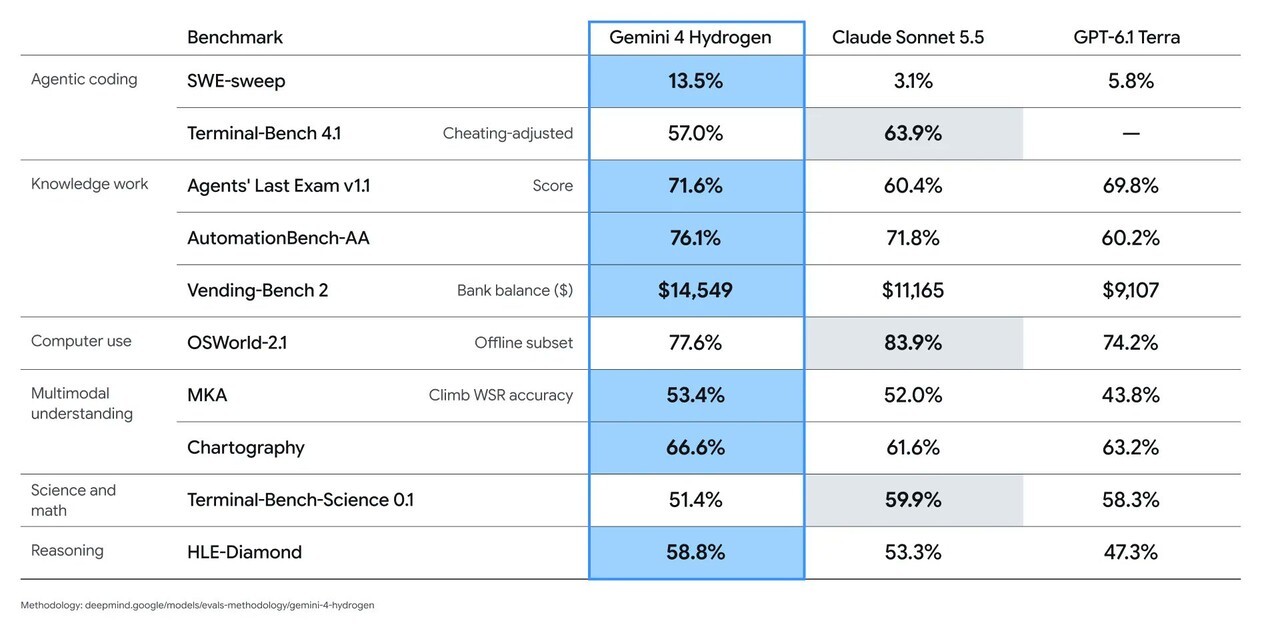
Improvements were also confirmed in internal evaluations. In 'Terminal-Bench 4.1', which performs software development tasks in a command-line environment, it achieved a success rate of 57%, more than three times higher than the 18.2% of the 3.8 Flash. The completion speed increased by 2.5 times, and the ratio of generating content that is factually incorrect was reduced to less than one fifth. However, it did not reach the 63.9% of 'Claude Sonnet 5.5' in Terminal-Bench.
In the enterprise automation evaluation 'Automation-Bench-AA', it scored 76.1%, surpassing Sonnet 5.5's 71.8% and GPT-6.1 Terra's 60.2%. In 'Agent's Last Exam (ALE) 1.1', which evaluates the ability to perform complex professional tasks, it also recorded a higher score of 71.6% than competing models.
 @
Google emphasized the way of using Hydrogen together with the top model. The newly introduced 'Orchestrator' in the AI coding tool 'Antigravity' automatically switches the model to use Carbon for tasks requiring complex judgment and Hydrogen for repetitive tasks such as code writing and testing.
According to Google, the terminalbench 4.0 maintains a success rate close to using Carbon alone while reducing the usage quota by an average of 24% and shortening completion time by 19%. It can be utilized by having Carbon coordinate the entire task and Hydrogen handle code writing and verification when multiple agents work simultaneously.
It also stated that the safety of the agents has been improved. Compared to the previous 3.8 Flash, the ratio of agents acting beyond their allowed permissions was reduced by up to 81%, and the occurrence of inappropriate actions and task omissions was reduced by 12 times in tool usage and coding evaluation.
It provides four levels of inference: Low, Medium, High, and X-High, allowing adjustment of speed and inference depth according to the difficulty of the task. It can be used for various agent tasks, not only software development, but also data analysis, document processing, and website creation.
The API price is $1.50 per 1 million input tokens and $7.50 per 1 million output tokens. Although it is double the current price of the 3.8 Flash, which is $0.75 for input and $3.75 for output, the Flash will also be priced at the same rate starting in January next year. It is cheaper than the initial pricing of Argon and Carbon, which was $2 for input and $10 for output.
The actual task processing capability of Hydrogen has also drawn attention in external evaluations. Box's CEO, Aaron Levy, stated that the task accuracy of AI agents using Hydrogen increased from 74% to 79% compared to the previous Flash, and the task time was reduced by less than half. In independent evaluations by Zapier, it recorded a task success rate of 51.1%, showing almost the same performance as the top model Argon (51.3%), while the cost per task was only about half.
Hydrogen is provided through Google AI Studio, Gemini API, Gemini for enterprise, and Google Search. Users can use it automatically through model selection even as free users on the Gemini app, and subscribers to Google AI Pro and Ultra can also use it in Antigravity.
Yoon Dae-jun, Staff Writer, ydj@aitimes.com




