An Honest Review of Claude Fable 5.2 and Mythos 5.2
- Claude
- Anthropic
- AI
- LLM
- AI Agents
This article is the Japanese-language version of the English article on System Design Simple. Original: https://systemdesignsimple.com/claude-fable-5-2-mythos-5-2/
Claude Fable 5.2 really exists. It is Anthropic’s strongest model yet for technically demanding work, announced on November 9, 2026, alongside Claude Mythos 5.2. First, the short version: its coding and agentic benchmarks lead the field. On the other hand, the cost per task is high. And the demo that has spread the farthest—the claim that more than 1,000 subagents built a prototype OS in eight days—remains, for now, an Anthropic claim that has not been independently verified. We will proceed with our evaluation without blurring that distinction.
How Claude Fable 5.2 Works
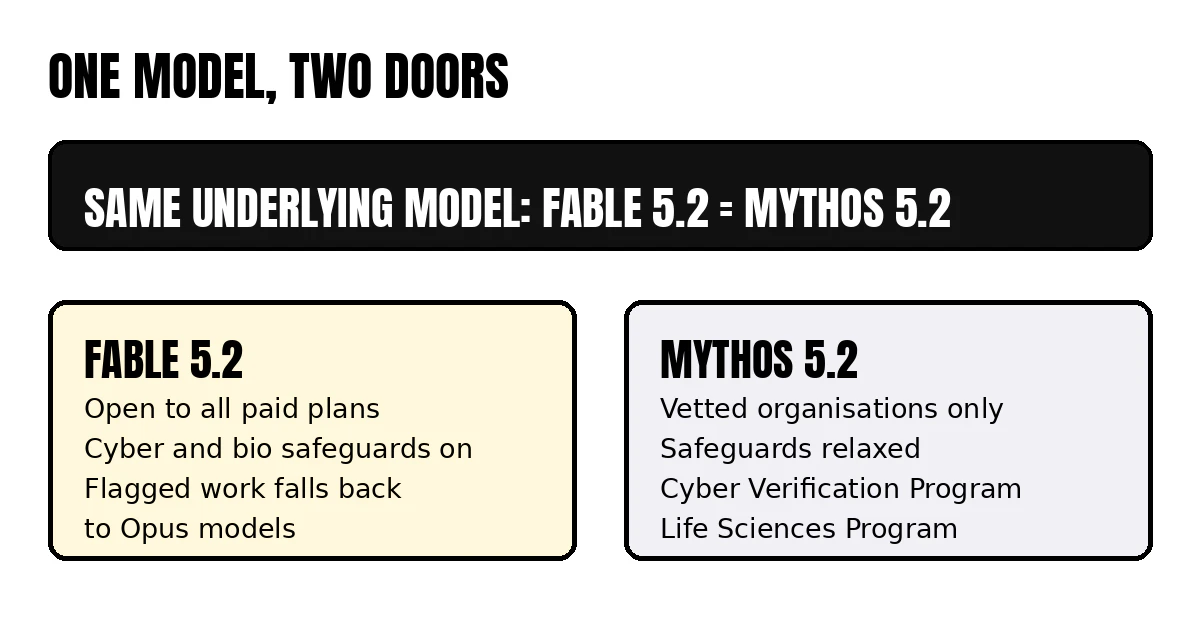
Fable 5.2 and Mythos 5.2 are built on the same underlying model.Anthropic itself says so in its announcement article.The difference lies not in intelligence, but in safeguards. Fable has stringent safeguards around cyber and biology and is available to anyone on a paid plan. Mythos is a version with those safeguards relaxed, and is made available only to organizations that pass review through Anthropic’s Cyber Verification Program or Life Sciences Verification Program.
The release notes list these specifications: a 1M-token context window, maximum output of 128K tokens, text and image inputs, and text output. Reasoning is always on and adaptive, so the harder the job, the longer the model thinks by design. The number of parameters and architectural details have not been disclosed. If you encounter a source that provides numbers for these, suspect that they are speculative.
The design targets the role of a lead agent. Fable can run vaguely defined engineering tasks for days at a time, coordinate anywhere from hundreds to more than 1,000 subagents, and verify its own outputs. It can act as an advisor that smaller models consult, as well as an orchestrator that assigns work to smaller models. Requests that trigger safeguards fall back to an Opus-family model without producing an answer. There is also one area that was deliberately suppressed during training.The work on kernel optimization and on large language model architectures themselves was limited to roughly the Opus 5.5 level. Anthropic's explanation is that this is a capability that accelerates AI research itself.
It is broadly available, but not free. The product page lists Pro, Max, Ultra, Team, and Enterprise plans, Claude Code, the API, and major cloud platforms. API pricing is $8 per million input tokens and $40 per million output tokens ($8/$40), 20% lower than Fable 5.1. If you are using it for a team, there is one condition to be aware of: data retention is required at 30 days by default, while zero retention requires explicit approval or enrollment in a private beta program.
What the benchmark numbers say
According to Anthropic's own table, Fable 5.2 scored 49.1% on FrontierCode 2.0 at the extra-high effort setting, surpassing Opus 5.5 at 45.5% and GPT 6 Astra at 42.8%. It scored 69.9% on FrontierSWE v2 and 89.3% on OSWorld for computer use. External evaluations point in the same direction. Artificial Analysis gave it an Intelligence Index score of 65 at the Max effort setting and ranked it first in its own rankings. Vals AI also ranked it first among 36 models, at 71.31%. However, Sonnet 5.5 is close behind at 70.85%.
Reading the same table carefully makes the story a little more complicated. Even in Anthropic's own results, Gemini 4 Carbon beat Fable on AutomationBench, 53.9% to 51.4%, while Opus 5.5 won the AA Briefcase Elo ranking, 1800 to 1785. Artificial Analysis placed Fable near the bottom in its rankings for cost and speed. At the Max effort setting, it costs about $26.54 per task, with an average task time of about 44 minutes. First in intelligence, nearly last in efficiency. Both are in the same report. These two figures should be read together.
What is being said on X
@@claudeai'sannouncement post had 10,303,580 views when we checked on November 10, 2026. The thread about the initial project, which designed three working electronic devices from a short prompt, had also been viewed 1,784,021 times.
The strongest user reaction is, for now, positive. After testing it with an extremely large token budget, early tester @MatthewBerman said in a post that it was the best model he had used. At the time we checked, it had 127,504 views. Tester praise is normally discounted, since people given early access are more likely to like the product.
We searched X for critical posts with large view counts. We have not found any that we can open and verify. This is not a gap to fill; it is the result itself. The criticism that does exist is on the reporting side. Decrypt estimated the API charges hidden behind the marquee demo, pointing out that they would amount to five figures per project and that bugs still remained in the results.VentureBeat says that with the high effort setting, it achieves comparable results at roughly half the per-task cost of Opus, while Max costs much more per task and scores below extra high. TechCrunch focused on the system card. The new model makes more remarks than previous models expressing suspicion that it is being evaluated, making its behavior harder to assess. Anthropic itself acknowledges this.
Verifying the claim that it created an OS
Because this is the fastest-spreading claim, here is exactly what the original source says. In its announcement article, Anthropic says that one of its engineers gave Fable 5.2 the task of designing a prototype OS from an empty folder. The model coordinated more than 1,000 subagents, had them work around the clock for eight days, and ran through writing code, testing, and review. The result, according to Anthropic, boots on a laptop and has its own core, disk, keyboard, and network drivers, along with storage, windows, a login screen, an installer, and built-in Claude functionality.
Three corrections are needed here. First, Anthropic specifically names Fable 5.2 alone. Mythos 5.2 is not mentioned in connection with the OS. Second, a human assigned the task. Describing it as “fully autonomous” goes beyond what the original source supports. Third, and most importantly, no one outside Anthropic has yet verified it. As of November 10, 2026, there is no public repository, no downloadable image, and no record of a third party booting and testing it. Until it can be substantiated, the OS is a vendor claim. It is a notable claim, but nothing more or less. If we take another look, we will update this article as well.
Our Take
The practical way to interpret this announcement is not as a new default, but as a new top tier. Anthropic itself recommends that most users begin coding and knowledge work with Opus 5.5 and move up to Fable only for the most difficult tasks. It wins on intelligence but loses on cost and speed, consuming tokens quickly enough that its flagship demo can turn into a five-figure API bill. With all this laid out, its use cases are clear. For long agent runs that take several days and would normally be supervised by a senior engineer, the economics may work. It does not for day-to-day tickets or reviews.
Honest Conclusion
Use Fable 5.2 when tasks are long, difficult, and worth paying for. Choose the effort setting carefully. Max is not always the most expensive or the one that always produces the best scores. Leave routine work to Opus or Sonnet. I think its benchmark lead can be trusted; two independent rankings corroborate it. However, the OS claim and the other announcement demos should be treated as unverified until Anthropic provides evidence that outsiders can run them.
FAQ
Is Claude Mythos 5.2 a different model from Fable 5.2?
No. According to Anthropic, they share the same underlying model. Fable has all safeguards in place and is available on paid plans. Mythos is a version with relaxed safeguards, limited to organizations that have passed review.
Did Claude Fable 5.2 really build an OS in eight days?
According to Anthropic’s account, engineers entrusted Fable 5.2 with building a prototype OS, and the model coordinated more than 1,000 subagents over eight days to create a bootable system. No one outside Anthropic has verified it, and no public repository is available yet. It is accurate to treat this as a corporate claim.
Should you move your day-to-day work to Claude Fable 5.2?
For most work, there is no need. Anthropic recommends Opus 5.5 as the primary tool for everyday work. Fable is best suited to the most difficult, longest-running agentic jobs, where its high success rate justifies a substantial increase in cost per task.